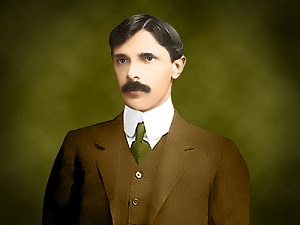
Muhammad Ali Jinnah was a barrister, politician and the founder of Pakistan.
SHARE
This op-ed is in continuation of another that I had written a couple of months ago titled “Unethical legal practitioners,” wherein I addressed the forgotten obligations of legal practitioners as professionals, and their duty to the courts, the public, and their fellow colleagues.
What really hurts me is that all the unethical practices carried out by most of these legal practitioners are in clear violation of ethical and leadership principles set out by our founder, Quaid-e-Azam, Muhammad Ali Jinnah, for us to progress as a nation, such as honesty, steadfastness, loyalty, dedication, commitment, and integrity. His picture hangs in every public office, and yet, his principles are not seen reflected in conduct. Here, I focus on the legal profession because Quaid was a lawyer and the only possible role model for any ethical lawyer of this country. With each passing day, legal practitioners and the profession itself have become partisan rather than working towards uplifting the rule of law irrespective of the political party we follow.
The most recent example was witnessed when the President of the Supreme Court Bar Association (SCBA) was working hand-in-glove with PMLN representatives and sharing victorious speeches with them before the media. For him, protecting parliamentarians’ rights to vote against their party and selling themselves in the open market was such an important constitutional matter that he had to approach the Supreme Court of Pakistan.
Meanwhile, SCBA condemned the barbaric and highly unconstitutional acts of 25th May 2022 that took place during the Haqiqi Azadi March through a press release only. The question arises, what is the actual mandate of the SCBA and why are they so selective in their approach? We all know the answer, but what legal duty are they performing, and against what? The bar council is the regulatory body for lawyers — if the conduct of their representative is questionable, whom do we look up to? Where is Quaid’s conduct represented here? I have come across articles by lawyers, lecturing us on constitutional law.
Maria Rafique
When I got the opportunity to work with the National Electric Power Regulatory Authority (NEPRA), I questioned the maladministration in NEPRA and stood against the authoritative and egoistic mindset of the incumbent Chairman. The result of this was that I was terminated “without a cause.” I was harassed into filing an application against me before the Secretariat Police Station Islamabad to carry out a forced settlement.
We have seen those very lawyers presenting fake documents (Calibri font scandal) before the Honorable Supreme Court. If this had happened in any other country, the license of such a lawyer could have been revoked. Where is Quaid’s conduct represented here? I am forced to believe that it is not academic institutions, but the upbringing by parents that builds the character of an individual. Character is what we see missing in our society. To have character is the courage to speak the truth and question lawlessness. Parents have the ability to instill strong values in their children. I still recall watching all the matches of the 1992 cricket World Cup with my father: this was not very common for us because he was usually posted out of the city.
The reason we could do it that year was that he had to stay home after he was made OSD (Officer/Official on Special Duty) by the premier financial institution of the Government of Pakistan because he had refused to sign the loan waiver documents of the “Sharif” family. My father has remained my role model ever since. He taught me not to compromise on my ethics and principles.
I did not and will not give up. Starting with the complaint before the Federal Ombudsman, Civil Court, and High Court, my petition is now pending before the Supreme Court. I have not been heard on my merit yet. I was made an example of, to show the employees of the NEPRA that anyone who questioned their maladministration would follow my fate.
When I got the opportunity to work with the National Electric Power Regulatory Authority (NEPRA), I questioned the maladministration in NEPRA and stood against the authoritative and egoistic mindset of the incumbent Chairman. The result of this was that I was terminated “without a cause.” I was harassed into filing an application against me before the Secretariat Police Station Islamabad to carry out a forced settlement.
I had to face retaliation at the NEPRA gate because I was refused entry and they accessed my closed office. I did not and will not give up. Starting with the complaint before the Federal Ombudsman, Civil Court, and High Court, my petition is now pending before the Supreme Court. I have not been heard on my merit yet. I was made an example of, to show the employees of the NEPRA that anyone who questioned their maladministration would follow my fate.
However, the advisors involved in the legal department’s corruption sided with the legal department audit report that I am privy to; the employment contracts of such advisors were extended by NEPRA. I wrote to the Cabinet Secretary; however no action has been taken against the Chairman, who has been playing with the futures of righteous people and should be removed on account of misconduct, along with all those contributing to it. Once again, Quaid’s conduct is missing in the Chairman’s actions, despite the fact that a portrait of Quaid hangs in his office. I am sharing my experience to show others that irrespective of the challenges we face in the path of “Amr bil Maroof wa Nahi ‘anil Munkar,” supporting what is good and forbidding what is evil is the ultimate way of living this life and representing Quaid in our conduct!