
Categories Courts

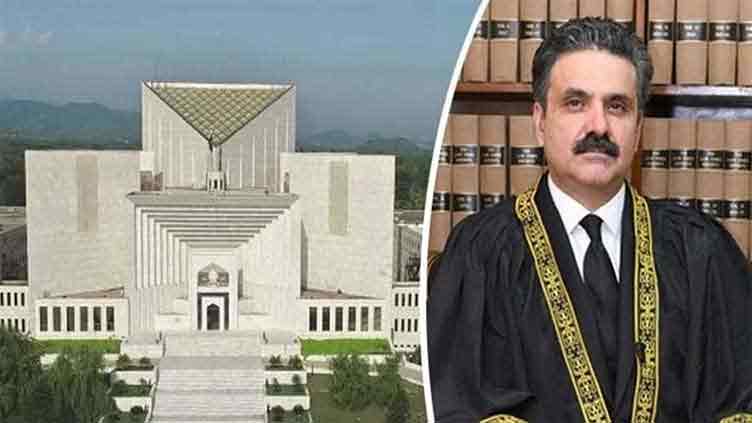
Justice Yahya Afridi Named CJP After Parliamentary Review of Judges Appointment

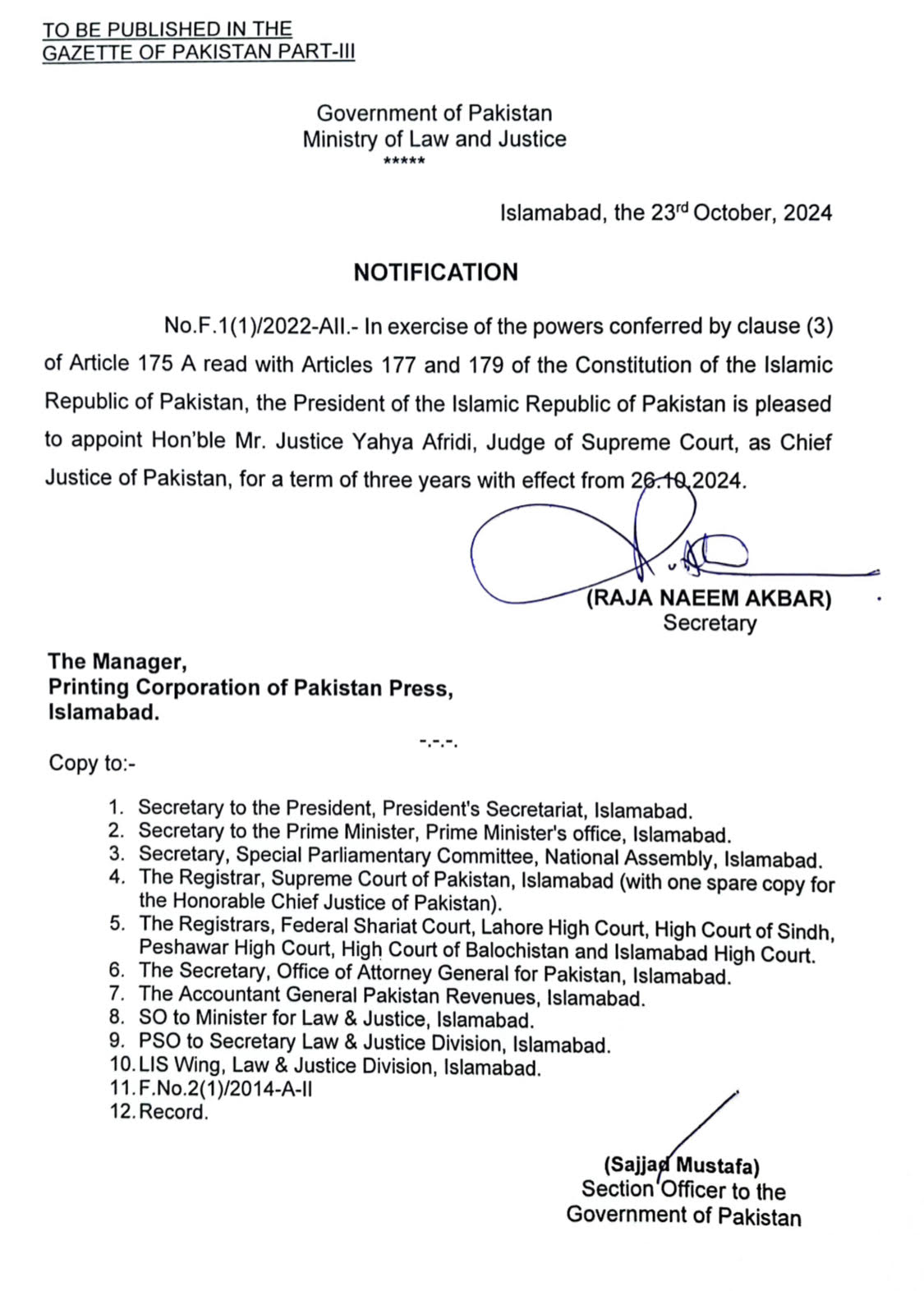
Soon after the Special Parliamentary Committee has completed process for judging the judges with two third majority, President Asif Ali Zardari approved nomination of a junior judge as top court head in response to recently passed 26th Constitutional Amendment. Subsequently, Raja Naeem Akbar, Secretary of the Ministry of Law and Justice Wednesday notified Justice Yahya Afridi as Chief Justice of Pakistan for a three-year term commencing from October 26, 2024.

Earlier, President Asif Ali Zardari has assented to Justice Yahya Afridi, a Supreme Court justice, as the 30th Chief Justice of Pakistan. The President made the appointment of Justice Afridi for a period of three years with effect from October 26, 2024, according to a President House press release.

The appointment was made in exercise of the powers conferred under Articles 175 A (3), 177 and 179 of the constitution. President Zardari also approved October 26 as the date for administering the oath of office to Justice Afridi as the next Chief Justice of Pakistan.

The Special Parliamentary Committee nominated Justice Yahya Afridi as the Chief Justice of Pakistan after “thorough deliberations” late night.  Earlier, the committee meeting was postponed till 8:30pm on Tuesday.  The committee, which held its first round of meeting, was constituted for the first time in the country’s history for the appointment of the top judge.Editor, Khudayar Mohla, Justice Yahya Afridi, Chief Justice of Pakistan, 26th Constitutional Amendment, President Asif Ali Zardari, judicial appointments, Special Parliamentary Committee, Supreme Court judges, judicial revolution, appointment process, Qazi Faez Isa, parliamentary panel, political developments, Azam Nazeer Tarar, PTI, Sunni Ittehad Council, constitutional changes, Articles 175A, 177, 179, oath of office, committee members, legislative history, Pakistan judiciary, judicial review, political dynamics
 

Members of the Committee

The committee was formed following the 26th amendment and it comprised of representatives from both the National Assembly and the Senate. It comprised of MNAs Khawaja Asif, Ahsan Iqbal, Shaista Pervaiz Malik, Raja Pervez Ashraf, Syed Naveed Qamar, Rana Ansar, Gohar Ali Khan, Sahibzada Muhammad Hamid Raza, and Senators Farooq Hameed Naik, Azam Nazeer Tarar, Syed Ali Zafar and Kamran Murtaza.

The session took place at Room No 5 of Parliament House. The two other judges in contention were Justices Mansoor Ali Shah and Munib Akhtar. The outgoing Chief Justice Qazi Faez Isa is set to retire on Oct 25.

What major change 26th Amendment brings about in CJP appointment

The 26th amendment has brought about significant changes in the judicial appointments. For instance, under amendments to clause 3 of Article 175A, instead of the president appointing the “most senior judge of the Supreme Court” as the CJP, the top judge will now be “appointed on the recommendation of the Special Parliamentary Committee from amongst the three most senior” SC judges.

PTI-SIC did not participate

The meeting was held without members of the PTI and Sunni Ittehad Council in attendance. The National Assembly Secretariat said that the SIC members have taken final decision not to attend the parliamentary panel’s meeting. “The committee has been apprised of the SIC’s decision.”

Law Minister Azam Nazeer Tarar said efforts would be made to woo the PTI and SIC. And, he clarified, in case of their absence again, the committee would continue its proceedings.

Author

Khudayar Mohla, Managing Partner Mohla & Mohla, Founder of the Law Today Pakistan,

Managing Partner at Mohla & Mohla - Advocates and Legal Consultants, Islamabad, Founder of The Law Today Pakistan (TLTP) Newswire Service. Former President Press Association of Supreme Court of Pakistan with over two decades of coverage of defining judicial moments - including the dissolution and restoration of Chief Justice Iftikhar Muhammad Chaudhry, Asif Ali Zardari NAB cases, Syed Yousaf Raza Gillani contempt proceedings, Panama Papers case against Mian Nawaz Sharif, matters involving Imran Khan, and the high treason trial of former Army Chief and President Pervez Musharraf. He now practises law and teaches Jurisprudence, International Law, Civil and Criminal Law. Can be reached at: mohla@lawtoday.com.pk

More From Author

Leave a Reply

Your email address will not be published. Required fields are marked *

You May Also Like

Khudayar Mohla,Depalpur court verdict, child rape murder case Pakistan, intellectually challenged girl murder, Muhammad Nadeem conviction, Additional Sessions Court Depalpur, Section 376 PPC rape sentence, Section 302 PPC murder conviction, DNA evidence Pakistan court, Punjab Forensic Science Agency PFSA, life imprisonment rapist murderer, Section 545 CrPC compensation, Anti-Rape Act 2021 Pakistan, sex offenders register Pakistan NADRA, child abduction murder Punjab, judicial compassion victim compensation, FIR 1634/2024 Depalpur, minor girl rape murder Pakistan, Sessions Judge Muhammad Amir Munir, consecutive sentences Pakistan court, child safety Punjab Pakistan

Depalpur Court Convicts Rapist-Murderer of Intellectually Challenged Girl, Orders Family Compensation

DEPALPUR: In a rare exercise of judicial compassion alongside conviction, the Sessions Court Depalpur directed…

Khudayar Mohla, NJPMC meeting Pakistan, National Judicial Policy Making Committee, Chief Justice of Pakistan, judicial austerity strategy Pakistan, energy conservation judiciary Pakistan, four-day working week courts Pakistan, Supreme Court Pakistan austerity measures, POL reduction judges Pakistan, petroleum oil lubricants judicial officers, High Court working week Monday Thursday, Federal Shariat Court four-day week, Lahore High Court austerity, Islamabad High Court energy conservation, Peshawar High Court measures, High Court Sindh Balochistan, Attorney General Pakistan NJPMC, video-link hearings Pakistan courts, rotational staff attendance judiciary, protocol security rationalisation courts, District Courts four-day week Pakistan, judicial expenditure reduction Pakistan, energy crisis Pakistan judiciary response, access to justice Pakistan, Supreme Court energy policy, judiciary national resilience Pakistan, court operations petroleum shortage, NJPMC virtual meeting Islamabad, Chief Justice Federal Shariat Court, judicial governance Pakistan 2025, sustainable judiciary Pakistan

NJPMC Approves Judicial Austerity Strategy; Four-Day Week, POL Cuts Ordered Across Courts

ISLAMABAD: The National Judicial (Policy Making) Committee (NJPMC) convened an emergent virtual meeting under the…

Chief Justice Yahya Afridi, CJP Yahya Afridi, women’s rights in Pakistan, judiciary commitment to women rights, gender responsive justice Pakistan, International Women’s Day Pakistan judiciary, Supreme Court of Pakistan women rights, access to justice for women Pakistan, gender sensitive judiciary Pakistan, National Judicial Policy Making Committee NJPMC, NJPMC gender responsive justice agenda, judicial reforms Pakistan 2026–27, women facilitation centers courts Pakistan, legal aid for women Pakistan, women legal advisory helpline Pakistan, Law and Justice Commission of Pakistan reforms, family law reforms Pakistan, mediation and family support services courts Pakistan, gender fair language in justice system, legal awareness for women Pakistan, rural women legal rights Pakistan, women empowerment through justice system, Pakistan judiciary reforms for women, rule of law and women protection Pakistan, Islamabad Supreme Court, Khudayar Mohla, justice for women justice for Pakistan

Justice for Women is Justice for Pakistan, says CJP Afridi

ISLAMABAD: Chief Justice of Pakistan (CJP) Yahya Afridi has reaffirmed the judiciary’s commitment to protecting…