
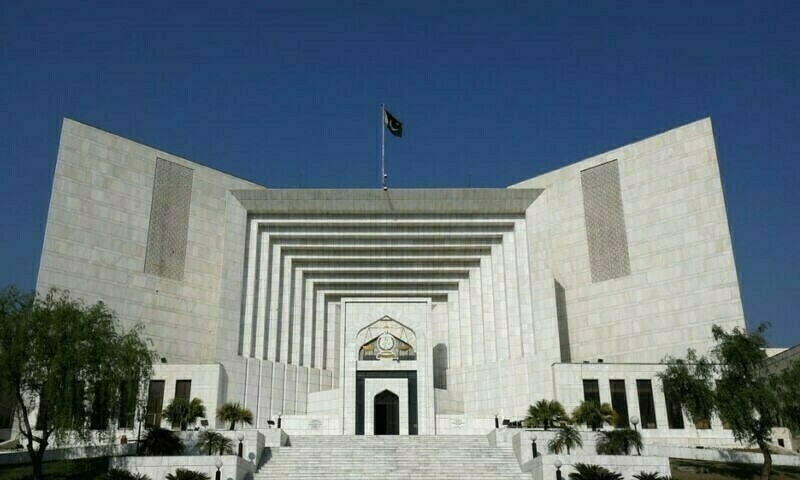
Resuming his arguments before a seven-member constitutional bench of the top court in appeals challenging civilian military trial on Thursday Salman Akram Raja – counsel for a convicted Arzam Juaid made a point saying the existing legal framework of Pakistan doesn’t permit civilian court martial.
A seven-member bench, headed by Justice Aminuddin Khan and including Justices Jamal Mandokhail, Muhammad Ali Mazhar, Hassan Azhar Rizvi, Musarat Hilali, Naeem Akhtar Afghan, and Shahid Bilal Hassan, questioned the legal framework surrounding military trials.
Raja placed arguments before the bench and cited UK law, explaining that court-martial cases are handled by independent judges rather than military officers, with commanding officers only referring serious cases to independent forums. However, Justice Khan urged him to focus on Pakistani law, while Justice Mazhar remarked that British military laws applied to military personnel, not civilians.
During the hearing, a member of the bench Justice Musarrat Hilali asked from Raja to respond whether he acknowledged that a crime was committed on May 9, 2023, questioning as to why basic rights are now being asked to protect after the limits were crossed during the incident.
Geo News reported citing Justice Hilali, “Limits were crossed on May 9, and now you remember basic rights?” Justice Hilali said that the pending appeals seek the restoration of annulled provisions. She pointed out if the provisions are to be reviewed, international laws must also be considered. She added that had the provisions not been annulled, the arguments could have been irrelevant, but now they are not.
Justice Jamal Khan Mandokhail raised a question regarding potential for civilians to undergo court-martial under the current legal system, to which Raja firmly responded that such a thing was not possible under any circumstances. The proceedings also highlighted the ongoing struggle for justice by victims of the Army Public School (APS) attack, as advocate Raja submitted that despite their tragic loss, the victims are still deprived of a fair and just resolution.
Justice Amin-Ud-Din, in response, noted that achieving a fair trial would require navigating past certain legal hurdles, such as addressing Article 8(3) of the Constitution. Justice Rizvi remarked that while the military has specialised corps such as engineering and medical and questioned whether there should also be a judicial corps within the army.
Raja further argued that simply accusing someone and depriving them of a fair trial is concerned with the issue of basic human rights. Recalling that he had been falsely accused of conspiring with the Pakistan Tehreek-e-Insaf (PTI) to kill Rangers personnel and warned that if the law’s provisions were restored, he could be forced to appear before a colonel – in a military trial.
To this, Justice Mazhar mentioned that an anti-terrorism section was likely added to the FIR against Raja, while Justice Amin-Ud-Din questioned whether a military custody request had been made in his case. Raja submitted hat his case was an example of how the system works, where an accusation alone can lead to a civilian facing military trial.
Justice Mandokhail advised Raja to focus on facts and avoid speculation, urging him to remain grounded in the context of the case. Moving forward, Justice Hilali remarked that when the 21st Constitutional Amendment was enacted, your [Raja’s] party supported the establishment of military courts, the judge said, she could say that at least one political party had supported military courts under the 21st Constitutional Amendment. Raja clarified that he did not represent any political party and acknowledged that their support for military courts in the past had been a mistake.
Justice Hilali, however, questioned whether it was appropriate to label past decisions as mistakes — now that the political landscape had changed. The court also deliberated on the provision in the 21st Amendment that exempted political parties from military trials, with Justice Mandokhail remarking that it was a positive aspect.
Later, the bench adjourned hearing of the matter till February 18 where Salam Akram Raja will resume arguments in the matter.