

Categories Courts

LHC Defines ‘Absconder’ vs. ‘Proclaimed Offender’ Boundary; Sets Aside Death Sentence Over Procedural Lapses

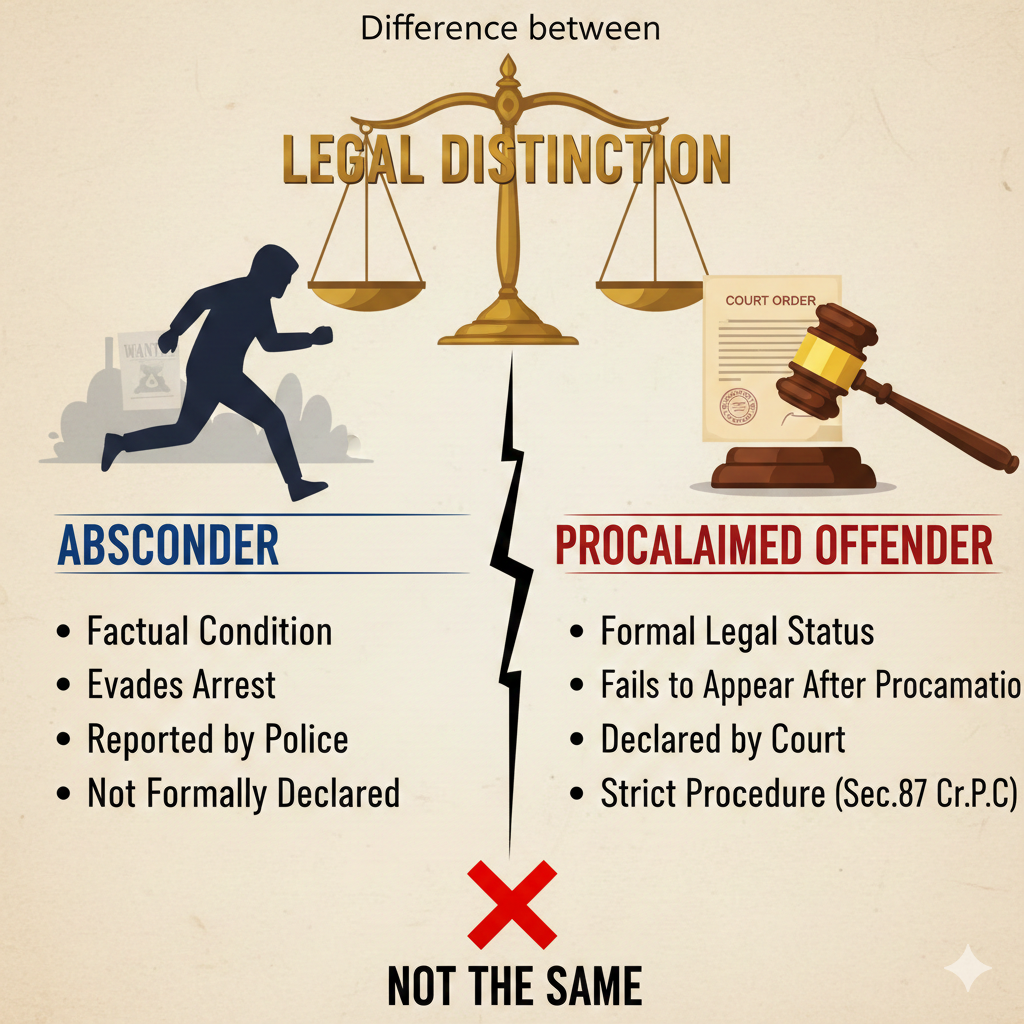
LAHORE: In a significant judicial determination that reinforces the protection of fundamental rights against arbitrary state action, the Lahore High Court has meticulously delineated the legal boundaries between a mere “absconder” and a formally “proclaimed offender”.

Authoring the judgment, Justice Ali Zia Bajwa clarified that while an absconder is defined by the factual condition of willfully evading arrest or concealing one’s whereabouts to avoid a warrant, a proclaimed offender holds a formal legal status that can only be conferred by a Court following a rigorous, multi-step judicial process. The Court emphasized that this distinction is not a mere formality but a substantive safeguard, noting that while every proclaimed offender is inherently an absconder, not every person evading arrest attains the formal status of a proclaimed offender.

The Anatomy of a Proclaimed Offender Status

According to the judgment, the transition from an absconder to a proclaimed offender requires the state to satisfy specific, conjunctive legal prerequisites under the Code of Criminal Procedure: Judicial Control over Coercive Measures: The Court observed that the power to declare an individual a proclaimed offender remains under the exclusive control of the judiciary to prevent unlawful infringements upon liberty by investigating agencies.  Mandatory Modes of Publication: Justice Bajwa highlighted that the law demands three collective modes of publication: the proclamation must be publicly read in the individual’s home village, affixed to their known residence, and displayed prominently within the courthouse. The Weight of Conclusive Evidence: The judgment stipulates that a Court must provide a written statement certifying that all publication requirements were strictly met before the status is legally finalized.

Acquittal and the Failure of Due Process

In the specific case of appellant Asad Abbas, who had been sentenced to death following an eleven-year absence, the Court found that the state had fundamentally failed to observe these procedures. The High Court noted that the initial warrant was not addressed to a specific officer, the police failed to document diligent search efforts, and no judicial certificate existed to prove the proclamation was correctly published. Crucially, the Court ruled that abscondence alone is not proof of guilt, describing it instead as a suspicious circumstance that cannot substitute for concrete, substantive evidence. Finding that the medical evidence directly conflicted with the eyewitness accounts of the 2007 shooting, the Court held that the prosecution had miserably failed to prove its case beyond a shadow of a doubt. The judgment concluded by allowing the appeal and ordering the appellant’s immediate release, reaffirming the legal maxim that the benefit of any reasonable doubt remains an absolute right of the accused.

Author

Khudayar Mohla, Managing Partner Mohla & Mohla, Founder of the Law Today Pakistan,

Managing Partner at Mohla & Mohla - Advocates and Legal Consultants, Islamabad, Founder of The Law Today Pakistan (TLTP) Newswire Service. Former President Press Association of Supreme Court of Pakistan with over two decades of coverage of defining judicial moments - including the dissolution and restoration of Chief Justice Iftikhar Muhammad Chaudhry, Asif Ali Zardari NAB cases, Syed Yousaf Raza Gillani contempt proceedings, Panama Papers case against Mian Nawaz Sharif, matters involving Imran Khan, and the high treason trial of former Army Chief and President Pervez Musharraf. He now practises law and teaches Jurisprudence, International Law, Civil and Criminal Law. Can be reached at: mohla@lawtoday.com.pk

More From Author

Leave a Reply

Your email address will not be published. Required fields are marked *

You May Also Like

Khudayar Mohla,Depalpur court verdict, child rape murder case Pakistan, intellectually challenged girl murder, Muhammad Nadeem conviction, Additional Sessions Court Depalpur, Section 376 PPC rape sentence, Section 302 PPC murder conviction, DNA evidence Pakistan court, Punjab Forensic Science Agency PFSA, life imprisonment rapist murderer, Section 545 CrPC compensation, Anti-Rape Act 2021 Pakistan, sex offenders register Pakistan NADRA, child abduction murder Punjab, judicial compassion victim compensation, FIR 1634/2024 Depalpur, minor girl rape murder Pakistan, Sessions Judge Muhammad Amir Munir, consecutive sentences Pakistan court, child safety Punjab Pakistan

Depalpur Court Convicts Rapist-Murderer of Intellectually Challenged Girl, Orders Family Compensation

DEPALPUR: In a rare exercise of judicial compassion alongside conviction, the Sessions Court Depalpur directed…

Khudayar Mohla, NJPMC meeting Pakistan, National Judicial Policy Making Committee, Chief Justice of Pakistan, judicial austerity strategy Pakistan, energy conservation judiciary Pakistan, four-day working week courts Pakistan, Supreme Court Pakistan austerity measures, POL reduction judges Pakistan, petroleum oil lubricants judicial officers, High Court working week Monday Thursday, Federal Shariat Court four-day week, Lahore High Court austerity, Islamabad High Court energy conservation, Peshawar High Court measures, High Court Sindh Balochistan, Attorney General Pakistan NJPMC, video-link hearings Pakistan courts, rotational staff attendance judiciary, protocol security rationalisation courts, District Courts four-day week Pakistan, judicial expenditure reduction Pakistan, energy crisis Pakistan judiciary response, access to justice Pakistan, Supreme Court energy policy, judiciary national resilience Pakistan, court operations petroleum shortage, NJPMC virtual meeting Islamabad, Chief Justice Federal Shariat Court, judicial governance Pakistan 2025, sustainable judiciary Pakistan

NJPMC Approves Judicial Austerity Strategy; Four-Day Week, POL Cuts Ordered Across Courts

ISLAMABAD: The National Judicial (Policy Making) Committee (NJPMC) convened an emergent virtual meeting under the…

Chief Justice Yahya Afridi, CJP Yahya Afridi, women’s rights in Pakistan, judiciary commitment to women rights, gender responsive justice Pakistan, International Women’s Day Pakistan judiciary, Supreme Court of Pakistan women rights, access to justice for women Pakistan, gender sensitive judiciary Pakistan, National Judicial Policy Making Committee NJPMC, NJPMC gender responsive justice agenda, judicial reforms Pakistan 2026–27, women facilitation centers courts Pakistan, legal aid for women Pakistan, women legal advisory helpline Pakistan, Law and Justice Commission of Pakistan reforms, family law reforms Pakistan, mediation and family support services courts Pakistan, gender fair language in justice system, legal awareness for women Pakistan, rural women legal rights Pakistan, women empowerment through justice system, Pakistan judiciary reforms for women, rule of law and women protection Pakistan, Islamabad Supreme Court, Khudayar Mohla, justice for women justice for Pakistan

Justice for Women is Justice for Pakistan, says CJP Afridi

ISLAMABAD: Chief Justice of Pakistan (CJP) Yahya Afridi has reaffirmed the judiciary’s commitment to protecting…