

Categories Courts

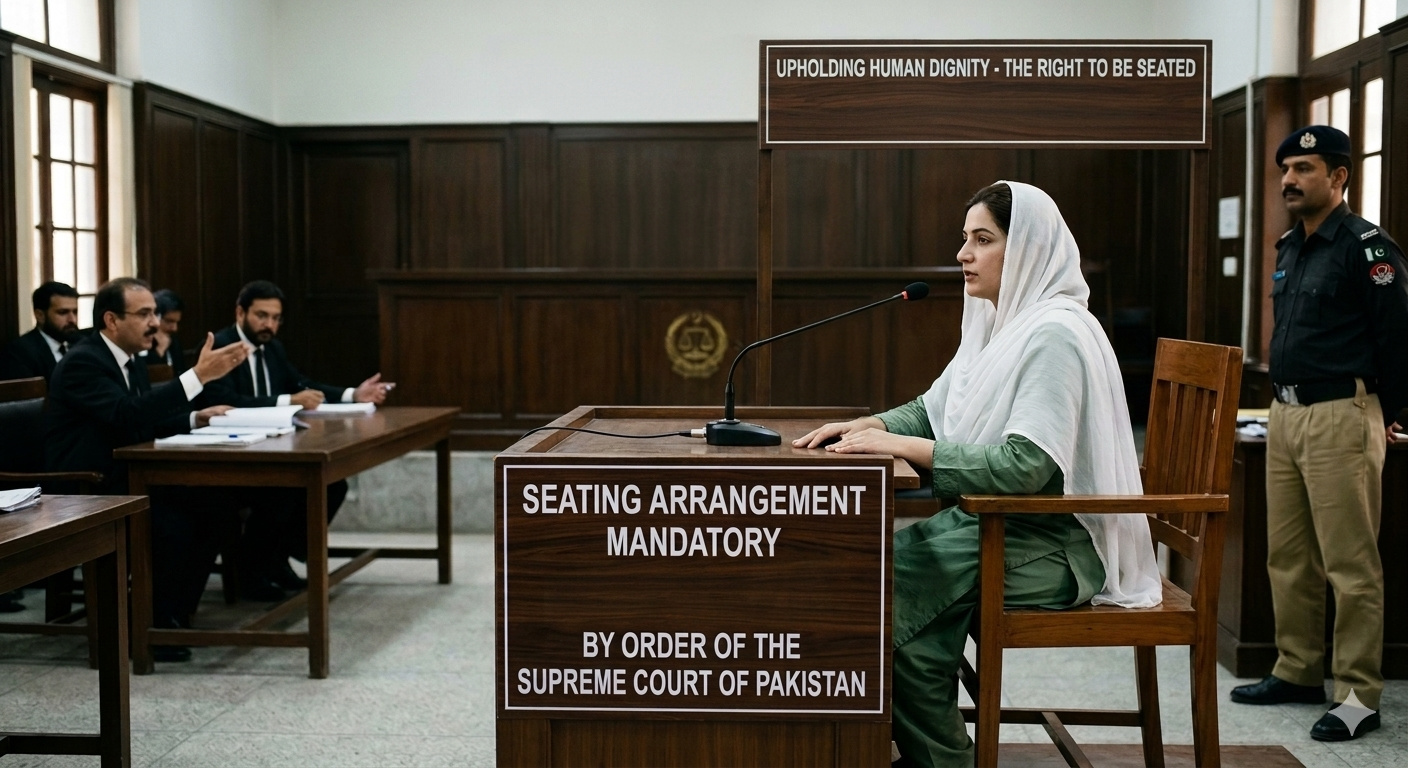
SC Directs Courts Nationwide to Provide Seating for Witnesses During Testimony

ISLAMABAD: Emphasizing that justice must be administered with humanity and respect for individual dignity, the Supreme Court issued directives  directed courts across the country to provide proper seating arrangements for witnesses during testimony, declaring that compelling them to stand for prolonged periods in the witness box serves no legitimate purpose in the administration of justice.

A judgment issued in response to a criminal petition , three-member bench of the Supreme Court comprising Justice Muhammad Hashim Khan Kakar, Justice Salahuddin Panhwar and Justice Ishtiaq Ibrahim expressed a courtroom is not merely a place where disputes are resolved but a forum where the authority of law must operate alongside respect for human dignity.

Author judge of the 11-page verdict in the matter, Justice Salahuddin Panhwar held that witnesses who appear before the judiciary assist the administration of justice and must therefore be treated with fairness, composure, and respect.  The bench noted that in many trial courts witnesses are often required to remain standing in the witness box for long periods during examination and cross-examination, sometimes extending for several hours regardless of age, health, or gender.

According to the court, no provision in the Code of Criminal Procedure, the Code of Civil Procedure, or the Qanun-e-Shahadat Order requires a witness to remain standing while giving evidence. The judgment observed such practices may impose unnecessary physical and psychological strain on witnesses and could affect the clarity and composure with which testimony is delivered.  Allowing a witness to remain seated while deposing, the court said, does not undermine the sanctity of the oath or the dignity of judicial proceedings; instead, it strengthens fairness and the orderly administration of justice.

Referring to constitutional guarantees, the bench highlighted that the protection of witnesses and complainants flows directly from Articles 9, 10-A, and 14 of the Constitution, which ensure security of person, the right to a fair trial, and the dignity of man. Together, these provisions impose a duty upon the State to protect individuals appearing before courts from intimidation, humiliation, or undue hardship.

The bench further noted that Pakistan’s statutory framework also reflects this commitment through witness protection laws enacted at both federal and provincial levels. These laws provide mechanisms such as anonymity, relocation, security arrangements, and testimony through video-link in appropriate cases to safeguard vulnerable witnesses.

Highlighting the ethical foundation of judicial proceedings, the court remarked that a witness enters the witness box as a citizen assisting the justice system, not as a servant of the court. Justice, it observed, does not demand endurance or unnecessary suffering but requires the truth to be presented in an atmosphere of composure, security, and respect. Accordingly, the Supreme Court directed all District and Sessions Judges, special courts, tribunals, and subordinate courts across Pakistan to ensure that appropriate seating arrangements such as chairs, seats, or benches are provided in witness boxes. The registrar of the court has also been directed to circulate the judgment to the chief justices of all high courts to ensure nationwide implementation.

The ruling came while the court dismissed a petition seeking consolidation of two trials arising from separate FIRs under different legal regimes, holding that the question involved judicial discretion and did not warrant interference under Article 185(3) of the Constitution.  Legal observers say the directive marks an important step toward making Pakistan’s courtrooms more humane and aligned with constitutional principles of dignity and fair trial.

Author

Khudayar Mohla, Managing Partner Mohla & Mohla, Founder of the Law Today Pakistan,

Managing Partner at Mohla & Mohla - Advocates and Legal Consultants, Islamabad, Founder of The Law Today Pakistan (TLTP) Newswire Service. Former President Press Association of Supreme Court of Pakistan with over two decades of coverage of defining judicial moments - including the dissolution and restoration of Chief Justice Iftikhar Muhammad Chaudhry, Asif Ali Zardari NAB cases, Syed Yousaf Raza Gillani contempt proceedings, Panama Papers case against Mian Nawaz Sharif, matters involving Imran Khan, and the high treason trial of former Army Chief and President Pervez Musharraf. He now practises law and teaches Jurisprudence, International Law, Civil and Criminal Law. Can be reached at: mohla@lawtoday.com.pk

More From Author

Leave a Reply

Your email address will not be published. Required fields are marked *

You May Also Like

Khudayar Mohla,Depalpur court verdict, child rape murder case Pakistan, intellectually challenged girl murder, Muhammad Nadeem conviction, Additional Sessions Court Depalpur, Section 376 PPC rape sentence, Section 302 PPC murder conviction, DNA evidence Pakistan court, Punjab Forensic Science Agency PFSA, life imprisonment rapist murderer, Section 545 CrPC compensation, Anti-Rape Act 2021 Pakistan, sex offenders register Pakistan NADRA, child abduction murder Punjab, judicial compassion victim compensation, FIR 1634/2024 Depalpur, minor girl rape murder Pakistan, Sessions Judge Muhammad Amir Munir, consecutive sentences Pakistan court, child safety Punjab Pakistan

Depalpur Court Convicts Rapist-Murderer of Intellectually Challenged Girl, Orders Family Compensation

DEPALPUR: In a rare exercise of judicial compassion alongside conviction, the Sessions Court Depalpur directed…

Khudayar Mohla, NJPMC meeting Pakistan, National Judicial Policy Making Committee, Chief Justice of Pakistan, judicial austerity strategy Pakistan, energy conservation judiciary Pakistan, four-day working week courts Pakistan, Supreme Court Pakistan austerity measures, POL reduction judges Pakistan, petroleum oil lubricants judicial officers, High Court working week Monday Thursday, Federal Shariat Court four-day week, Lahore High Court austerity, Islamabad High Court energy conservation, Peshawar High Court measures, High Court Sindh Balochistan, Attorney General Pakistan NJPMC, video-link hearings Pakistan courts, rotational staff attendance judiciary, protocol security rationalisation courts, District Courts four-day week Pakistan, judicial expenditure reduction Pakistan, energy crisis Pakistan judiciary response, access to justice Pakistan, Supreme Court energy policy, judiciary national resilience Pakistan, court operations petroleum shortage, NJPMC virtual meeting Islamabad, Chief Justice Federal Shariat Court, judicial governance Pakistan 2025, sustainable judiciary Pakistan

NJPMC Approves Judicial Austerity Strategy; Four-Day Week, POL Cuts Ordered Across Courts

ISLAMABAD: The National Judicial (Policy Making) Committee (NJPMC) convened an emergent virtual meeting under the…

Chief Justice Yahya Afridi, CJP Yahya Afridi, women’s rights in Pakistan, judiciary commitment to women rights, gender responsive justice Pakistan, International Women’s Day Pakistan judiciary, Supreme Court of Pakistan women rights, access to justice for women Pakistan, gender sensitive judiciary Pakistan, National Judicial Policy Making Committee NJPMC, NJPMC gender responsive justice agenda, judicial reforms Pakistan 2026–27, women facilitation centers courts Pakistan, legal aid for women Pakistan, women legal advisory helpline Pakistan, Law and Justice Commission of Pakistan reforms, family law reforms Pakistan, mediation and family support services courts Pakistan, gender fair language in justice system, legal awareness for women Pakistan, rural women legal rights Pakistan, women empowerment through justice system, Pakistan judiciary reforms for women, rule of law and women protection Pakistan, Islamabad Supreme Court, Khudayar Mohla, justice for women justice for Pakistan

Justice for Women is Justice for Pakistan, says CJP Afridi

ISLAMABAD: Chief Justice of Pakistan (CJP) Yahya Afridi has reaffirmed the judiciary’s commitment to protecting…