
GILGIT: In a development that has sent shockwaves through the legal fraternity and civil society of Gilgit-Baltistan, police have apprehended four senior leaders of the GB Awami Action Committee (AAC) on charges of delivering alleged anti-state speeches during an Iftar party, triggering widespread condemnation from bar councils, human rights organisations, and political circles across the region.
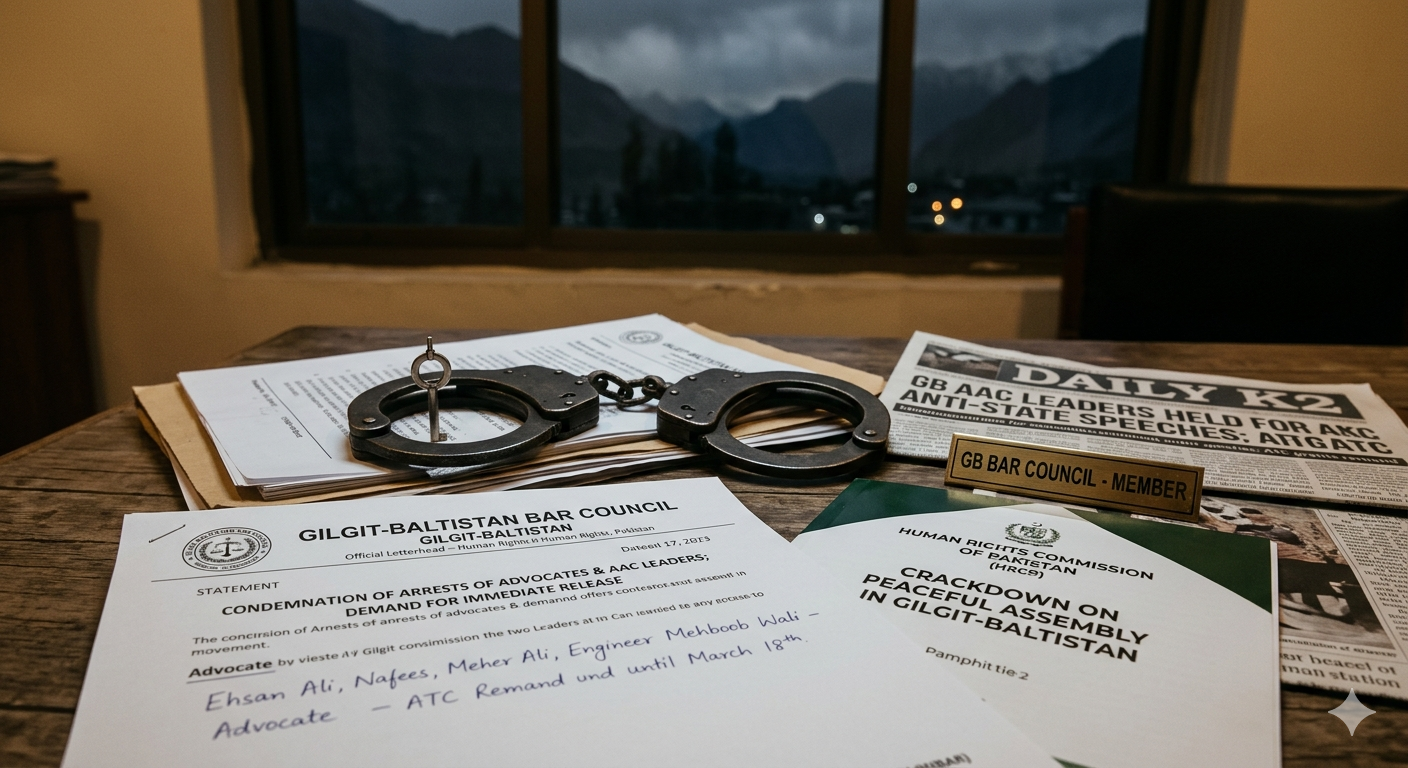
According to reports emerging on Thursday, the four arrested individuals have been identified as AAC Chairman Advocate Ehsan Ali, Advocate Nafees, Meher Ali, and Engineer Mehboob Wali. All four were taken into custody on Wednesday, following which an Anti-Terrorism Court (ATC) judge, Rehmat Shah, granted their physical remand until March 18, setting the stage for what promises to be a highly contentious legal battle.
Advocate Ehsan Ali, the most prominent among those arrested, is a highly respected and senior member of the legal community in Gilgit-Baltistan. He has previously served as President of both the GB Supreme Appellate Court Bar Association and the GB High Court Bar Association, and currently member of the GB Bar Council – credentials that have made his arrest all the more alarming and controversial in the eyes of the legal community.
Prior to the arrests, a First Information Report (FIR) was registered under the Anti-Terrorism Act at the Jutial police station, naming the AAC chief and the other three leaders, along with a host of other individuals, for allegedly making anti-state speeches during an Iftar gathering and conspiring to organise a protest demonstration. The FIR, which names as many as 13 AAC leaders in total, accuses them of delivering anti-state speeches, inciting the public, and planning to arrange protests against the state.
The other individuals named in the FIR include Asghar Shah, Masoodur Rehman, Manzar Mayar, Taroo Abbas, Nusrat Hussain, Waheed Hassan, Sahib Khan, Fida Esar, and Engineer Nadeem. The broad sweep of the FIR, encompassing a large number of civil and political activists, has drawn sharp criticism from multiple quarters, with many viewing it as a deliberate attempt to suppress legitimate political activity and silence dissenting voices in the region.
The arrests have provoked an immediate and strong reaction from the legal community. The Gilgit-Baltistan Bar Council issued a strongly worded statement expressing serious concern over what it described as the illegal detention of Advocate Ehsan Ali by local police. The Bar Council stressed that the detention of a practising advocate without transparent legal justification raised grave questions about the rule of law and created deep anxiety and apprehension among the legal fraternity of Gilgit-Baltistan.
Calling for swift and transparent action, the Bar Council urged the concerned authorities and police officials to immediately clarify the circumstances surrounding the detention and ensure that the rights and dignity of the learned advocate were fully respected and protected. The Council further demanded the immediate and unconditional release of Advocate Ehsan Ali, warning that any action that undermined the independence and dignity of the legal profession could not and would not be tolerated under any circumstances.
“The Gilgit-Baltistan Bar Council stands firmly with its member and will continue to monitor the situation closely to safeguard the rights of advocates and uphold the rule of law,” the statement concluded, signalling the legal community’s resolve to pursue the matter to its logical end.
The GB High Court Bar Association also joined the chorus of condemnation, along with numerous lawyers’ bodies, political organisations, and civil society groups, all of whom expressed alarm at the use of the Anti-Terrorism Act against individuals engaged in what they characterised as entirely peaceful and constitutionally protected political activity.
The Human Rights Commission of Pakistan (HRCP) also weighed in strongly, expressing deep concern over the arrest of at least five AAC leaders in Gilgit. The HRCP noted that reports of continuing police raids to detain other leaders — carried out in the wake of a meeting in Gilgit and ahead of a planned public outreach visit to Skardu — raised serious and troubling questions about the extent to which peaceful political activity was being systematically restricted and suppressed in Gilgit-Baltistan.
The HRCP demanded that the authorities ensure due process in all proceedings related to the detained leaders and refrain from curbing citizens’ fundamental rights to organise, assemble, and engage in lawful public dialogue. “Peaceful political activity is a fundamental right. Yet, in Gilgit-Baltistan, the government is denying these rights, and the FIR registered against AAC leaders for organising peaceful protests is condemned,” the HRCP statement said.
As the matter is now before the Anti-Terrorism Court, all eyes will be on the judiciary to ensure that justice is served transparently, impartially, and without any undue influence -particularly given the sensitive political dimensions of the case and the stature of those implicated.