

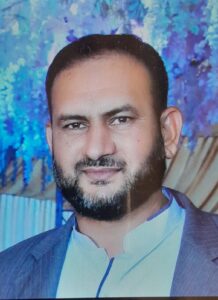
Pakistan’s political landscape has long been dominated by wealth, inherited influence, and entrenched patronage networks. Electoral politics, particularly in rural constituencies, remains largely inaccessible to individuals lacking financial resources or dynastic backing. Yet occasionally, certain individuals challenge this deeply unequal order through unconventional journeys rooted more in personal conviction than material strength. One such figure is Muhammad Afzal Najmi Baloch Advocate, a resident of Chak No. 2/K.B., Balochan Wala, Pakpattan. I recently met him at the office of Yasir Arafat Gujjar, General Secretary of the Bar Association Pakpattan, where Advocate Aftabur Rashid Bhutta was also present.
It was my first interaction with him, and the conversation offered insight into an unusual trajectory – one that moves from legal practice towards political ambition. Afzal Najmi belongs to a Baloch family that, by his own account, endured prolonged litigation and recurring legal disputes during his formative years. Those experiences appear to have shaped his inclination towards the law. After completing his matriculation from Bahawalpur and graduating in Chemistry and Atomic Energy from the University of Karachi, he pursued legal education and eventually established Lalkaar Law Chamber upon joining the Bar Association Pakpattan Sharif. With the support of fellow lawyers, he was subsequently elected Finance Secretary of the bar association.
His ambitions, however, did not remain confined to courtrooms. He argues that legal advocacy alone is insufficient in a society grappling with inflation, unemployment, inequality, weak governance, and eroding public trust in institutions. In his view, meaningful change requires participation in parliamentary politics. It was under this conviction that he contested the provincial election from PP-194 Pakpattan on the platform of Muttahida Qaumi Movement Pakistan.
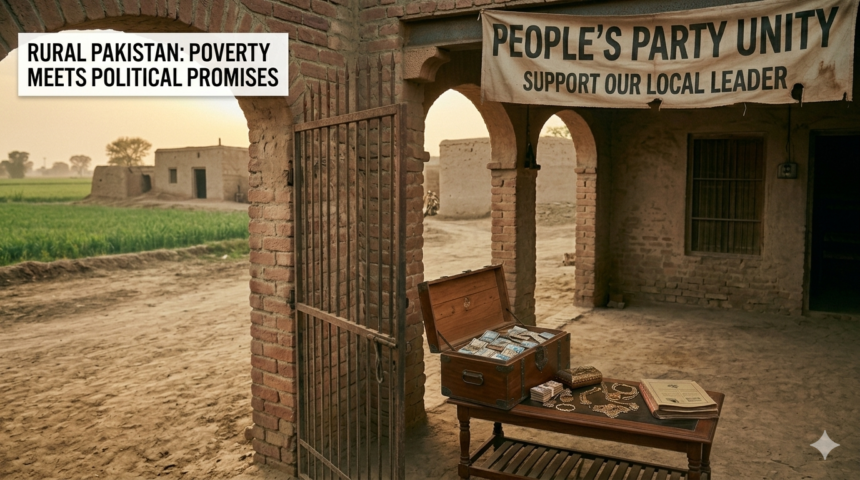
What distinguished his campaign was not organisational strength or financial muscle, but symbolism. Lacking the means for a conventional campaign, he travelled on camelback through the constituency – a decision that drew local attention and became associated both with his Baloch identity and his deliberate projection of simplicity in politics. In a political culture increasingly driven by expensive campaigns and media spectacle, the image of a candidate riding a camel through villages carried a quiet, theatrical defiance. For supporters, it reflected resilience and authenticity; for critics, perhaps idealism detached from electoral realities. Yet the symbolism succeeded in generating recognition where resources could not.
Najmi now speaks of broader ambitions. He intends to contest future elections from all four provinces for the National Assembly and aspires one day to run for the presidency of Pakistan. His political discourse centres on dismantling what he describes as feudal, capitalist, and interest-driven systems that continue to marginalise ordinary citizens. He points out that while over a hundred political parties are registered with the Election Commission, public political space remains overwhelmingly concentrated around a few dominant formations, leaving smaller groups without visibility or meaningful participation. Whether one agrees with his diagnosis or not, the frustration underlying such arguments resonates with many citizens who feel estranged from conventional political structures.
His insistence that ordinary people should engage through smaller political platforms — rather than remain dependent upon elite-controlled parties — reflects a wider and legitimate debate about representation and democratic access in Pakistan. Najmi also presents himself as a constitutionally outspoken lawyer. He claims to have pursued legal action against Indian Prime Minister Narendra Modi over alleged violations of the Indus Waters Treaty, and against US President Donald Trump following sanctions related to Pakistan’s missile programme — actions he frames as expressions of patriotism and constitutional activism. The practical reach of such efforts within international legal structures may be limited, but the intent behind them speaks to a particular kind of civic engagement. What makes his story noteworthy is not the certainty of political success, but the persistence of aspiration in the absence of conventional means. Pakistani politics rarely accommodates outsiders without wealth, clan influence, or institutional backing. To enter that arena armed with little more than professional identity, symbolic politics, and personal determination is, at minimum, an act of unusual confidence. Perhaps that is why his journey evokes the old poetic sentiment: “Teesha kya majal thi ke karta woh koh-kani, Dil ka hi sara zor tha jis ne pahaar dha diya.” The verse captures a truth often overlooked in contemporary politics: institutions may favour power, but political participation still occasionally survives on sheer will alone. And in an increasingly cynical environment, even the attempt to light a small candle against prevailing darkness retains its own quiet significance.