
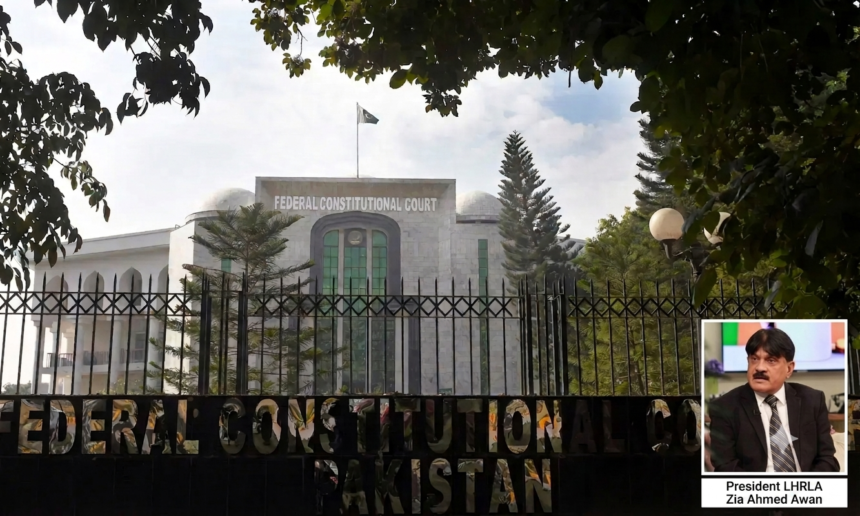
KARACHI: Zia Ahmed Awan, President of Lawyers for Human Rights and Legal Aid (LHRLA) and founder of Pakistan’s Madadgaar National Helpline, urged the Federal Constitutional Court of Pakistan (FCCP) on Tuesday to conclusively decide the country’s longest-running case on missing, trafficked, kidnapped, and street children, ahead of a hearing scheduled for Thursday, July 16, 2026.
Awan issued a press release calling on the Court to finally resolve Constitutional Petition No. 23 of 2017. He filed the petition on June 1, 2017, under Article 184(3) of the Constitution. The petition names 37 federal and provincial respondents. These include the Ministry of Interior, NADRA, police departments, home departments, women’s development departments, and human rights commissions of all four provinces. The petition asks the Court to compel a coordinated national response to the crisis.
Nine years have passed since the filing. Two Chief Justices have overseen the case. At least a dozen hearings have taken place. The case still awaits final disposal, according to the Court’s own case record generated on July 14, 2026.
The petition emerged from Awan’s decades of work through LHRLA and Madadgaar. Madadgaar operates as Pakistan’s first helpline for women and children. The organisation has documented a rising number of missing, trafficked, kidnapped, and street children nationwide. The petition alleges that federal and provincial authorities failed to establish coordination mechanisms. It cites gaps in data-sharing systems, shelter infrastructure, and cross-border cooperation. The petition asks the Court to compel action on registration, rehabilitation, shelter homes, budget transparency, interprovincial coordination, and civil society engagement.
The case has traveled alongside two related matters. Constitution Petition No. 36 of 2018, filed by the Roshni Research & Development Welfare Organisation, addresses missing children. Human Rights Case No. 63 of 2017 involved Tayyaba, a child domestic worker tortured by a sitting judge. That case was disposed of separately in 2023.
Court orders reveal a consistent pattern of delay. On June 7, 2023, the Supreme Court linked the missing-children petitions to the Tayyaba case and disposed of the latter separately. The Court directed a formal briefing from the National Commission on the Rights of Child (NCRC) and the Ministry of Human Rights. It also ordered all four provincial Advocates-General to file statements.
Only Punjab filed its report on time by July 5, 2023. Khyber Pakhtunkhwa, Sindh, and Balochistan sought further time. The Court granted one month. That deadline stretched into years.
The case resurfaced on November 21, 2024, amid public outrage over the kidnapping of ten-year-old Muhammad Musawir in Quetta. The incident triggered protests outside the Balochistan Assembly and High Court. The Court ordered Home Secretaries and Inspectors-General of Police from all four provinces and Islamabad to personally appear.
The IGP Balochistan reported some progress on November 28, 2024. The Court found more action was required. It directed the Attorney-General and provincial Advocates-General to file compliance progress reports.
The NCRC’s report finally reached the Court on March 18, 2025, nearly 21 months after the original directive. Petitioner’s counsel stated he had not yet seen the report and requested time to review it.
A government law officer requested additional time on April 14, 2025, to submit a comprehensive report. The NCRC Chairperson failed to appear on May 12, 2025. The Court adjourned the hearing for four weeks.
The NCRC Chairperson finally appeared in person on October 27, 2025. She briefed the Court on a report submitted to Parliament. The Director-General of the Zainab Alert, Response and Recovery Agency (ZARRA) also appeared. The Court recorded a striking admission: no rules exist yet to operationalise the relevant federal legislation. The Court noted that without these rules, the law’s benefits cannot be secured. It directed the Additional Attorney-General to coordinate rule-framing between the Federation and all provinces.
The case is now listed before Bench-II of the Federal Constitutional Court for the July 16, 2026 hearing. The bench comprises Justice Syed Hasan Azhar Rizvi, Justice Aamer Farooq, and Justice Syed Arshad Hussain Shah. The connected Roshni Helpline petition on missing children will also come up for hearing.
The NCRC holds a significant mandate under law. Parliament created the National Commission on the Rights of Child Act, 2017, the same year Awan filed his petition. The Act mandates the NCRC to examine child-rights policies, laws and practices. It requires the Commission to inquire into violations, steer research, raise public awareness, and advise government on reforms. The NCRC functions as an oversight body, not a service-delivery agency.
Nine years after Parliament passed the Act, the rules needed to make it operational still do not exist. The Court’s October 2025 order confirmed this gap. LHRLA does not allege bad faith by any individual officer. However, the organisation says the institutional pattern of delay, non-appearance, and incomplete reporting now forms part of the Court’s own record.
Awan issued a direct appeal to the Court. “This petition has outlived two Chief Justices, survived the transition from the Supreme Court’s Constitutional Bench to the new Federal Constitutional Court, and still awaits a final, enforceable resolution,” he said. “Every year of delay is measured in missing children, not paperwork. We are asking the FCCP not to let institutional transition become an excuse for this case to be quietly dropped or left to drift between adjournments. The children this case was filed for cannot wait another nine years.”