

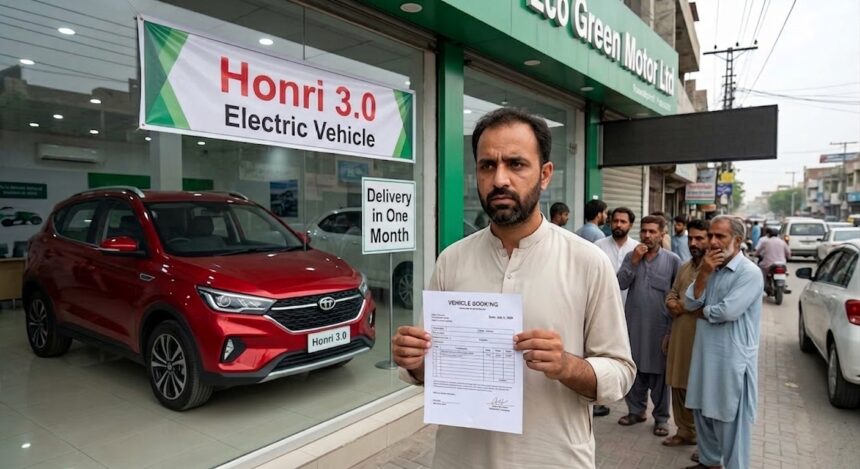
ISLAMABAD: When Zain Afzaal booked a Honri 3.0 electric vehicle at Eco Green Motor Ltd – a Rawalpindi-based dealership under Yousuf Dewan Companies on July 3, 2026, he did what any careful buyer would do before parting with Rs 4.399 million. He asked, specifically, how long delivery would take.
He was told: one month.
More than six weeks later, Afzaal has no vehicle, no confirmed date, and no clear answer from the company that took his money. When he pressed the dealership, he was redirected to Honri Pakistan’s Complaints Department in Karachi where an official told him delivery may not happen until the end of September 2026. That would put the total wait at roughly ninety days from full payment, three times what he was promised at the point of sale.
Afzaal is not alone. A review of customer complaints circulating on Facebook and WhatsApp groups shows a pattern rather than an isolated lapse: buyers who paid in full for Honri 2.0 units as far back as March 2026 are still waiting, alongside a growing number of Honri 3.0 customers in the same position. Complaints extend beyond delivery, customers describe unresolved after-sales issues, quality concerns, and what they call dismissive treatment from dealership staff.
Legal question: a promise made at the point of sale
Under Pakistani law, what happened to Afzaal is not merely poor service – it sits squarely within the definition of a consumer rights violation. Where the transaction was concluded in Rawalpindi, the Punjab Consumer Protection Act, 2005 applies; where Honri’s complaints process is being run out of Karachi, the Sindh Consumer Protection Act, 2014 becomes relevant to that leg of the dispute. Both statutes, along with the original Islamabad Consumer Protection Act, 1995 that set the template for provincial legislation, guarantee a consumer’s right to accurate information at the time of purchase and the right to redress when a seller fails to honour the terms on which payment was accepted. A dealership representative’s specific, verbal assurance of a one-month delivery timeline – given precisely to secure the payment – is not a casual remark; it forms part of the terms of sale on which the customer relied.
That reliance brings ordinary contract law into play as well. Under the Contract Act, 1872, a specific representation made to induce payment, if false or not honoured, can amount to a breach of the terms on which consent to the contract was obtained. Where a seller knew, or ought reasonably to have known, that actual delivery timelines ran to 60-90 days while continuing to promise 30 days to new bookings – the conduct edges further from an honest delay into what consumer law characterises as a misleading or deceptive trade practice, actionable independently of ordinary breach of contract.
Consumer courts established under the provincial Acts – headed by a District and Sessions Judge or Additional District and Sessions Judge are empowered to adjudicate such complaints through summary trial, without the delay of ordinary civil procedure, and can direct delivery, refund, or compensation, alongside penalties on the offending business that can extend to imprisonment or fine in cases of established infringement.
The unanswered question
That legal exposure is precisely what makes the central question buyers are now asking impossible for the company to sidestep: if actual fulfilment timelines run to 60-90 days, why are dealerships still booking new customers against a 30-day commitment?
Afzaal, like other affected buyers, is now seeking two remedies – immediate delivery of the vehicle he has fully paid for, and a formal determination of responsibility for the delay. He argues that customers who have paid in full in cash should never be left, for months at a stretch, without a definite schedule after being given a specific commitment at booking.
The stakes extend beyond individual buyers. Pakistan’s push toward electric vehicles is a stated government priority in the transition to cleaner transport and reduced carbon emissions. Every buyer left waiting without explanation, industry observers note, is a buyer who will warn others off – undermining an adoption drive the country can ill afford to stall.