

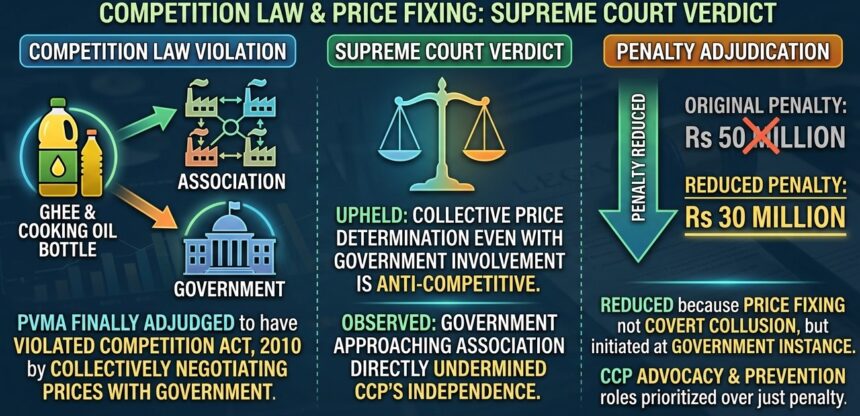
ISLAMABAD: The Supreme Court has upheld findings that the Pakistan Vanaspati Manufacturers Association (PVMA) violated competition law by collectively negotiating and fixing ghee and cooking oil prices with the Federal Government, though it reduced the penalty imposed on the association from Rs50 million to Rs30 million.
A two-member bench comprising Justice Jamal Khan Mandokhail and Justice Salahuddin Panhwar issued the verdict in response to appeal of the PVMA, assailing Competition Appellate Tribunal judgment of April 24, 2025, which had maintained Competition Commission of Pakistan (CCP) which imposed penalty on the appellant in 2011.
The case originated from a CCP show-cause notice issued in April 2011, alleging that PVMA had played a lead role in negotiating and fixing prices with the government on behalf of its members, in violation of the Competition Act, 2010. The Commission had also raised allegations concerning transport rate-fixing and discrimination between manufacturing units and commercial importers – both of which were resolved earlier in the proceedings.
The core dispute centered on whether PVMA’s consultations with the government between 2007 and 2009 during which it urged member mills to pass on the benefit of falling international palm oil prices to consumers amounted to a prohibited “decision” under Section 4 of the Act.
The PVMA’s counsel argued that the price reduction was made at the government’s request for public welfare, was merely recommendatory, and did not restrict competition among manufacturers. The Commission’s counsel countered that the association’s costing committee had been used to share commercially sensitive data and issue circulars binding member mills to uniform rates, thereby undermining independent pricing decisions.
The Court held that the collective determination of prices by an association, even at the government’s behest and even where consumers benefited in the short term, interferes with each undertaking’s obligation to independently set its own prices – a principle it noted is consistent with competition law in other jurisdictions, including the European Union.
The bench further observed that the government’s direct approach to the association, rather than routing the matter through the Commission, amounted to interference with the CCP’s statutory independence.
However, taking into account that the price negotiations were initiated at the government’s instance rather than through covert collusion, the Court found the original Rs50 million penalty excessive and reduced it to Rs30 million.
The Court also used the judgment to underline the Commission’s broader advocacy and preventive role, observing that enforcement and penalties should ordinarily be a measure of last resort rather than the primary tool of regulation.