

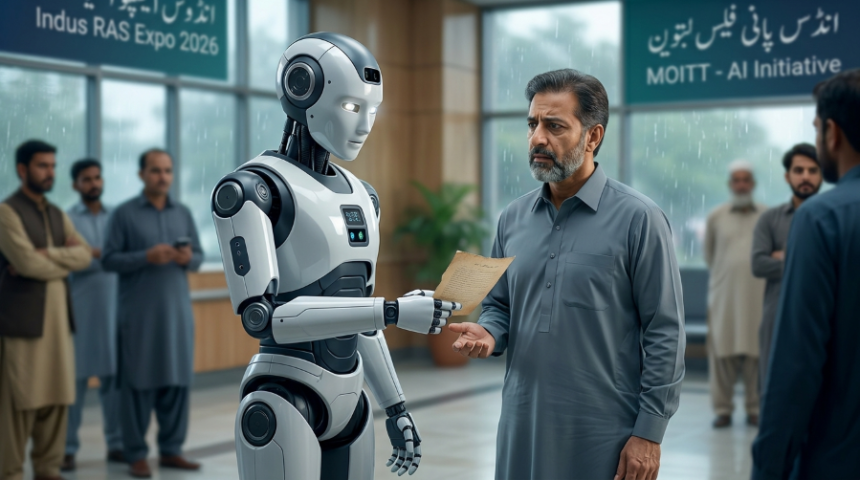

Is Pakistan preparing for Cyborgs? That would still be too early to say that. However, the country is definitely at a technological crossroads. In a nation where, as its own Economic Survey states, 28.9% of the population lives below the poverty line, such developments might appear to be at odds with the constitutional principles governing policy and with the aims of government goodwill.
Yet at the Indus RAS Expo 2026 the Ministry of IT and Telecommunications announced a clear step in the direction of creating machines that are able to navigate, perceive, and act in the physical world. As policymakers and technologists lead the country into this new age of intelligent machines, a basic challenge arises: Pakistan is moving forward with technologies that will have a close impact on everyday life without first properly addressing the fundamental issues concerning the ownership, control, and protection of personal data (as is the case with the pending Personal Data Protection Bill).
The form of Artificial Intelligence that we are familiar with has already been available on our screens for several years. It is now possible to ask it questions, have it do our homework, write our blog posts, produce creative images and advertisements, and even generate music. Yet we do not appear to be concerned about what happens to the information which we have just handed over. This was known as Generative AI. The next phase of AI will be different since it will have a physical body. The MOITT has already started this shift at the aforementioned Indus RAS Expo 2026. That programme specifically covered physical AI, drones, industrial automation, and human-machine collaboration. The point being made was that humanoid robots can any longer be regarded as something experimental; they are now becoming part of Pakistan’s emerging technology agenda.
Pakistan is introducing technological advances ranging from humanoid robots to autonomous drones and industrial automation. However, the system proposed to govern personal data is still caught in the cobwebs of red tape. Although it is important to keep pace with innovation, we must make sure that technology does not go beyond our protections of dignity, privacy, and control.
Embodied AI generally refers to AI systems that are incorporated into physical machines. Such machines are able to perceive their surroundings and act upon them in a way that is as human-like as possible (What does it mean to be human?). Robots that are fitted with cameras, microphones, depth sensors, navigation systems, and an AI model do not just process the information that is given to them; instead, they interpret it, learn from their experiences during interaction, and then take action themselves.
For instance, a hospital in Lahore could use embodied AI robots to deliver medical supplies to various departments, navigating the corridors with the help of sensors, recognizing staff members, and adapting to the daily routines. The importance of this distinction lies in the context of Pakistan: since such deployments could help hospitals with their logistics, enable agriculture to achieve better crop monitoring and maintenance, and improve the efficiency of factories, these domestic robots will eventually, after having processed huge amounts of data, be able to identify people, objects, routines, patterns, and behaviours.
The main issue is whether these robots will limit themselves to the data for which they have obtained explicit “consent”, or whether the data collected in one situation is going to be used to train a completely different model. It has been claimed that strong technical safeguards can make sure that data is used in an appropriate way and that anonymised data might adequately protect individual rights without preventing technological progress from moving forward.
Yet the US National Institute of Standards and Technology (NIST) has already warned of the dangers of re-identification and of increased behavioural tracking and surveillance. The Constitution of Pakistan is clear in regard to privacy and dignity; Article 14 states that they are inviolable, as do the judicial interpretations and court rulings from the Superior Courts. Therefore, even though technical solutions may provide certain protections, these legal issues are not something that belongs to the future; they are the questions we must raise and deal with as we develop new technologies.
The policy papers of Pakistan have recently begun to use more proactive language in order to stress the significance of new technologies. The National AI Policy 2025 states that the use of AI entails the processing of personal data and connects this point with the draft personal protection bill. The Islamabad AI Declaration of February 2026 goes further by advocating sovereign data stewardship, privacy, security, explainability, and auditability. Yet it must be understood that such policies are only promises and cannot take the place of enforceable rights.
Since these documents outline general aims and principles, they do not include clear mechanisms for accountability, specific timeframes for implementation, or detailed procedures for supervision and enforcement. Because no binding legislation has been put into effect, even though the government recognises the risks associated with surveillance and with improper access to data by both public and private bodies, it has not yet offered citizens any effective legal remedies or protections. Consequently, the regulatory framework remains fragmented: while the government is trying to foster an ecosystem for autonomous machines, the existing legal framework still fails to provide comprehensive and practical safeguards for handling citizens’ data (today’s petro-dollar equivalent).
It is wrong to treat privacy as being secondary to technological advancement. AI that is embodied must incorporate privacy from the very beginning. Specific policy measures are required: Pakistan should pass comprehensive data protection laws which require explicit consent before embodied AI collects data, impose strict rules on the localisation of data, and provide clear and enforceable procedures enabling individuals to challenge automated decisions and to obtain compensation when harmed.
There are still some questions to be answered: what data will be collected; how and where will it be stored and processed; will it be transferred outside of Pakistan; can the automated designs be challenged; and if people are harmed by these autonomous machines, who will be liable? Therefore, if the future of AI is to be embodied, shouldn’t our rights also be embodied?
—-
Muhammad Huzaifa is a final-year law student at Quaid-i-Azam University, Islamabad, currently working as an apprentice at a private company. He was previously selected as a U.S. Department of State-sponsored YES Scholar in the United States. He focuses his writing and research on emerging legal frameworks, privacy rights, and tech governance. He can be reached at muhammad.huzaifa.yes@gmail.com