Khudayar Mohla –
Speakers on Friday underscored the need for availing remedy from international legal system in order to include Indian Occupied Kashmir in the UN list of Non-Self Governing Territories (NSGT).
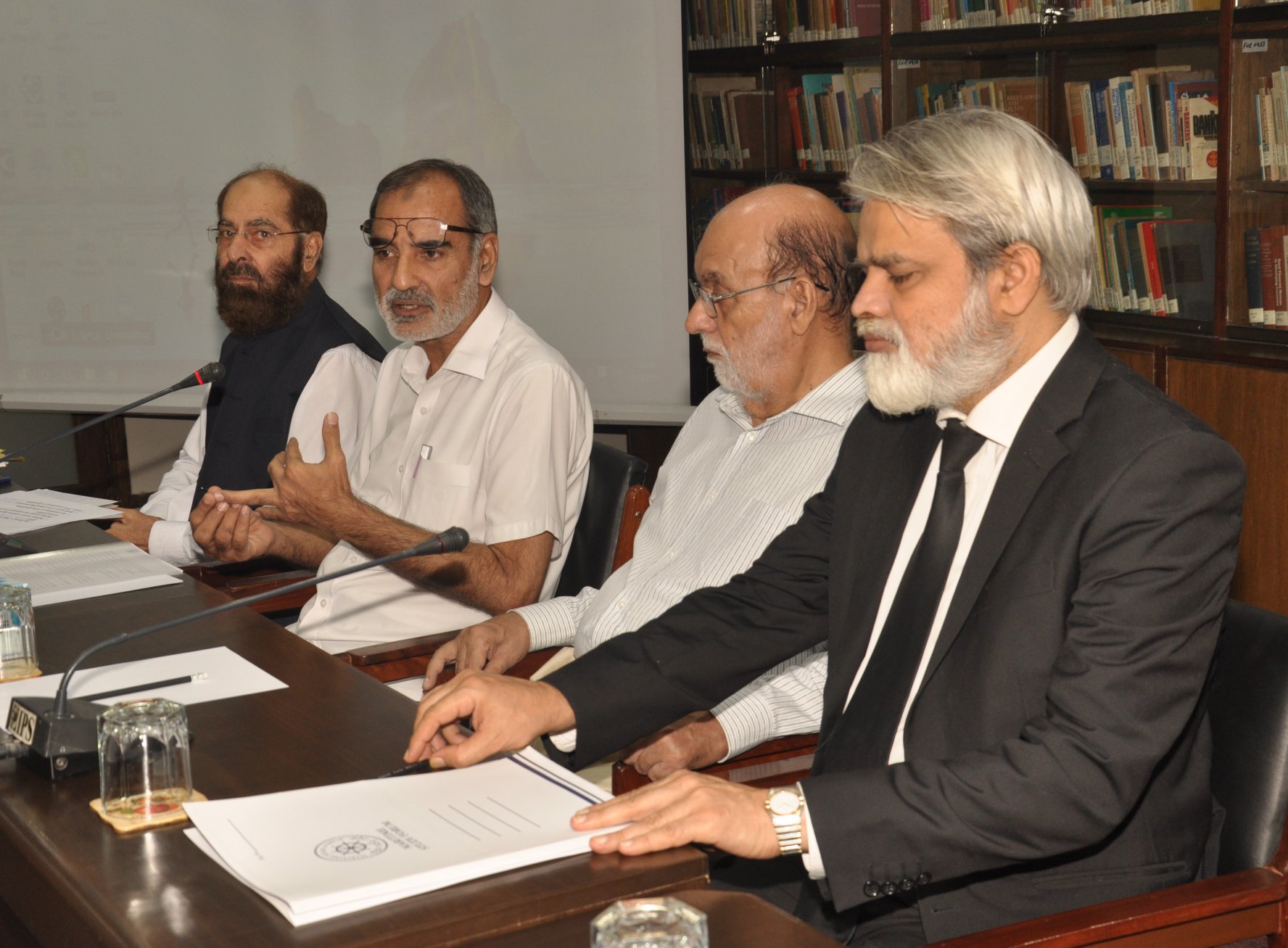
During a consultative session on ‘Evolving Situation in Kashmir’, held here at Institute of Policy Studies (IPS), Islamabad under the chair of Maj Gen. rtd Sardar Muhammad Anwar Khan, ex-president, Azad Jammu and Kashmir (AJ&K), speakers said that Articles 370 and 35-A were the only legal bridges linking Indian constitution with Jammu and Kashmir, and their abrogation by India has effectively made the region independent on technical grounds.
They expressed the situation provides ample opportunity to accentuate Kashmir cause internationally, availing which efficaciously can help setting the region and its people free from their decades old plight.
They were of the opinion that there were hundreds of options available for Pakistan to conduct the statecraft between peace and war. International legal system must be focused in order to find innovative ways for building a case for Indian Occupied Kashmir.
Speakers who deliberated on the occasion include; Executive President IPS Khalid Rahman, Sr. Defence Analyst Brig (r) Said Nazir, Amb (r) Abrar Hussain, Amb (r) Tajammul Altaf, Hurriyat Leader Ghulam Muhammad Safi, Dr. Syed Muhammad Anwer, former deputy attorney general of Pakistan, Abdur Rehman Usmani, CEO Al Hijrah Trust Pakistan, and Muhammad Ali, a renowned defence Analyst.
They added that Pakistan should seek to include Indian occupied Kashmir in the UN list of Non-Self Governing Territories (NSGT) – which are the territories that are governed by another country, are rarely allowed representations in the governing country’s legislature, and their people are yet to attain the full measure of self-governance.
The speakers were unanimous that Modi’s extremist actions have severed the bridge tying Indian constitution with Kashmir and now under the aegis of law, even the presence of a single Indian soldier in the valley would be regarded as an illegal occupation.
Commenting on the legal aspects of the Kashmir issue, the speakers highlighted that multiple petitions have been filed against the Indian actions of August 05 even in the Indian courts. This however must be remembered that the Indian courts are a part of the same system that supports occupant forces, and therefore no positive expectations should be attached with any component of the Indian system.
All the experts expressed that resources could also be mobilized to achieve membership of Kashmir in Unrepresented Nations and Peoples Organization. Highlighting the security dimensions of the Kashmir issue, the biggest challenge faced by India in occupied Kashmir, according to the speakers, was to control the ground situation, and the country was most likely to continue using its state machinery to the full extent for the purpose.
“Kashmiris on the other hand were doing a remarkable job braving more than half of the total of Indian military troops in their region, and in return, Pakistan needs to not only recognize the sacrifice of the people of Kashmir but should also seek to disperse the concentration of the Indian troops from Indian Occupied Kashmir, speakers maintained.
Pondering upon the question of war, the speakers stated that the logic suggests that India is not interested in initiating war outside Indian Occupied Kashmir, however it can try to create distractions here and there every now and then, making it essential for Pakistan to stay vigilant and prepared in a clear and visible manner for any kind of threat.
It was also stressed that any small success achieved by Pakistan over the Kashmir cause should only be seen as a small step and must not be blown out of proportion. The focus must remain on the freedom struggle of Kashmir, in the support of which Pakistan should openly announce the provision of every humanitarian and material help for Kashmiris purely on principle, humanitarian, moral and ethical grounds.