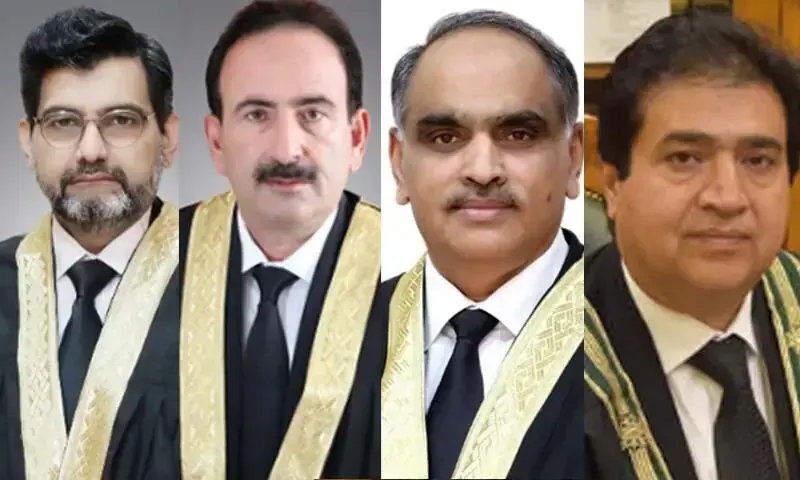
ISLAMABAD: The Judicial Commission of Pakistan (JCP), led by Chief Justice Yahya Afridi, approved four ad-hoc judge appointments on Monday – three for the Islamabad High Court and one for the Balochistan High Court. In the same session, the commission rejected the nomination of Justice Ayub Khan of the Balochistan High Court.
It has been reported that the JCP confirmed the appointment of three ad-hoc judges currently performing their duties at the Islamabad High Court despite a letter by JCP member and IHC senior puisne judge Mohsin Akhtar Kayani questioning the competence of his colleagues.
The JCP meeting at the Supreme Court, chaired by the chief justice of Pakistan, considered the names of Justice Mohammad Azam Khan, Justice Mohammad Asif, and Justice Raja Inaam Ameen Minhas from the IHC and Justice Najamuddin Mengal and Justice Ayub Khan from the BHC. Except for Justice Ayub Khan, all judges were cleared. In his letter to the CJP and the IHC chief justice, Justice Kayani, who is also a JCP member, opposed the confirmation of his colleagues. Sources said that the judge labelled the fellow judges as ‘incompetent’ and objected to their confirmation. They said the senior puisne judge had sought the record of these judges from the high court, but the progress reports were not shared with him.
During the meeting, the hit-and-run accident involving Justice Asif’s son also came up. The judge had found himself embroiled in a controversy following an accident by his underage son that killed two girls on the spot. IHC CJ Sarfraz Dogar and Justice Kayani appreciated that Justice Asif did not use his official position to influence the aggrieved family. Subsequently, Justice Kayani and Justice Munib Akhtar did not vote for him.
The commission, however, recommended, by majority, his confirmation, as well as that of Justice Khan and Justice Minhas, as IHC judges, after due consideration of the relevant data forms, antecedents, and evaluation of the material placed before it. Also, the judicial commission also recommended, by consensus of the present members, the confirmation of Justice Najamuddin Mengal as a judge of the Balochistan High Court, while the confirmation of another additional judge, Justice Ayub Khan, was not approved by majority on the report of the antecedent committee.
Dawn News reported that despite the strongly worded letter, the three additional IHC judges secured 13 votes each out of 17 votes. Two PTI members were absent from the JCP meeting, while two judges did not vote in their favour. Justice Khan and Justice Minhas were appointed as additional judges in the IHC on Jan 17 last year. Justice Asif was also appointed the same day as an additional judge of the Balochistan High Court. However, he was later transferred from the BHC to the IHC.
According to the official data, Justice Minhas decided the highest number of cases in 2025. His single-bench disposal stood at 2,039; Justice Khan decided 1,841 cases in the single bench, while Justice Asif decided 1,338 cases. CJ Dogar decided 1,236 cases, Justice Kayani 1,081, Justice Tariq Mehmood Jahangiri 706, Justice Babar Sattar 387, Justice Sardar Ejaz Ishaq Khan 347, Justice Arbab Mohammad Tahir 812, Justice Saman Rafat Imtiaz 685, and Justice Khadim Soomro 529.
Meanwhile, the JCP met in different compositions to deliberate on key institutional and policy matters, besides making recommendations for the confirmation of ad-hoc judges. It will meet again on Tuesday to confirm the appointment of 12 SHC judges. The commission also discussed the criteria for nominating judges of the constitutional benches of different high courts, policy decisions regarding the interview of candidates for the appointment of judges, and amendments to the Judicial Commission of Pakistan (Appointment of Judges) Rules 2024 for the inclusion of a provision for the appointment of judges of the FCC, as inserted by the 27th Amendment. Following deliberations, the JCP authorised the committee headed by Justice Aamir Farooq to place recommendations before it regarding the procedure for interviews, and amendments to the rules, ensuring effective and transparent implementation of the constitutional framework.