Categories Courts World

LHC Justice Jawad Hassan Underscores Arbitration Mechanism’s Importance at London Arbitration Week

LONDON – A day ago, Justice Jawad Hassan of the Lahore High Court (LHC) spoke as a key panelist at a highly regarded event at the London School of Economics and Political Science (LSE) during London Arbitration Week, where he underscored the critical importance of the Arbitration Mechanism for modern global justice and commerce.

Justice Hassan contributed his insights to the panel titled “From Award to Execution: Evolving Court Support in the Enforcement Stage,” where he addressed the crucial role national courts play in the post-award phase of arbitration. The  panel discussion focused on the legal and practical challenges of enforcing arbitration awards across different jurisdictions under the New York Convention. Justice Hassan delivered insights rooted in the context of South Asia, highlighting the progressive intent of the Pakistani judiciary to embrace international best practices in Alternative Dispute Resolution (ADR).

His core argument centered on the necessity of strong arbitration mechanisms and the supportive role required from national courts to ensure the effective enforcement of awards, which is crucial for enhancing investor confidence and facilitating the ease of doing business in countries like Pakistan.ustice Jawad Hassan, Lahore High Court, LHC, LSE, London School of Economics, London Arbitration Week, arbitration mechanism, global justice, commerce, international arbitration, judicial cooperation, enforcement of arbitral awards, Alternative Dispute Resolution, ADR, Pakistani judiciary, legal experts, Robin Knowles CBE, Can Eken, Crina Baltag, Paul McMahon, Saleem Raza Sheikh, investor confidence, ease of doing business, Pakistan, LSE Law School, academics, practitioners. Addressing the central themes of the panel – the tension between judicial intervention and party autonomy, and the evolving approach of courts toward recognition and execution – Justice Hassan expressed there is dire need to move towards a smart and time effective and system of disputes resolution. Terming ADR as crucial for growth, development and investment and to strengthen national institutions, Justice Hassan stressed the need for national courts to adopt a pro-enforcement judicial attitude toward arbitral awards, minimizing unnecessary intervention and procedural delays to uphold the fundamental principle of party autonomy underlying arbitration.

He underscored the importance of modernizing Pakistan’s arbitration law to align with globally accepted frameworks, such as the UNCITRAL Model Law, to assure international investors of a reliable and familiar legal environment consistent with the New York Convention’s goals.  Justice Hassan used to express , “We are turning out lawyers of adversarial mindsets; we need lawyers who are of pro-settlement mindset, it cannot be disputes all the time.

” It is pertinent to mention that Justice Hassan’s participation highlighted key lessons for practitioners and businesses relying on international arbitration, particularly regarding the necessary shift toward judicial efficiency and support for arbitral awards.  The LSE event brought together a distinguished group of legal experts from the UK, Europe, and South Asia to offer comparative perspectives on the complexities of post-award enforcement, including: Honourable Mr Justice Robin Knowles CBE (UK), Justice Jawad Hassan (Pakistan), Can Eken, Dr Crina Baltag, Paul McMahon and Saleem Raza Sheikh (Senior Partner).

The LSE Law School has hosted the event which was attended by both academics and practitioners, signaling continued engagement with the global arbitration community on matters of cross-border enforcement.




Author

Khudayar Mohla, Managing Partner Mohla & Mohla, Founder of the Law Today Pakistan,

Managing Partner at Mohla & Mohla - Advocates and Legal Consultants, Islamabad, Founder of The Law Today Pakistan (TLTP) Newswire Service. Former President Press Association of Supreme Court of Pakistan with over two decades of coverage of defining judicial moments - including the dissolution and restoration of Chief Justice Iftikhar Muhammad Chaudhry, Asif Ali Zardari NAB cases, Syed Yousaf Raza Gillani contempt proceedings, Panama Papers case against Mian Nawaz Sharif, matters involving Imran Khan, and the high treason trial of former Army Chief and President Pervez Musharraf. He now practises law and teaches Jurisprudence, International Law, Civil and Criminal Law. Can be reached at: mohla@lawtoday.com.pk

More From Author

Leave a Reply

Your email address will not be published. Required fields are marked *

You May Also Like

Khudayar Mohla, Sindh High Court, SHC Karachi, Federal Investigation Agency, FIA Pakistan, Pest Management Services (Private) Limited, Methyl Bromide import, illegal Indian imports, Justice Adnan Iqbal Chaudhry, Justice Abdul Mobeen Lakho, Enquiry No. ENQ-ACC-KHI-1/26, Imports and Exports (Control) Act 1950, Federal Investigation Agency Act 1974, Agricultural Pesticides Ordinance 1971, Section 160 CrPC, writ petition dismissal, jurisdictional challenge, forged import permits, trade with India, Anti-Corruption Circle Karachi, pesticide import regulations, chemical smuggling investigation, Paras Ali Lodhi, Saddam Hussain Chang, Shazia Hanjra Deputy Attorney General, Department of Plant Protection, Pakistan trade law, industrial chemical enquiry.

SHC Upholds FIA Jurisdiction in Probe into Prohibited Chemical Imports

KARACHI: While dismissing a plea seeking directives against the Federal Investigation Agency (FIA), a division…

Khudayar Mohla, Supreme Court Pakistan, Sindh High Court contempt case, contempt of court Pakistan, preliminary hearing requirement, Article 204 Constitution Pakistan, Contempt of Court Ordinance 2003, Supreme Court verdict 2026, SHC orders set aside, Justice Muhammad Ali Mazhar, Justice Hasan Azhar Rizvi, Justice Aqeel Ahmed Abbasi, Hira Rauf case, Mushtaq Ahmed case Pakistan, procedural law Pakistan, prima facie case law, contempt proceedings Pakistan, judicial procedure Pakistan, intra court appeal Pakistan, legal lapses in court orders, due process in contempt cases, Pakistan judiciary news, Supreme Court rulings Pakistan, constitutional law Pakistan, legal rights of accused contemnor

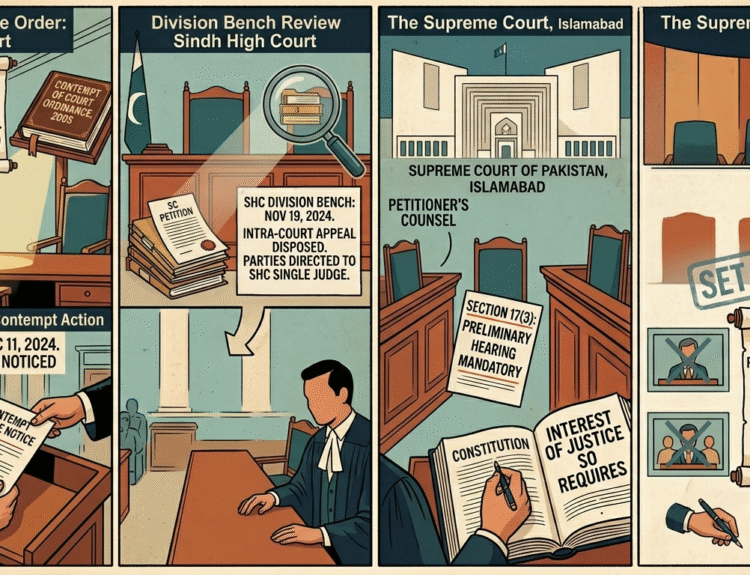
SC Sets Aside SHC Verdict, Rules Preliminary Hearing Mandatory Before Framing Charge in Contempt Proceedings

ISLAMABAD: The Supreme Court has set aside Sindh High Court orders in a contempt matter,…

khudayar Mohla, Justice Jawad Hassan,Sheikh Rasheed Ahmed, Sheikh Rasheed Umrah travel ban, Lahore High Court Rawalpindi Bench, LHC Rawalpindi verdict, Anti-Terrorism Court Pakistan, Section 28-A Anti-Terrorism Act 1997, ATA passport impoundment, Justice Jawad Hassan, Justice Tariq Mahmood Bajwa, Intra Court Appeal Pakistan, ICA No 76 2025, Division Bench LHC, passport impounded by operation of law, freedom of movement Article 15 Constitution Pakistan, reasonable restriction fundamental rights Pakistan, Provincial National Identification List, PNIL Pakistan, Exit Control List Pakistan, ECL Pakistan, no estoppel against law Pakistan, judicial estoppel Pakistan, writ petition LHC, constitutional jurisdiction High Court Pakistan, Additional Attorney General Pakistan, Federal Investigation Agency Pakistan, FIA passport impounding, anti-terrorism law Pakistan, charge-sheeted accused travel ban Pakistan, ATC permission travel abroad, Umrah travel permission Pakistan court, legislative intent Section 28-A, mandatory legal presumption ATA, appellate jurisdiction LHC, Law Reforms Ordinance 1972, Pakistan terrorism trial travel restrictions, criminal justice Pakistan, passport impounding terrorism accused, Sheikh Rasheed Ahmed court case, Sheikh Rasheed Ahmed 2025 2026, LHC sets aside Umrah permission, Pakistan court ruling travel ban, Pakistan High Court anti-terrorism verdict

LHC Rawalpindi Bench Sets Aside Sheikh Rasheed’s Umrah Travel Order, Rules ATC is Sole Authority for Passport Impoundment Under Anti-Terrorism Law

RAWALPINDI: While interpreting the legislative intent behind Section 28-A of the Anti-Terrorism Act, 1997, read…