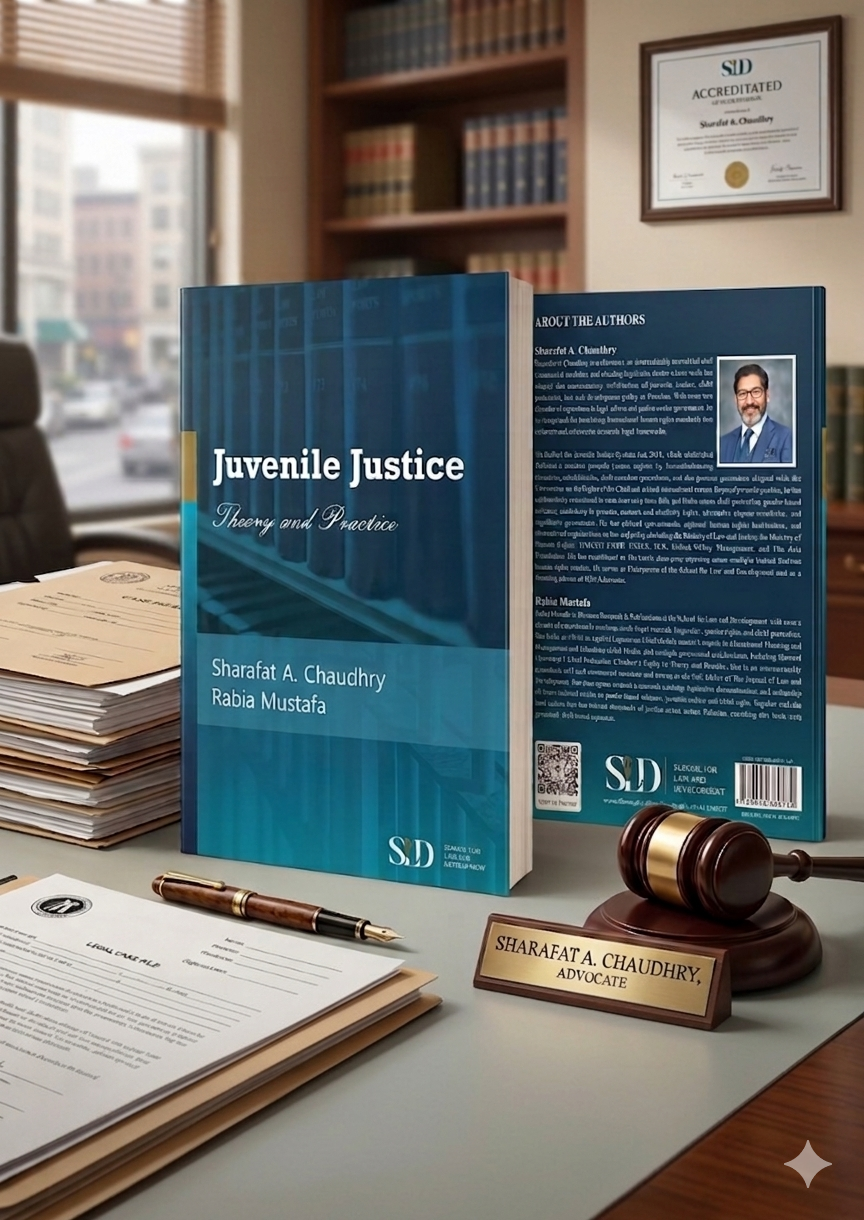
| Title | Juvenile Justice: Theory and Practice |
| Authors | Sharafat A. Chaudhry & Rabia Mustafa |
| Publisher | School for Law and Development (SLD) |
| ISBN | 979-968-23897-3-0 |
| Price | PKR 2,200 / USD 55 (Export) |
| Rating | ★★★★★ (5 / 5) |
“Written from the rare vantage point of someone who has not only studied juvenile justice but has supported design, operationalize, and defend it in practice – this book is both a scholarly achievement and a practitioner’s compass.”
OVERVIEW
Juvenile Justice: Theory and Practice is a landmark contribution to Pakistan’s legal and policy literature – one that arrives at a pivotal moment in the country’s child-rights journey. Published by the School for Law and Development (SLD), the book offers a rigorously grounded yet accessible account of juvenile justice as both a normative framework and a living institutional system. It is, in essence, the definitive guide to understanding how Pakistan has sought to transform its approach to children in conflict with the law, and where the road ahead leads.
The volume is distinctive not merely for its subject matter but for the authority its authors bring to it. Together, Sharafat A. Chaudhry and Rabia Mustafa fuse legislative draftsmanship, field-based training, socio-legal research, and academic scholarship into a single, cohesive intellectual project. The result is a work that practitioners, judges, advocates, academics, and policymakers will each find indispensable.
ABOUT THE AUTHORS
Sharafat A. ChaudhryAdvocate, internationally accredited civil-commercial mediator, and principal drafter of the Juvenile Justice System Act, 2018. With over two decades in legal reform, justice-sector governance, and legislative drafting, Chaudhry has shaped more than sixty Acts, Bills, and Rules spanning child protection, gender-based violence, trafficking, disability rights, and regulatory law. He serves as Chairperson of SLD and founding partner of HSU Advocates. |
Rabia MustafasDirector of Research and Publications at SLD and Sub-Editor of the Journal of Law and Development. Mustafa holds an MPhil in Applied Linguistics (Gold Medal), a Master of Education (Gold Medal), and qualifications in educational planning, TEFL, and civil-commercial mediation. Her scholarly portfolio spans gender justice, child rights, judicial backlog, and socio-legal research, enriched by over a decade of field engagement with Pakistan’s justice sector. |
SCOPE AND SIGNIFICANCE
The book’s central preoccupation is the Juvenile Justice System Act, 2018 — legislation that Chaudhry himself drafted through an inclusive consultative process spanning 2014 to 2018. The JJSA, 2018 marked a decisive shift in Pakistan’s treatment of child offenders: institutionalizing diversion, rehabilitation, and child-sensitive procedures in alignment with the Convention on the Rights of the Child and international human rights norms. By placing this statute at the heart of the book, the authors ensure that theoretical exposition is always anchored in enforceable legal reality.
What distinguishes this work is its comprehensiveness. Rather than treating juvenile justice in isolation, the authors situate it within Pakistan’s broader constitutional, legislative, and institutional ecosystem. The book draws on international human rights instruments – CRC, CEDAW, and multiple UN treaty body standards – while remaining attentive to the specificities of Pakistan’s federal and provincial legal architecture. Provincial implementing rules, territorial jurisdictions, and the practical challenges of implementation are addressed with the care of those who have lived these complexities firsthand.
INTERDISCIPLINARY DEPTH
Ms Mustafa’s contribution lends the book an important interdisciplinary dimension. Her background in applied linguistics, educational planning, and socio-legal research informs sections dealing with child psychology, communication in justice settings, and the pedagogical dimensions of judicial training. This is not a conventional black-letter law text; it engages with the social and human dimensions of justice in ways that enrich its utility for a wide readership.
Together, the authors have trained thousands of judges, prosecutors, police officers, lawyers, and government officials across Pakistan. This accumulated field knowledge permeates the book, giving it a texture and groundedness that purely academic treatments of the subject often lack. Cases, institutional challenges, and reform trajectories are rendered with the specificity of direct experience.
CONTRIBUTION TO THE FIELD
There is a persistent gap in Pakistan’s legal literature between statutory texts and their operationalization. Juvenile Justice: Theory and Practice does the essential work of bridging that gap. By bringing together drafting history, doctrinal analysis, procedural guidance, and reflective practice, the book equips justice actors with tools that go well beyond what bare legislation can provide.
The book also speaks to a global audience. Jurisdictions grappling with juvenile justice reform – particularly those seeking to align domestic frameworks with international children’s rights standards — will find in Chaudhry and Mustafa’s approach a model of how law reform can be conducted with rigour, inclusivity, and genuine commitment to the child’s best interest.
CRITICAL ASSESSMENT
The book’s greatest strength – its proximity to the legislative and institutional processes it describes – is also the source of its one potential limitation: readers seeking a detached comparative critique of the JJSA, 2018’s shortcomings may wish for a somewhat more adversarial analytical posture. However, this should not be overstated. The authors’ insider knowledge enables them to illuminate implementation challenges with a frankness and nuance that external commentators rarely achieve. The book reads as honest and clear-eyed, not as advocacy dressed in academic clothing.
Structurally, the work benefits from the authors’ evidently shared intellectual sensibility. There are no awkward seams between co-authored sections. The prose is clear, precise, and accessible – a notable achievement for a text that must navigate dense statutory and international legal terrain.
EDITORIAL VERDICTJuvenile Justice: Theory and Practice is essential reading for every stakeholder in Pakistan’s justice system – judges, lawyers, policymakers, academics, and child-rights advocates alike. It is a work of rare authority: historically grounded, legally rigorous, and humanely attentive to the children whose futures it ultimately concerns. The School for Law and Development is to be commended for producing a text that the field has long needed and will long rely upon. |
Review prepared on the basis of the book’s front matter, back cover, and “About the Authors” sections.