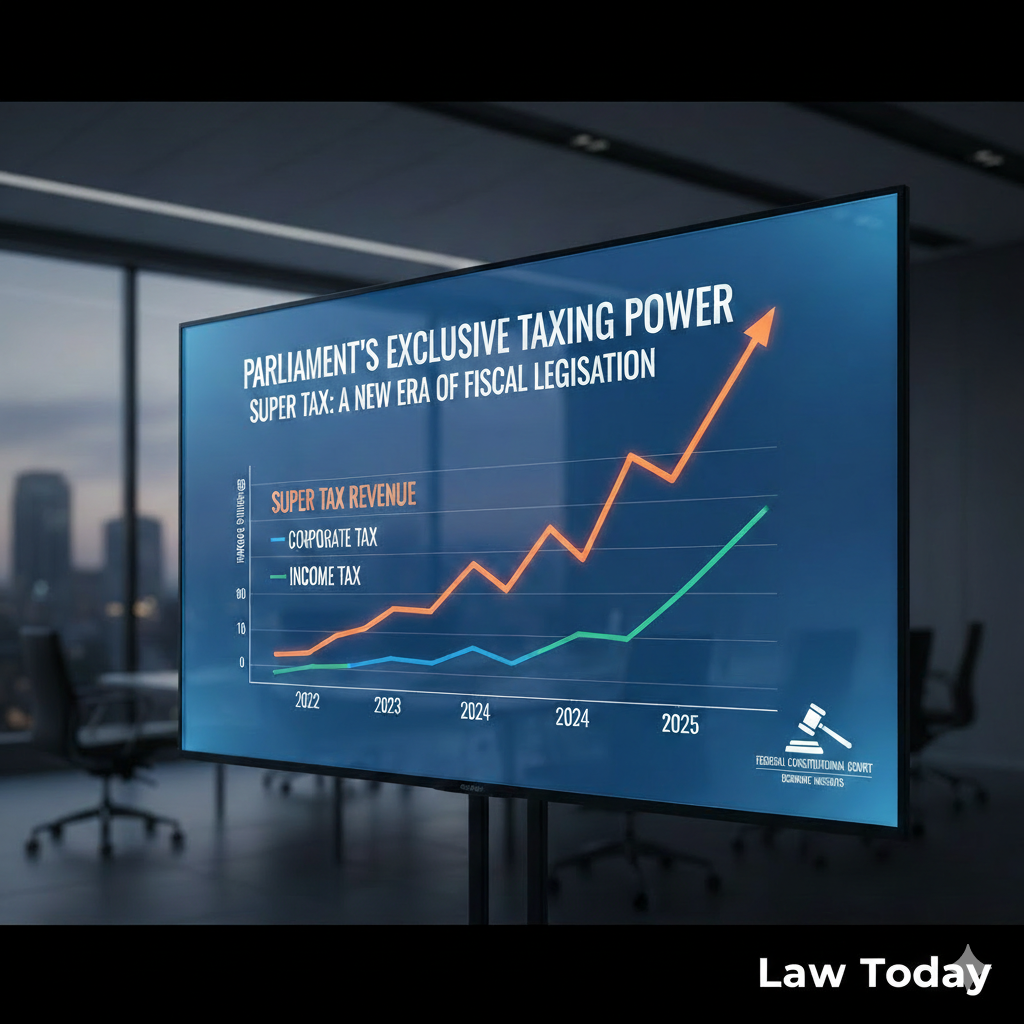
ISLAMABAD: A three-member bench of the Chief Justice Federal Constitutional Court Justice Amin-ud-Din Khan is currently hearing government appeals, challenging verdicts of Sindh, Lahore and Islamabad High Courts about legality of Section 4‑C of the Income Tax Ordinance, 2001 – commonly referred to as the ‘Super Tax’ – which imposes an additional levy on high-income earners.
Section 4‑C (Super Tax) was incorporated into the Income Tax Ordinance, 2001 by the Finance Act, 2022–23. During the proceedings, Federal Board of Revenue (FBR) counsel Asma Hamid submitted a list of 150 writ petitions filed in various high courts challenging the super tax. She argued that once a high court has upheld the validity of a legal provision, the same law should not be challenged in other high courts. She also alleged that Fauji Fertilizer continues to file petitions to obtain favorable rulings. The FBR counsel rejected claims that legal requirements were not fulfilled, stating that such requirements are addressed during court proceedings rather than during the legislative process. She added that it is not constitutionally mandatory to hear taxpayers before imposing taxes at the lawmaking stage.
She further noted that while petitioners cited US Supreme Court rulings, each country follows its own constitutional and legal framework. She informed the court that Pakistan’s Supreme Court has previously upheld the retrospective application of taxes. According to the FBR, a 29 percent normal income tax is currently in force, while the super tax represents an additional 10 percent charge and is legally payable.
Justice Hasan Azhar Rizvi raised questions regarding the treatment of expenses such as share-based operations, bank loans, and interest payments. The FBR counsel responded that these matters are clearly covered under the Eighth Schedule of the Income Tax Ordinance and have not been challenged. Appearing on behalf of the Secretary Revenue Division and the FBR, Advocate Hafiz Ahsaan Ahmad Khokhar advanced constitutional arguments in T.C. No. 1031/2025 and 225 connected matters, including 71 intra-court appeals, all transferred to the Constitutional Bench under Article 186-A of the Constitution following the 27th Constitutional Amendment.
Khokhar argued saying the Super Tax is a tax on income, not a fee or cess, and therefore fully within legislative competence. He argued that multiple fiscal levies on the same subject are constitutionally permissible where each is enacted under valid statutory authority. He submitted that Super Tax is expressly included within the definition of ‘tax’, making it an additional charge on high-income earners, akin to surcharge or advance tax, and not a parallel or independent impost.
While opposing taxpayers’ objections on the maintainability of the appeals, Khokhar contended saying under Article 99 of the Constitution and the Rules of Business, 1973, taxation and fiscal litigation fall within the exclusive domain of the Revenue Division and FBR, and revenue litigation is expressly excluded from mandatory consultation with the Ministry of Law and Justice or the Attorney General’s Office. Acts by Commissioners Inland Revenue, he added, are acts of the Federation itself, enjoying a strong presumption of legality. He further contended that the federation and the FBR lawfully filed appeals against the Islamabad High Court judgments on Super Tax (4C), raising substantial constitutional and fiscal questions.
Responding to the query of a member of the bench Justice Syed Hasan Azhar Rizvi whether any power was delegated to Commissioner-Inland Revenue to file petition before the High Court and the Supreme Court, the counsel submitted that by Article 186-A and the 27th Amendment, the cases were automatically transferred to the Federal Constitutional Court, requiring no fresh authorization. Advocate Khokhar maintained that under Rule 14-A read with Entry 35 of Schedule II of the Rules of Business, 1973, the Revenue Division and its attached department, the Federal Board of Revenue, hold exclusive responsibility for the administration, enforcement, and protection of federal taxes and revenues, which necessarily includes the power to initiate, prosecute, defend, and pursue litigation arising from fiscal statutes; without such litigation authority, the statutory allocation itself would be rendered ineffective.
Opposing the High Courts’ verdicts in the matter, Khokhar pointed out the Courts failed to adhere the settled principles governing the interpretation of the vires of law, adding the constitutional test for judicial review of legislation is limited to examining: (i) whether Parliament possessed legislative competence, and (ii) whether the enactment transgresses any express constitutional prohibition. Khokhar contended saying judicial review cannot extend to reassessing the wisdom, necessity, or fairness of fiscal measures. He argued the doctrine of reading down is meant only to preserve constitutionality, not to rewrite, reconstruct, or substitute the language of Parliament.
He further said that by overstepping into fiscal policy- an area constitutionally entrusted to the Legislature and Executive – the High Courts, he contended, transgressed the separation of powers and displaced the will of the people as expressed through their elected representatives. He submitted that financial enactments occupy a distinct constitutional footing, being the primary instrument through which the State mobilises resources and frames economic policy. Fiscal statutes involve complex economic assessments, distributive choices, and revenue exigencies, requiring judicial restraint and deference to legislative wisdom, as courts are institutionally unsuited to evaluate macroeconomic policy.
Opposing the double taxation claim, he argued that Section 4-C operates as a distinct charging provision “in addition” to normal income tax under Section 4, imposing an additional fiscal burden rather than re-taxing the same income. Khokhar clarified that a ‘Special Tax Year’ refers to self-contained or year-specific fiscal regimes, which do not limit Parliament’s authority to levy Super Tax within the ordinary tax year. On the point of past and closed transactions, and retrospectivity, the counsel emphasised that the levy of Super Tax under the Finance Act, 2022 was prospective; lawfully applicable to Tax Year 2022, as no vested right accrues until the return filing date under Sections 114 and 120 of the Ordinance. Fiscal statutes, unlike criminal laws, may validly operate retrospectively to meet revenue exigencies.
Concluding his arguments, the counsel submitted saying the High Courts’ judgments reflect judicial overreach into fiscal and policy domains, contrary to the principles of separation of powers. He urged the FCC to set aside the High Courts verdicts in the matter and prayed Section 4-C of the ITO, 2001 be upheld as intra vires the Constitution, lawful, and consistent with principles of taxation, distributive justice, and constitutional governance. The FBR counsels – Asma Hamid and Hafiz Ahsaan Ahmed Khokhar – and Additional Attorney General for Pakistan Aamir Rehman have completed their arguments on Monday. Later, the bench adjourned hearing of the matter till January 27, where Makhdoom Ali Khan is expected to furnish rebuttal arguments in the matter.