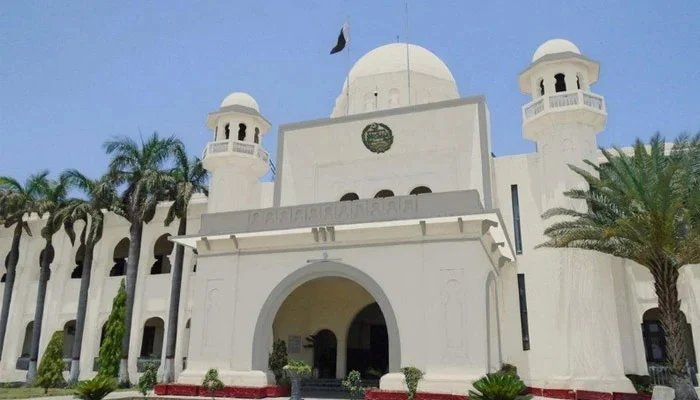
Announcing a landmark verdict in response to identical petitions challenging vires of Section 7E, Income Tax Ordinance, 2001, which imposes tax on Deemed rental income of property which is not rented, Peshawar High Court on Wednesday struck down the legislation while ruling that federal legislature has no power to make this law.
While striking down the legislation in the matter, a Divisional Bench of the PHC ruled, “The impugned legislation (Section 7E introduced through Finance Act, 2022 to the Ordinance), which imposes taxes on immoveable property through a deeming clause does not qualify the test of Capital Value of Assets, therefore, is beyond the legislative competence of the Parliament; hence, the same is hereby struck down”.
Former Member of the Provincial Assembly Ahmed Kundi , one of the petitioners has invoked jurisdiction of the PHC through counsels Barrister Umer Ijaz Gilani and Hamza Bangash. The petitioner, who is an activist for provincial rights has alleged that the said tax falls outside the competence of Federal Government.
It is worth mentioning that earlier during the year of 2022, the Federal Finance Act, 2022 inserted Section 7E in the Income Tax Ordinance, 2001. The new law mandated that every property which is not in the use of the owner, will be “deemed” by the FBR as a bearing a rent equivalent to 5% of the total market value to the property. This “deemed rental income” would be taxed at a rate of 20%. In simple words, every property owner would have to pay a tax equivalent to 1% of the market value of his property to the federal government.
Appearing before the Divisional Bench of Justice Roohul Amin and Syed Arshad Ali, counsel for petitioner argued that property tax has remained a provincial subject under all the various constitutions of Pakistan. Counsel further contended saying the even though tax levied under newly inserted Section 7E of the Income Tax Ordinance, 2001 has been cleverly disguised by the FBR as an “income tax”, it is not a tax on income. It is a property tax which only the province can levy. This is clear from entry 50 of the Federal Legislative List.
After hearing preliminary arguments of the Petitioner, the Court was pleased to issue notice to the Respondents and sought comments. Whereas after providing ample opportunity to both the parties in the matter a Divisional Bench of the PHC comprising Justice Abdul Shakoor and Justice Syed Arshad Ali announced a 33-page verdict in the matter.
According to facts of the case, petitioners being owners of immovable property were unhappy with the insertion of section 7E in the Income Tax Ordinance, 2001, which imposes a tax on the fair market value of their property as deemed income. They argue that this tax is unconstitutional, discriminatory, and confiscatory.
Appearing on behalf of federal government respondents’ counsels defend the validity of section 7E saying the tax is not on immovable property, but on the capital value of assets, which is within the legislative competence of the parliament. They also claim that the tax is based on a deeming provision that treats the property as income, which is permissible under the law.
The court also sought assistance from amicus curie and appointed two advocates as amicus curie to assist in the matter. They submit that the tax is in fact on immovable property, which is excluded from the federal jurisdiction after the 18th Amendment in the Constitution. They also assert that the tax is not on income, but on capital, which is contrary to the basic principle of direct taxation.
The copy of 33-page verdict in the matter available with TLTP transcribes the court examines the relevant constitutional provisions, the definition of income, the concept of deeming income, the meaning of capital value of assets, and the scope of exclusion of immovable property from taxation. The court also reviews the precedents from Pakistan and India on similar issues before announcing the judgment in the matter in hand.