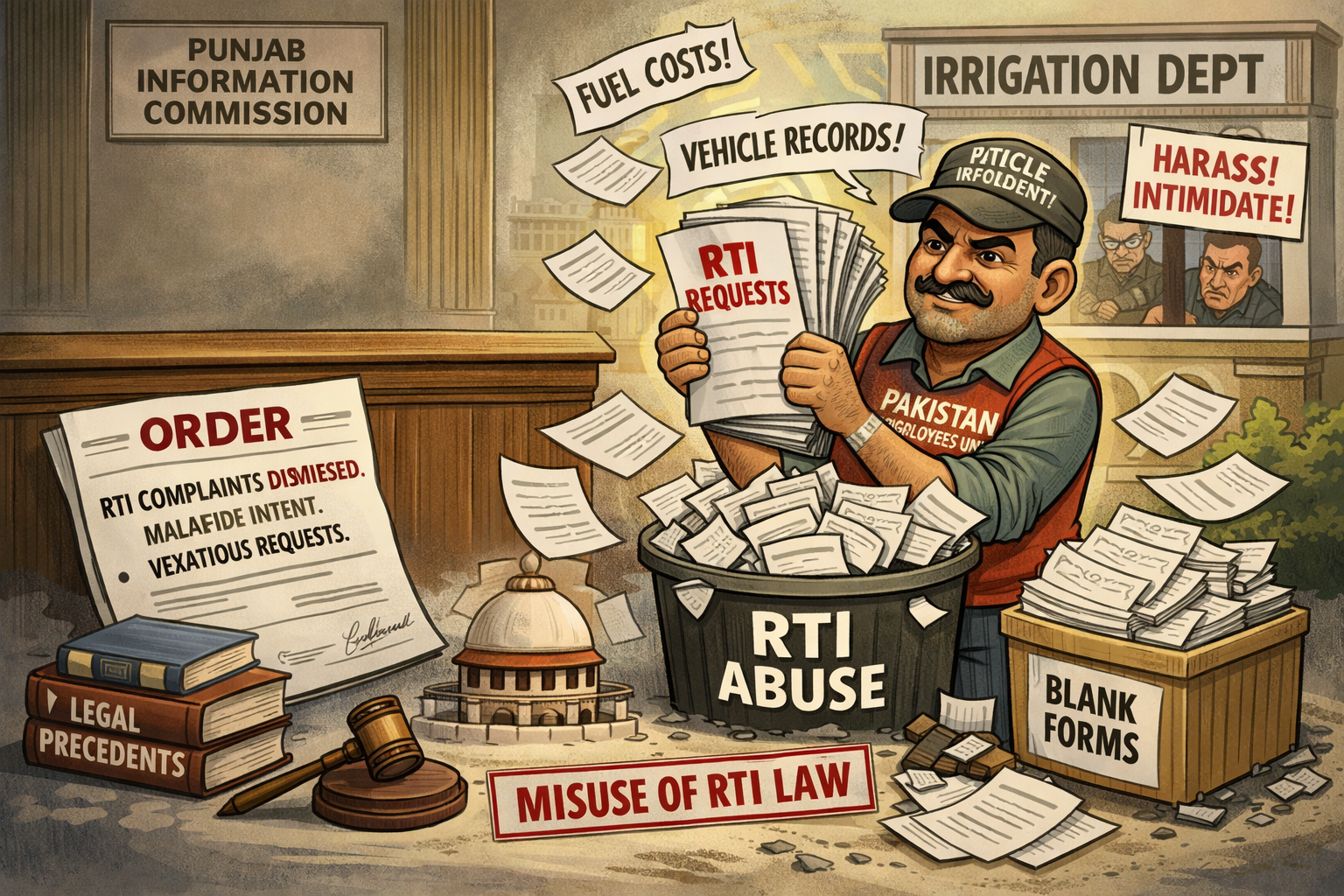
LAHORE: The Punjab Information Commission (PIC) has thrown out 35 Right to Information complaints filed against multiple offices of the provincial Irrigation Department, ruling that submitting large volumes of identical requests amounts to misuse of transparency law and demonstrates mala fide intent.
The order, issued on March 24 by Chief Information Commissioner Muhammad Malik Bhulla and Information Commissioner Bushra Saqib, marks one of the rare instances where the commission has explicitly characterised a complainant’s conduct as an abuse of the RTI framework rather than simply disposing of individual complaints on technical grounds, national media reported.
The ruling comes after the same complainant, Attique-ur-Rehman, had 45 earlier complaints against the same department disposed of by the commission on similar grounds. Far from deterring further filings, that outcome appeared to prompt a fresh round of applications targeting different offices of the Irrigation Department across Punjab.
On examination, the commission found all 35 requests had been prepared on a standard printed proforma, with only the name of the public body and the year inserted by hand. In at least one case, the attached RTI application was entirely blank, consisting solely of the printed template with no information request filled in whatsoever.
Beyond the pattern, the commission found the requests substantively deficient. Rather than identifying a specific project, work or vehicle, the applications broadly sought fuel costs and maintenance records of all departmental vehicles for a given year.
Such sweeping demands, the commission ruled, failed to meet the requirements of Section 10(3) of the Punjab Transparency and Right to Information Act 2013, which obliges applicants to clearly specify the information they seek. Vague, undefined requests of this nature, it held, do not qualify for relief under the law.
The complainant had filed the applications on the letterhead of the Pakistan Irrigation Employees (Power) Union, presenting himself as its office-bearer. However, during earlier proceedings the commission established that the union’s registration with the National Industrial Relations Commission had lapsed. When summoned to justify his claimed status, the complainant failed to provide a satisfactory explanation.
The Irrigation Department told the commission that Attique-ur-Rehman had a history of filing numerous complaints against it before various forums. The commission said this pattern, taken together with the identical nature of the requests, pointed firmly to an intent to intimidate the department rather than seek genuine accountability.
To reinforce its legal reasoning, the commission drew on judicial precedents from India, including the Supreme Court’s landmark 2011 ruling in CBSE vs Aditya Bandopadhaya, along with decisions of the Delhi High Court and the Central Information Commission. Those judgments established that repetitive RTI requests of wide scope can transform transparency legislation from a tool of public accountability into an instrument of harassment and oppression against public institutions.
The commission dismissed all 35 complaints on two counts – vagueness and vexatiousness – and issued a firm warning that the RTI law cannot be weaponised to harass public bodies. The ruling serves as a reminder that transparency legislation, while a vital democratic safeguard, carries with it a responsibility of good faith on the part of those who invoke it.