Categories Courts

SC Banishes ‘Faryaadi’ Culture and ‘Bakhidmat Janaab SHO’ Salutations to End Colonial Policing Legacies

ISLAMABAD: Announcing its 19-page landmark verdict , the Supreme Court made it clear that citizens approach police stations as a matter of legal right, not favour, and disapproved the use of terms like ‘Faryaadi’ and salutations such as “Bakhidmat Janaab SHO”, terming them colonial legacies with no place in the contemporary era.

A three-member bench of the top court, comprising Justice Muhammad Hashim Khan Kakar,  Justice Salahuddin Panhwar and Justice Ishtiaq Ibrahim ruled while deciding a criminal petition challenging conviction in murder case and appeal in the matter which the Sindh High Court dismissed.

Author judge of the verdict, the top court Justice Salahuddin Panhwar wrote a 19-page verdict in response to the criminal appeal in the matter.

The apex court undertook a detailed examination of police terminology, colonial legacies, and constitutional guarantees governing the criminal justice system. The Court held that the continued use of expressions portraying citizens as supplicants is legally misconceived and constitutionally impermissible.  Explaining the origins of the terminology, the Court noted that the word ‘Faryaadi, commonly used in Sindh, is derived from the Persian word Faryad, meaning a cry for help or lamentation, while ‘Muddai’, used in other parts of the country, originates from Arabic and implies a claimant or accuser.Supreme Court of Pakistan, FIR rights, Faryaadi term, Bakhidmat Janaab SHO, police terminology Pakistan, police reforms Sindh, Section 154 CrPC, citizens legal rights, criminal justice system Pakistan, colonial police legacy, police accountability, delayed FIR registration, Section 201 PPC, police officers duty, police public service, Itlaah Deendhar, Shikayat Kandhar, Itlaah Dahinda, Sindh police reforms, constitutional guarantees Pakistan, rights-based policing, criminal petition verdict, Sindh High Court, murder case appeal, Pakistan police procedure, criminal law Pakistan, top court landmark verdict, citizen protection law, law today Pakistan, Khudayar Mohla, Justice Muhammad Hashim Khan Kakar, Justice Salahuddin Panhwar, Justice Ishtiaq Ibrahim
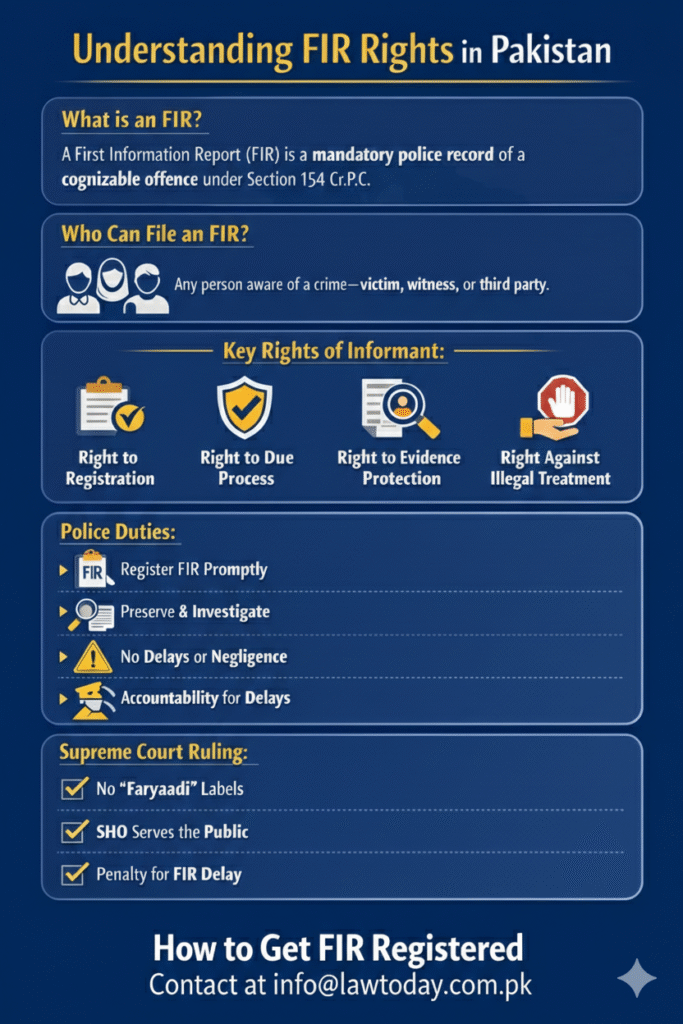
The bench observed that both terms wrongly suggest that a citizen seeks mercy from the police, whereas, in law, a person furnishing information of a cognizable offence is merely an informant, and the State becomes the complainant once an FIR is registered.

The Court categorically held that the Code of Criminal Procedure does not recognise any concept of supplication before police authorities. Under Section 154 Cr.P.C., the officer in charge of a police station is under a mandatory statutory duty to record information relating to a cognizable offence and set the law in motion.

Any failure in this regard, the Court said, offends the guarantees of due process and lawful treatment under Article 4 of the Constitution. Disapproving the routine use of phrases such as “Bakhidmat Janaab SHO”, the Court observed that sbuch addressals have no legal backing and reflect a feudal and colonial mindset inconsistent with constitutional governance. It emphasised that police officers are public servants paid from public funds, entrusted with the protection of life and liberty under Article 9 of the Constitution, and are duty-bound to serve citizens, not rule over them. Tracing the historical roots of such practices, the Court observed that the policing system introduced under the Police Act, 1861, particularly after 1857, was designed as an instrument of control rather than service.

In Sindh, the Court noted, the delayed introduction of civil and criminal laws and prolonged governance under martial law left enduring structural consequences, fostering practices resistant to rights-based reform. To align police practice with constitutional principles, the Supreme Court directed that the use of the terms Faryaadi’ and Muddai’ in police proceedings be discontinued. Instead, legally accurate alternatives such as ‘Itlaah Deendhar’ or ‘Shikayat Kandhar’ in Sindhi and ‘Itlaah Dahinda’ in Urdu were ordered to be used to reflect the true legal status of the person furnishing information.

The judgment also took serious notice of the persistent delay in registration of FIRs, particularly in Sindh. The Court warned that deliberate delay in registering an FIR may attract criminal liability under Section 201 of the Pakistan Penal Code, relating to the disappearance of evidence. It held that police officers enjoy no immunity and stand on the same legal footing as private citizens when accused of concealing or causing the loss of evidence.

Issuing directives to all the provincial police chiefs including Islamabad Capital Territory, the bench ordered for strict compliance to ensure prompt registration of FIRs, establish internal accountability mechanisms, and initiate departmental as well as criminal proceedings against delinquent officers.

All the provincial Prosecutor Generals were also directed to frame standard operating procedures in line with the Cr.P.C., while district courts were instructed to ensure that the term ‘Faryaadi’ is no longer used in judicial proceedings.

The bench directed to its concerned office to circulate the judgment to all High Courts, district courts, police chiefs, and prosecution departments across the country for guidance and implementation.

Author

Khudayar Mohla, Managing Partner Mohla & Mohla, Founder of the Law Today Pakistan,

Managing Partner at Mohla & Mohla - Advocates and Legal Consultants, Islamabad, Founder of The Law Today Pakistan (TLTP) Newswire Service. Former President Press Association of Supreme Court of Pakistan with over two decades of coverage of defining judicial moments - including the dissolution and restoration of Chief Justice Iftikhar Muhammad Chaudhry, Asif Ali Zardari NAB cases, Syed Yousaf Raza Gillani contempt proceedings, Panama Papers case against Mian Nawaz Sharif, matters involving Imran Khan, and the high treason trial of former Army Chief and President Pervez Musharraf. He now practises law and teaches Jurisprudence, International Law, Civil and Criminal Law. Can be reached at: mohla@lawtoday.com.pk

More From Author

Leave a Reply

Your email address will not be published. Required fields are marked *

You May Also Like

Khudayar Mohla, Islamabad High Court, IHC Justice Mohsin Akhtar Kayani, Zeeshan Masih jail appeal, life sentence murder case, single FIR multiple trials, double trial same incident, procedural illegality criminal trial, criminal administration of justice Pakistan, FIR legality Pakistan, Additional Sessions Judge Islamabad, deputation judges Lahore High Court, LHC deputation controversy, judicial competence Pakistan, murder trial procedural lapse, jail appeal Islamabad High Court, Prosecutor General Islamabad summoned, due process of law Pakistan, criminal justice system Pakistan, High Court supervisory jurisdiction, subordinate courts oversight, witness testimony recording, judicial training Pakistan, prosecutors training Pakistan, double jeopardy Pakistan, Section 403 CrPC, criminal procedure Pakistan, Islamabad courts news, Pakistan judiciary accountability, Law Today Pakistan news

IHC Questions ‘Grave Procedural Lapse’ as Single FIR Leads to Multiple Trials

ISLAMABAD:  While hearing a jail appeal of Zeeshan Masih – who is currently serving life…

FCC Super Tax verdict, Federal Constitutional Court Pakistan, Super Tax on high earners, Parliament taxing powers Pakistan, Section 4C Income Tax Ordinance, Super Tax legality Pakistan, Chief Justice Amin-ud-Din Khan, income tax law Pakistan, high income earners tax, oil and gas sector Super Tax, tax exemptions Pakistan, mudarabah Super Tax exemption, mutual funds tax exemption, unit trust funds Pakistan, retrospective taxation Pakistan, double taxation challenge, Supreme Court Super Tax case, High Courts Super Tax ruling, constitutional amendments Pakistan, 26th Constitutional Amendment, 27th Constitutional Amendment, revenue generation Pakistan, Rs310 billion revenue, Pakistan tax litigation, business community tax challenge, banks Super Tax Pakistan, corporate taxation Pakistan, federal budget Super Tax, economic stabilisation measures Pakistan, Operation Zarb-e-Azb levy, internally displaced persons fund, tax policy Pakistan, constitutional bench Pakistan, Khudayar Mohla

FCC Validates Parliament’s Legislative Competence To Levy Super Tax

ISLAMABAD: While dismissing all pleas challenging legality of the Super Tax on high-income earners, the…

Khudayar Mohla, Islamabad High Court, IHC, Islamabad Local Government elections, local government election petitions, Election Commission of Pakistan, ECP, presidential ordinance, Islamabad Capital Territory, ICT local government, Jamaat-e-Islami, JI, Mohammad Nasrullah Randhawa, Advocate Chaudhry Shoaib Ahmed, local bodies term, constitutional obligation, local government election delay, Islamabad LG polls, ICt Local Government Amendment Ordinance 2026, President Asif Ali Zardari, Articles 17, 32, 89, 140-A, election schedule withdrawal, court adjournment, bench unavailability, deferred hearing, joint petitions, Markazi Muslim League

IHC Adjourns Islamabad LG Election Pleas After Court Roster Cancelled

ISLAMABAD:  A scheduled hearing for the Islamabad Local Government (LG) election petitions was deferred Tuesday…