While announcing much awaited verdict relating to legality of Amendment in National Accountability Ordinance (NAO) 1999 Friday, a five-member larger bench of the Chief Justice of Pakistan Qazi Faez Isa declared the Amendments constitutional observing the top court has nothing to do with interference in jurisdictions of the country’s constitutional institutions or to act as the gatekeeper of Parliament.
This verdict has been pronounced in response to Intra Court Appeals (ICA) and Civil Misslionious Applications (CMA) of federal government and others includings Pakistan Tehreek-e- Insaf leader Imran Khan before the top court whereas any aggrieved by this judgment can file review petition under Article 188 of the Constitution before the Supreme Court.
It has been stated in a 16-page verdict in the matter, “The Constitution has set out the respective roles of the Legislature and that of the Judiciary and every care should be taken to ensure that neither encroaches onto the domain of the other. Constitutional institutions better serve the people when they respect each other and perform the functions respectively granted to them by the Constitution. The Chief Justice and the Judges of the Supreme Court are not the gatekeepers of Parliament”.
However, one of the judges in the bench hearing the ICA, Justice Athar Minallah rejected the federal government’s appeal while approving the remaining appeals. In his separate note in the verdict Justice Minallah expressed noting that the appeal filed by the Federation was not valid under the Supreme Court (Practice and Procedure) Act, 2023, and dismissed it.
Justice Minallah said that the appeals by private appellants were deemed maintainable and were allowed, resulting in the impugned judgment (by then CJP Bandial) being overturned. He further stated “Consequently, the impugned judgment is set aside. Moreover, the opinion recorded in the minority judgment is affirmed to the effect that members of the Armed Forces and Judges of the constitutional courts are not immune from accountability under the National Accountability Ordinance, 1999”.
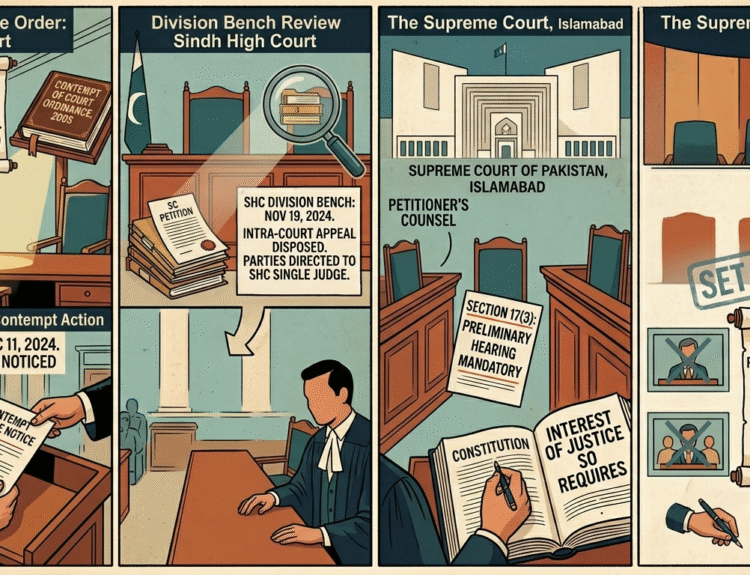
Three months ago, on June 6 a five-member bench comprised Chief Justice of Pakistan (CJP) Qazi Faez Isa, Justice Amin-ud-Din, Justice Jamal Mandokhail, Justice Athar Minallah, and Justice Hassan Azhar Rizvi has reserved the verdict in response to Intra Court Appeals of federal government and other parties including incarcerated leader of the Pakistan Tehreek-e-Insaf Imran Khan. It is worth noting that in September 2023, a three-member bench led by the then-CJP Umar Ata Bandial had nullified the NAB Amendments in response to a petition filed by former Prime Minister Imran Khan.
The CJP specified in operative part of the verdict saying the legislature holds exclusive authority to make laws, and such laws remain valid unless declared unconstitutional by a competent court. He added judicial bodies cannot overrule or disregard legislation simply because they believe it could be improved, reinforcing the need to respect Parliament’s authority in lawmaking.
Post Scenario of the SC Verdict:
In post scenario of the top court decision, the Amendments of 2022 to the NAB Ordinance will become operative as have been restored to their original state which the top court declared illegal in 2023. Giving reasons to declare the Amendments valid in the law, the CJP Qazi Faez Isa stated, “These Amendments are neither against the Constitution nor in violation of fundamental human rights.” The judgment further emphasized that “Parliament has the authority to legislate, and former Prime Minister Imran Khan has failed to prove that these Amendments are unconstitutional.”
Back in days, the National Accountability Bureau (NAB) law underwent as many as 27 Amendments during Pakistan Democratic Movement (PDM) government which called for a joint session of the National Assembly and Senate in June 2022 to secure the bill approval while the then President Arif Alvi declined to sign the bill. The legislation significantly has reduced NAB’s jurisdiction, excluding several types of cases from its purview as it was stated that these Amendments would have retrospective effect from inception of the National Accountability Ordinance (NAO) 1999.
One of the key Amendments specified that NAB could no longer investigate cases involving sums less than Rs500 million. Furthermore, NAB could only pursue fraud cases if the number of affected individuals exceeded 100. Additionally, the Ordinance reduced the maximum remand period an accused could be held by NAB from 90 days to 14 days, although later Amendments extended this to 30 days.
Following these changes, the NAB was barred from taking action on federal, provincial, or local tax matters, as well as cases involving regulatory bodies operating within the country. The bill also dictated that all pending inquiries, investigations, trials, or proceedings related to individuals or transactions under the NAO would be transferred to the relevant authorities, departments, and courts as per their respective laws.
Moreover, the Amendments reduced the term of office for both the NAB chairman and the Prosecutor General by one year, limiting it to three years. It was also established that upon expiry of the chairman’s term, the NAB deputy chairman would serve as the acting chairman until a new appointment was made.