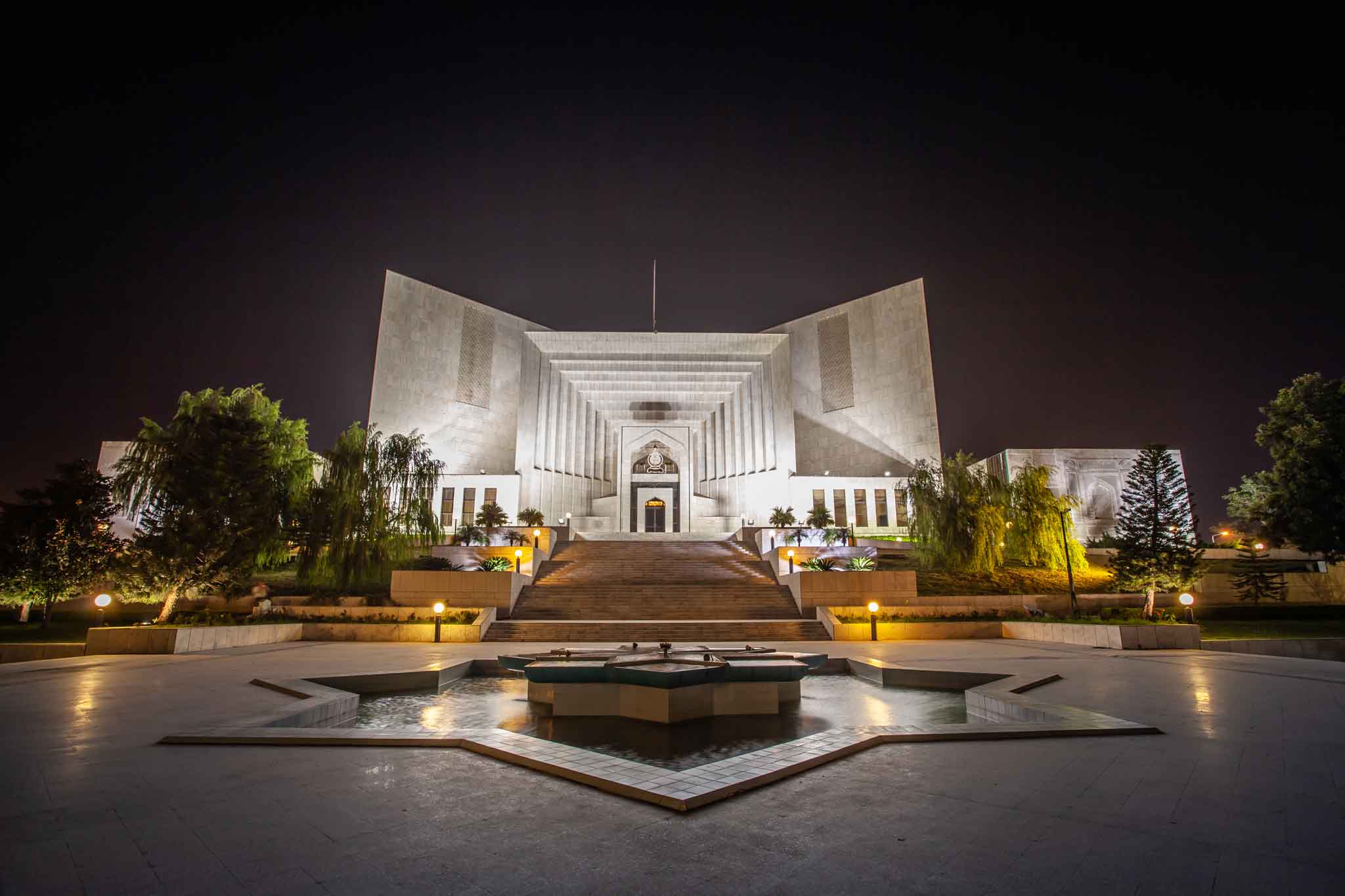
ISLAMABAD:While granting post-arrest bail to two accused in a case involving illegal transfer of Rs24 billion through hawala channels, the Supreme Court urged courts across the country to accelerate disposal of bail applications. It also sought swift trials to lessen the burden on overcrowded prisons as prolonged incarceration undermines constitutional safeguards.
The observation came in a five-page judgment authored by Justice Muhammad Hasham Kakar while granting post-arrest bail to two accused persons in a case related to the alleged illegal transfer of Rs24 billion through hawala channels. The ruling also placed the issue within the broader crisis facing the criminal justice system. A five-page judgment authored by Justice Muhammad Hasham Kakar granted a post-arrest bail to two accused persons in a case related to the illegal transfer of Rs24 billion through hawala channels.
“We find it extremely necessary to state here that the prisons in Pakistan are facing extreme overcrowding with most prison facilities operating beyond their official capacity,” the ruling observed. According to the prison data report for 2024, the prison population is stated to be 152.2% overcapacity on average. “More concerning is that the under-trial prisoners account for almost a quarter of the prisoners ie 73.41% of the total prison population. In such circumstances, courts must adjudicate the bail applications with heightened sensitivity to these figures and prioritise the swift disposal of trials.”
“Such measures are imperative to overcome unprecedented overcrowding in prisons and uphold the fundamental sanctity of the criminal justice system in Pakistan.” One petitioner, in his capacity as director accounts, has been implicated in the concealment and attempted destruction of incriminating records. Similarly, the other petitioner has been identified as the primary Hawala operator and conduit, allegedly facilitating the offshore settlement of large-scale cash withdrawals in violation of the provisions contained in the Act of 1947.
The court noted that the main offence for which the petitioners have been nominated is section 23 of the Act of 1947, where the offence is currently punishable with rigorous imprisonment for a term which may extend to five years, or with fine, or with both. It is relevant to state that previously the punishment for the said offence was simple imprisonment extendable up to two years, or fine, or both, and the same was amended in 2020 through Act No. X of 2020 with effect from 27.02.2020.
The date of occurrence as per the FIR is between the years 2007 and 2015, which predates the 2020 amendment. “As per the protections guaranteed by Article 12 of the Constitution of the Islamic Republic of Pakistan, 1973, no law shall authorise the punishment of a person for an offence by a penalty greater than, or of a kind different from, the penalty prescribed by law for that offence at the time the offence was committed.” “At a glance, protection against retrospective punishment as provided in Article 12 of the Constitution might appear as a notion dealing with procedural requirement, however it not as such.”
The ruling stressed that Article 12 of the Constitution does not state any procedural requirement of ordinary course, rather it is one of the fundamental rights and a highly guarded substantive right which is not to be taken lightly. “This doctrine concerning ex post facto laws is well recognised in almost all jurisdictions with respect to administration of criminal justice.” “As per well recognised legal encyclopaedia of American law i.e. Corpus Juris Secundum, an ex post facto law is one which makes criminal and punishes an act which was done before the passage of the law and which was innocent when done, aggravates a crime or makes it greater than it was when committed, changes the punishment and inflicts a greater punishment than was prescribed when the crime was committed, or alters the legal rules of evidence and receives less or different testimony than was required to convict at the time the offence was committed.”
Further, an ex post facto law may be one which, assuming to regulate civil rights and remedies only, in effect imposes a penalty or the deprivation of a right for something which, when done, was lawful, deprives persons accused of crime of some lawful protection or defence previously available to them, such as the protection of a former conviction or acquittal, or of a proclamation of amnesty, or, generally, in relation to the offence or its consequences, alters the situation of an accused to his material disadvantage. “Protection against such penal legislation is also provided by the Convention for the Protection of Human Rights and Fundamental Freedoms, which was signed by members of the Council of Europe in 1950, and later ratified by the United Kingdom.”
“The convictions and sentences to be recorded in the criminal jurisdiction under ex post facto law are also prohibited under Article 12 of the Constitution and well recognised by this court in its various judgments. The benefit of the said interpretation must also be extended to an accused not only at the stage of trial but also at the stage of bail,” the judgment further noted. “Clearly, in the instant case, the offence was allegedly committed at the time between years 2007 and 2015, therefore, the punishment for the offence under section 23 ibid would be considered as two years or fine or both.”
The order further stated that the next important aspect is the nature of the offence, which, although non-bailable under section 23 ibid, for the purposes of the instant case entails punishment of two years, or fine, or both. The principles laid down by the court regarding the grant of bail in non-bailable offences are well settled. The judgment noted that bail will be declined only in extraordinary and exceptional cases – for example, where there is a likelihood of abscondence of the accused, apprehension of tampering with prosecution evidence, danger of the offence being repeated if the accused is released on bail, or where the accused is a previous convict.
“The said principles were reiterated and reaffirmed by this court in various judgments. In the instant case, the offence entails punishment of two years or fine or both which does not fall within the prohibitory clause of the section 497 of the Code.” “Similarly, no extraordinary and exceptional circumstances have been pointed out before us to decline the relief of bail. In addition to this, we have also noted that the case of prosecution is based on documentary evidence and no valid ground has been raised before us to show that the petitioners are personally are required for further investigation. In such circumstances grant of bail is rule and refusal an exception.”