Categories Courts

SC Launches ‘Public Facilitation Portal’ to Revolutionize Access to Justice

ISLAMABAD – Taking a significant step toward judicial accessibility, the Supreme Court of Pakistan has launched its new Public Facilitation Portal, which is now live on the Court’s official website under the ‘Public Portal’ link. Developed under the special directions of the Chief Justice of Pakistan, the interactive online gateway bridges the gap between citizens and the judiciary.

The initiative aims to bridge the gap between citizens and the judiciary, simplifying access to justice for every individual regardless of their location, background, or profession. This digital transformation moves the Supreme Court from a formal, distant entity to an approachable and responsive service platform.

Key Features Enhancing Transparency and Ease of Use

The portal is a comprehensive tool featuring several modules designed to streamline judicial interaction:

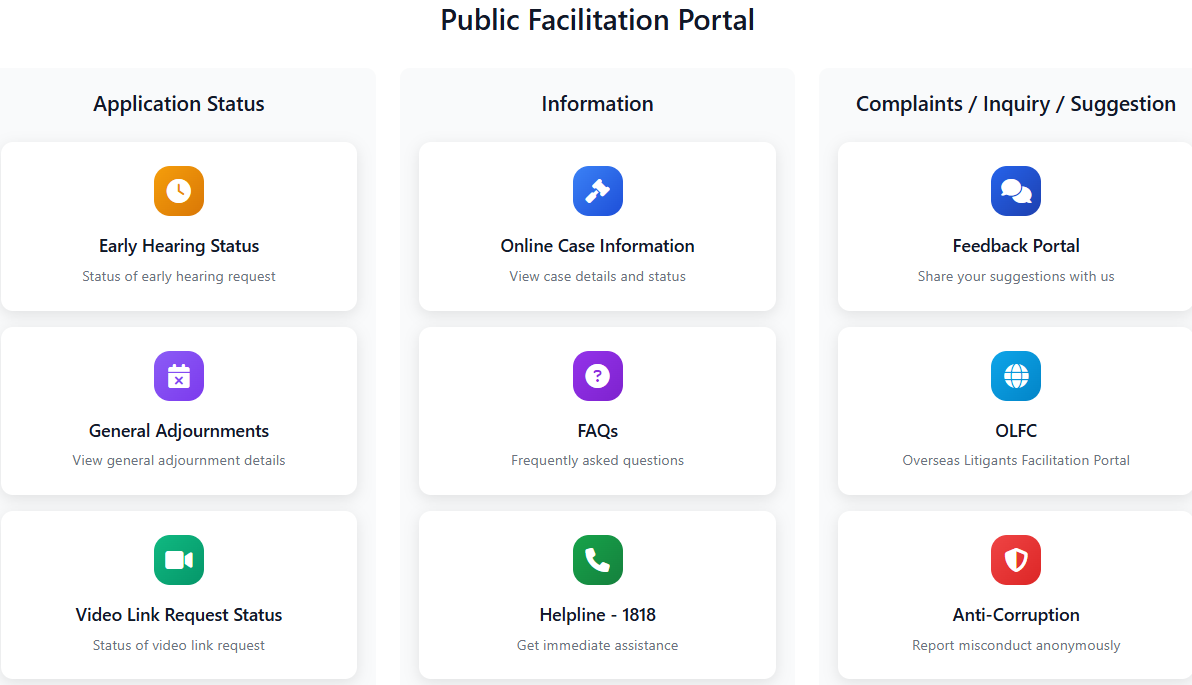
  • Cases Information: Users can conveniently search for case details by name, case number, or petition type, a service that previously often required in-person visits. The section also includes a Helpline 1818 for real-time guidance, technical support, and resolution of procedural queries. Furthermore, a detailed Frequently Asked Questions (FAQs) section explains complex judicial terms and procedures in plain language, empowering citizens without legal representation.
  • Applications Status: This module provides a seamless digital mechanism for the real-time monitoring of key applications, including Early Hearing Requests, General Adjournments, and Video Link Petitions. Litigants can track their requests from submission to decision, which significantly reduces the need for follow-up visits and written correspondence, ultimately cutting down on administrative delays. Critically, this feature ensures that overseas Pakistanis and those from remote regions can stay fully connected with their case progress without physical presence.
  • Complaints and Enquiries & Accountability: This cornerstone of institutional accountability includes a Feedback Portal for users to register grievances, submit feedback, or share improvement suggestions. The Anti-Corruption Reporting mechanism offers a confidential channel for the public to report unethical practices, reinforcing the SCP’s zero-tolerance stance against misconduct.
  • Overseas Litigants Portal: Extending judicial facilitation globally, this specific portal enables Pakistani nationals living abroad to securely communicate with the Court, monitor their cases, and lodge requests.

A New Era of Openness

The launch of the Public Facilitation Portal marks a new era of openness and accessibility in Pakistan’s justice system. By putting court services at every citizen’s fingertip, the Supreme Court is realizing its vision of justice without barriers, ensuring that the process is not only delivered but is also visible, understandable, and reachable.

The initiative, which exemplifies a responsive, transparent, and people-driven judiciary, ensures that the voice of every citizen is heard and respected within the framework of justice, stated in a press release.

 

Author

Khudayar Mohla, Managing Partner Mohla & Mohla, Founder of the Law Today Pakistan,

Managing Partner at Mohla & Mohla - Advocates and Legal Consultants, Islamabad, Founder of The Law Today Pakistan (TLTP) Newswire Service. Former President Press Association of Supreme Court of Pakistan with over two decades of coverage of defining judicial moments - including the dissolution and restoration of Chief Justice Iftikhar Muhammad Chaudhry, Asif Ali Zardari NAB cases, Syed Yousaf Raza Gillani contempt proceedings, Panama Papers case against Mian Nawaz Sharif, matters involving Imran Khan, and the high treason trial of former Army Chief and President Pervez Musharraf. He now practises law and teaches Jurisprudence, International Law, Civil and Criminal Law. Can be reached at: mohla@lawtoday.com.pk

More From Author

Leave a Reply

Your email address will not be published. Required fields are marked *

You May Also Like

FCC Super Tax verdict, Federal Constitutional Court Pakistan, Super Tax on high earners, Parliament taxing powers Pakistan, Section 4C Income Tax Ordinance, Super Tax legality Pakistan, Chief Justice Amin-ud-Din Khan, income tax law Pakistan, high income earners tax, oil and gas sector Super Tax, tax exemptions Pakistan, mudarabah Super Tax exemption, mutual funds tax exemption, unit trust funds Pakistan, retrospective taxation Pakistan, double taxation challenge, Supreme Court Super Tax case, High Courts Super Tax ruling, constitutional amendments Pakistan, 26th Constitutional Amendment, 27th Constitutional Amendment, revenue generation Pakistan, Rs310 billion revenue, Pakistan tax litigation, business community tax challenge, banks Super Tax Pakistan, corporate taxation Pakistan, federal budget Super Tax, economic stabilisation measures Pakistan, Operation Zarb-e-Azb levy, internally displaced persons fund, tax policy Pakistan, constitutional bench Pakistan, Khudayar Mohla

FCC Validates Parliament’s Legislative Competence To Levy Super Tax

ISLAMABAD: While dismissing all pleas challenging legality of the Super Tax on high-income earners, the…

Khudayar Mohla, Islamabad High Court, IHC, Islamabad Local Government elections, local government election petitions, Election Commission of Pakistan, ECP, presidential ordinance, Islamabad Capital Territory, ICT local government, Jamaat-e-Islami, JI, Mohammad Nasrullah Randhawa, Advocate Chaudhry Shoaib Ahmed, local bodies term, constitutional obligation, local government election delay, Islamabad LG polls, ICt Local Government Amendment Ordinance 2026, President Asif Ali Zardari, Articles 17, 32, 89, 140-A, election schedule withdrawal, court adjournment, bench unavailability, deferred hearing, joint petitions, Markazi Muslim League

IHC Adjourns Islamabad LG Election Pleas After Court Roster Cancelled

ISLAMABAD:  A scheduled hearing for the Islamabad Local Government (LG) election petitions was deferred Tuesday…

Khudayar Mohla, Section 4-C, Super Tax Pakistan, Income Tax Ordinance 2001, ITO 2001, Finance Act 2022–23, high-income taxpayers, Federal Board of Revenue, FBR Pakistan, Federal Constitutional Court, FCC Pakistan, government appeals, Hafiz Ahsaan Ahmad Khokhar, constitutional validity, judicial review Pakistan, taxation authority, double taxation, retrospective tax, separation of powers, Pakistan tax law, federal revenue

Levy of Super Tax Within Parliament’s Exclusive Taxing Power, Govt Lawyers Argue Before FCC

ISLAMABAD: A three-member bench of the Chief Justice Federal Constitutional Court Justice Amin-ud-Din Khan is…