Categories Courts

SC Protects Wife’s Dower in Illegal Second Marriage Case, Orders Rs1.2m Dower

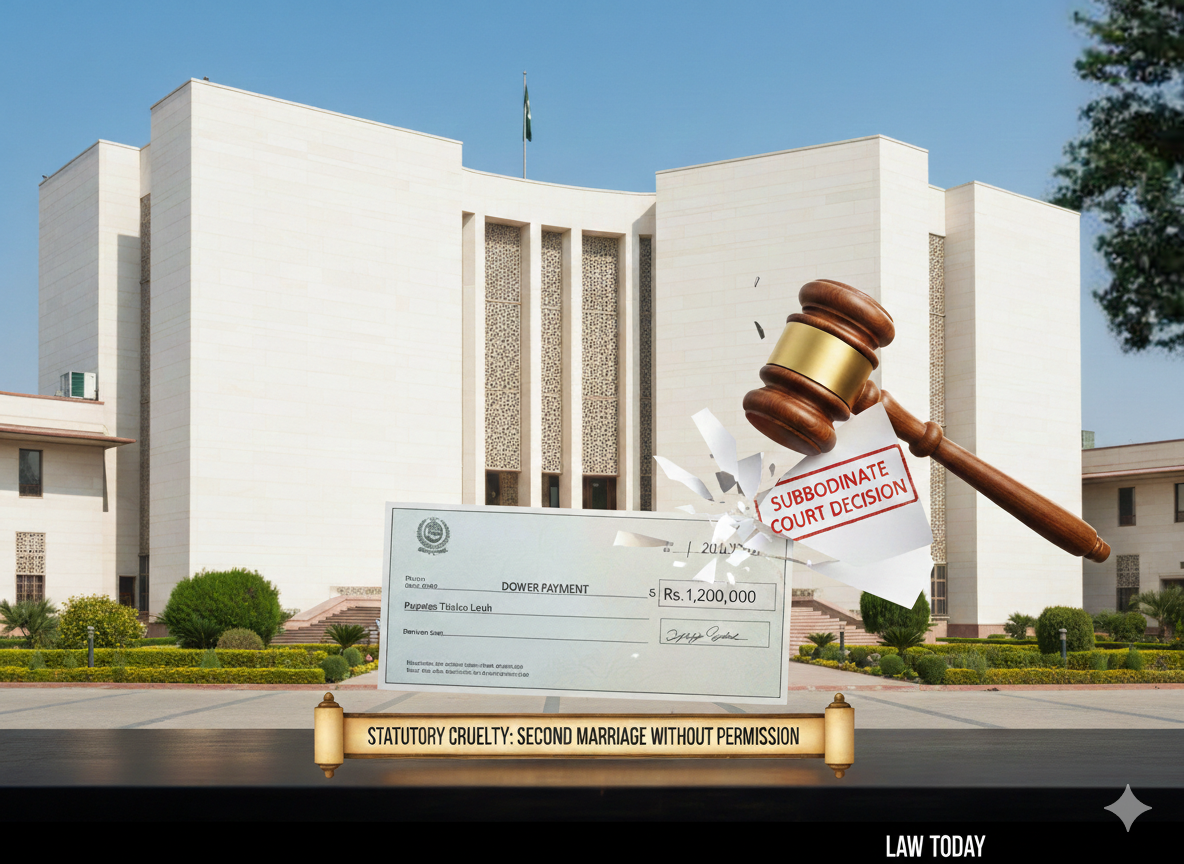
ISLAMABAD : While declaring a woman entitled to receive Rs1.2 million as the remaining dower in a family case, the Supreme Court set aside a subordinate court’s decision that had forced her to forego the amount. The top court also ruled that a husband’s second marriage without the wife’s legal permission constitutes statutory cruelty.

A two-member bench of the Supreme Court, comprising Chief Justice of Pakistan Justice Yahya Afridi and Justice Musarrat Hilali converted the case from a “Khula” (divorce by woman’s request) to a standard dissolution of marriage, ensuring the petitioner receives her full remaining dower of Rs. 1,200,000.

Justice Musarrat Hilali is the author judge noted in a five-page verdict that primary legal question was whether a wife is entitled to a decree for dissolution of marriage on the grounds of cruelty if her husband enters into a second marriage without the mandatory written permission required under family law.

A secondary issue was whether the lower courts were correct in treating the divorce as “Khula” – which requires the wife to return or waive her dower – despite the husband’s violation of statutory marriage laws. Issuing verdict in the matter the court relied upon statutory provisions including Section 6 of the Muslim Family Laws Ordinance (MFLO), 1961 which prohibits a man from contracting a second marriage without the prior written permission of the Arbitration Council, Section 2(iia) of the Dissolution of Muslim Marriages Act (DMMA), 1939 which specifically establishes that contracting a second marriage in contravention of the MFLO is a valid ground for a woman to seek the dissolution of her marriage.

The court established legal precedent about dower rights in the matter that if a marriage is dissolved due to the husband’s fault (such as cruelty or statutory violations), the wife is entitled to her full dower, unlike in cases of Khula. In the case of this Mst. Naila Javed who had made  Nasir Khan as respondent, (her ex-husband), who had admitted to marrying a second time without obtaining permission from the Arbitration Council or his first wife. The Supreme Court found that the Peshawar High Court and lower family courts had incorrectly assessed the evidence.

While the lower courts granted a divorce, they did so on the basis of “Khula,” forcing the wife to give up her financial rights. Justice Hilali noted that because the husband violated Section 6 of the MFLO, the wife had a “clear availability on the record” for a decree based on cruelty. Therefore, the fault lay with the husband, and the wife should not have been penalized financially for his breach of law.

The Supreme Court allowed the appeal, declaring the marriage dissolved on the grounds of cruelty (Talaq) rather than Khula. Consequently, the Court ordered the respondent to pay the petitioner the remaining dower of Rs. 1,200,000 (Twelve Lakh Rupees) through the Family Court, affirming that statutory violations by a husband protect a wife’s right to her dower upon divorce.

Author

Khudayar Mohla, Managing Partner Mohla & Mohla, Founder of the Law Today Pakistan,

Managing Partner at Mohla & Mohla - Advocates and Legal Consultants, Islamabad, Founder of The Law Today Pakistan (TLTP) Newswire Service. Former President Press Association of Supreme Court of Pakistan with over two decades of coverage of defining judicial moments - including the dissolution and restoration of Chief Justice Iftikhar Muhammad Chaudhry, Asif Ali Zardari NAB cases, Syed Yousaf Raza Gillani contempt proceedings, Panama Papers case against Mian Nawaz Sharif, matters involving Imran Khan, and the high treason trial of former Army Chief and President Pervez Musharraf. He now practises law and teaches Jurisprudence, International Law, Civil and Criminal Law. Can be reached at: mohla@lawtoday.com.pk

More From Author

Leave a Reply

Your email address will not be published. Required fields are marked *

You May Also Like

Supreme Court Pakistan, timely promotions, civil servants Pakistan, government inefficiency, administrative delays, Punjab Civil Servants Act, proforma promotion, Punjab Service Tribunal, Justice Ayesha Malik, Khudayar Mohla, employee rights, fair promotion

Administrative Inefficiency No Excuse for Delaying Promotions, SC

ISLAMABAD: The top court ruled on Thursday that procedural delays caused by administrative inefficiencies of…

Khudayar Mohla,ederal Constitutional Court, FCC Pakistan, Lahore High Court, LHC judgment, import ban from India, India Pakistan trade ban, SROs 927 and 928 2019, commerce ministry appeal, ban on Indian imports, books import ban, judicial overreach, separation of powers, foreign policy Pakistan, national security trade restrictions, statutory regulatory orders Pakistan, constitutional jurisdiction, executive domain, judicial review limits, Pakistan India trade relations, Kashmir policy Pakistan, Supreme Court Pakistan appeal transfer, 27th Constitutional Amendment, Justice Aamer Farooq, Justice Ali Baqar Najafi, Justice Rozi Khan Barrech, Advocate Hafiz Ahsaan Ahmad Khokhar, Additional Attorney General Aamir Rehman, non-justiciable matters, import export regulation Pakistan, federal government policy decisions

FCC Reserves Verdict on Govt Appeal Challenging LHC Directives on India Import Ban

ISLAMABAD: Upon hearing extensive arguments from Advocate Hafiz Ahsaan Ahmad Khokhar, the Federal Constitutional Court…

Law Today,Khudayar Mohla,Supreme Court Pakistan, Ms Sabiha Hameed promotion, promotion discrimination, natural justice, Audi Alteram Partem, CSS officer promotion, Central Selection Board, Federal Service Tribunal, civil service law, right to be heard, procedural fairness, fair hearing, CSB reconsideration, judicial directions, promotion eligibility, career rights civil servants, due process Pakistan, government promotion rules, FST ruling

SC Directs Establishment Division for Fresh CSB Hearing in Promotion Case of Retired CSS Officer

ISLAMABAD: While hearing the plea of retired CSS officer Ms Sabiha Hameed regarding promotion discrimination,…