Categories Courts

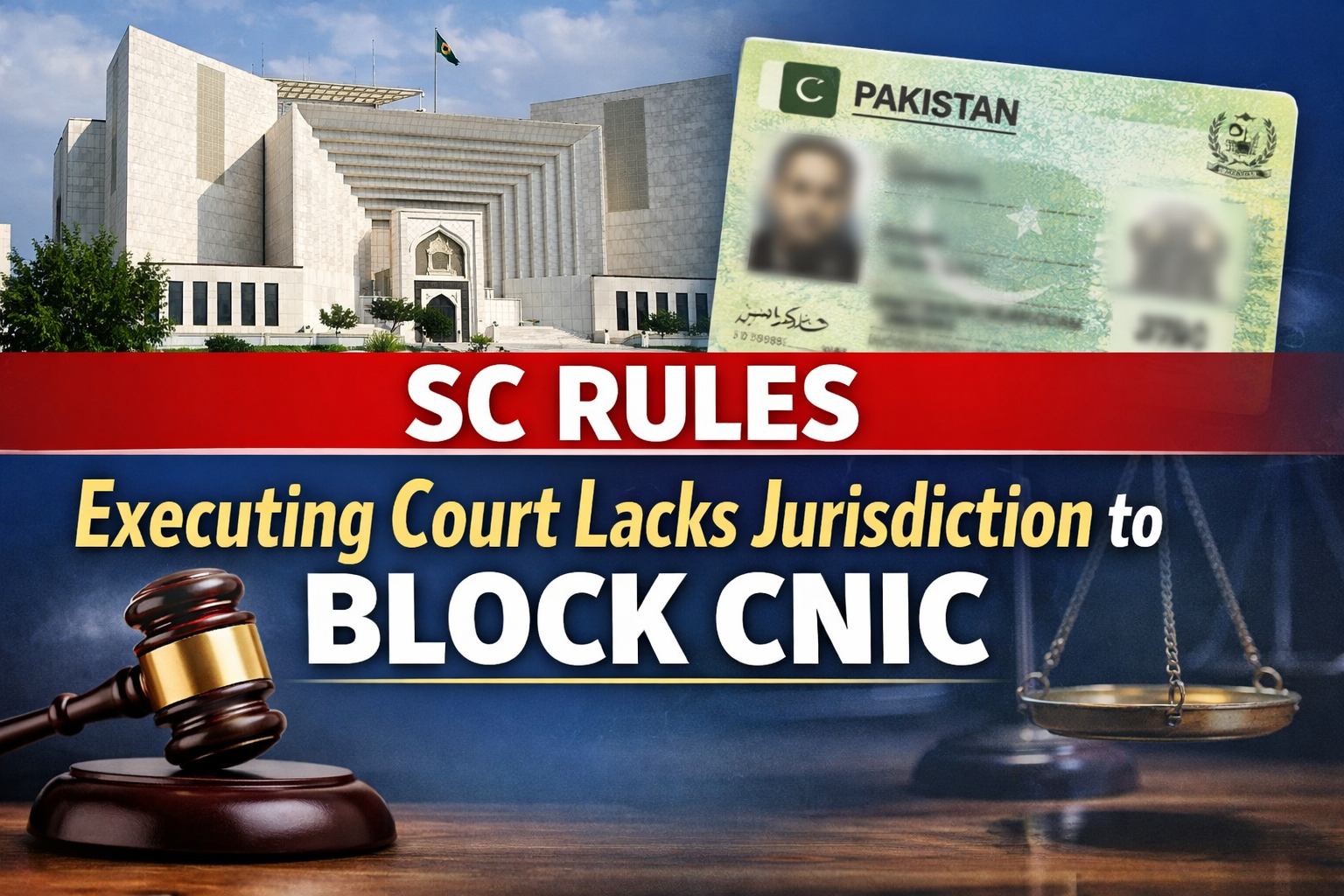
SC Rules Executing Court Lacks Jurisdiction to Block CNIC

ISLAMABAD: The Supreme Court set aside concurrent rulings that had ordered blocking of a Computerised National Identity Card (CNIC) in execution of a money decree, holding that an executing court lacks jurisdiction to impose such restriction.

The Supreme Court ruled on Saturday that a judgement debtor’s CNIC cannot be blocked as a mode of executing a money decree, declaring that such a practice is beyond the jurisdiction of executing courts. A two-judge bench, headed by Justice Munib Akhtar and including Justice Irfan Saadat Khan, made the decision after hearing an appeal from Agha Abid Majeed Khan, who had challenged an Aug. 1, 2023, ruling by the Sindh High Court that rejected his plea.

In a three-page order authored by Justice Akhtar, the Supreme Court observed that a CNIC is not a luxury or a mere statutory requirement. “In these times it has become essential to being able to carry on a normal way of life in the ordinary course,” the judgement said.

Petitioner Agha Abid was a judgement debtor in a summary chapter suit where a decree was passed in favour of respondent Idrees Ahmed. During execution proceedings initiated by the decree holder, the executing court ordered the blocking of Mr Abid’s CNIC until he furnished surety for the decretal amount.  Consequently, the petitioner approached the high court through a revision petition. It was dismissed on Aug 1, 2023, with an observation that blocking a CNIC was “a step towards execution of lawful orders”.
The lower court had noted that the litigation between the parties had been pending observation that blocking a CNIC was “a step towards execution of lawful orders”. The lower court had noted that the litigation between the parties had been pending since 2012 and the judgement and decree had remained unexecutable since March 29, 2016. However, the Supreme Court cautioned against a “muscular” approach, observing that Section 51 of the Code of Civil Procedure 1908 sets out different modes for executing a decree. The final clause (e) allows the decree to be executed “in such other manner as the nature of the relief granted may require”. While this clause confers the necessary flexibility to enable the executing court to ensure that a decree is satisfied, the Supreme Court observed that it cannot obviously be stretched to the point where the order made in execution loses all contact with the statutory provision.

In the case at hand, the decree is simply a money decree on a summary chapter suit, Justice Akhtar noted, adding that the court was not at all satisfied that such a decree would require or make permissible execution by blocking the CNIC of the judgement debtor by resort to Section 51(e). “One might as well then allow the executing court to order the blocking of utilities like electricity, water, etc., from the residence or workplace of a judgement debtor for execution of a money decree,” the judge observed.

While a robust approach should certainly be taken to ensure execution, it cannot be so muscular — especially in the exercise of a general power conferred by clause (e) — that it essentially deprives the judgement debtor of an essential aspect of living, the judgement continued.  To curtail a judgement debtor from this is not the proper exercise of discretion or statutory powers, as the high court erroneously concluded, Justice Akhtar emphasised. During the hearing, an Additional Attorney General had drawn the attention of the court to a 2018 amendment in which Order 21, Rule 117 was added: “The modes of compelling the judgement debtor for his attendance or for completing the execution proceedings may include  blockage of his CNIC.”

Justice Akhtar noted that the rule may apply in Khyber Pakhtunkhwa but not in Sindh, from where the present proceedings arose. While concluding, the Supreme Court converted the petition into an appeal and allowed it while setting aside the orders of both the executing court and SHC.

Author

Khudayar Mohla, Managing Partner Mohla & Mohla, Founder of the Law Today Pakistan,

Managing Partner at Mohla & Mohla - Advocates and Legal Consultants, Islamabad, Founder of The Law Today Pakistan (TLTP) Newswire Service. Former President Press Association of Supreme Court of Pakistan with over two decades of coverage of defining judicial moments - including the dissolution and restoration of Chief Justice Iftikhar Muhammad Chaudhry, Asif Ali Zardari NAB cases, Syed Yousaf Raza Gillani contempt proceedings, Panama Papers case against Mian Nawaz Sharif, matters involving Imran Khan, and the high treason trial of former Army Chief and President Pervez Musharraf. He now practises law and teaches Jurisprudence, International Law, Civil and Criminal Law. Can be reached at: mohla@lawtoday.com.pk

More From Author

Leave a Reply

Your email address will not be published. Required fields are marked *

You May Also Like

Khudayar Mohla, FAO, First Appeal, Lahore High Court, Bahawalpur Bench, LHC Bahawalpur, Ad Interim Injunction, Temporary Injunction, Stay Application, Order XLIII Rule 1(r) CPC, Order XXXIX Rules 1 and 2 CPC, Maintainability, Specific Performance, Balance of Convenience, Balance of Inconvenience, Interlocutory Order, Solar Energy Dispute, On-Grid Solar System, Solar Installation Agreement, Commercial Litigation, Energy Contract Dispute, SS Paper Board Mills, Swift Solar Energy, Civil Judge Rahim Yar Khan, Justice Malik Waqar Haider Awan, Sardar Abdul Basit Khan Advocate, Rs 87868000, Daily Loss Rs 250000, Installment Default, Security Cheques, Payment Dispute, Commercial Loss, Shariq Builders 2024 MLD 32, Muhammad Rasab 1998 MLD 2045, Abdullah Sugar Mills 2003 SCMR 1026, Indus Motor Company 2025 CLC 1951, Mst Shazia Mehmood 2025 MLD 1976, Approved for Reporting, FAO No 09 2026 BWP, March 12 2026, Snake Bitten Antidote, Judicial Empathy, 15 Days Directive, Pakistan Court News, Lahore High Court Order 2026, Solar Energy Pakistan, Civil Court Rahim Yar Khan, Pakistan Solar Dispute, LHC Order 2026, Pakistan Judiciary News, Court Reporting Pakistan, Legal News Pakistan, High Court Pakistan 2026

“Snake-Bitten May Die Waiting for Antidote” – LHC Disposes Solar Appeal, Orders Trial Court to Decide Stay Application in 15 Days

BAHAWALPUR : A Rahim Yar Khan-based paper and board mill, bleeding Rs. 250,000 daily, invoked…

Khudayar Mohla,Peshawar High Court, PHC ruling, civil courts jurisdiction, load shedding disputes, PESCO load shedding, Kohat load shedding, NEPRA jurisdiction, electricity load shedding Pakistan, PHC verdict, Justice Waqar Ahmad, NEPRA Act 1997, Section 45 NEPRA Act, civil revision petition, Jangal Khel Kohat, prolonged load shedding, 18 hour load shedding, discriminatory load shedding, fundamental rights violation, electricity consumers Pakistan, PESCO administrative policies, Barrister Asadul Mulk, power outages Pakistan, electricity distribution Pakistan, NEPRA regulatory body, special jurisdiction principle, Section 9 CPC, Code of Civil Procedure, Supreme Court precedents Pakistan, electricity complaints Pakistan, power sector regulation, load shedding KPK, Khyber Pakhtunkhwa electricity, consumer rights Pakistan, electricity grievances, NEPRA complaint forum, civil court dismissed, district court Kohat, electricity generation transmission, power distribution policy, judicial intervention electricity, legal jurisdiction electricity, Pakistan power sector, electricity law Pakistan, regulatory authority Pakistan, load shedding schedule, electricity supply company, high court KPK, Pakistan judiciary, electricity policy Pakistan, power outages fundamental rights

PHC Rules Civil Courts Lack Jurisdiction Over Load Shedding Disputes

PESHAWAR: While hearing a civil revision petition in a matter relating to prolonged daily load…

AAC Gilgit-Baltistan, GB Awami Action Committee, Advocate Ehsan Ali arrested, AAC leaders arrested, anti-state speeches Gilgit, Iftar party arrest Pakistan, Anti-Terrorism Act Pakistan, ATC remand Gilgit, Rehmat Shah ATC judge, PESCO load shedding, GB Bar Council statement, GB High Court Bar Association, HRCP condemnation, human rights Gilgit-Baltistan, Advocate Nafees arrested, Meher Ali arrested, Engineer Mehboob Wali, FIR anti-terrorism Gilgit, Jutial police station FIR, AAC protest Gilgit, political arrests Pakistan, civil liberties Gilgit-Baltistan, freedom of speech Pakistan, peaceful protest rights Pakistan, anti-terrorism law misuse, GB Supreme Appellate Court Bar Association, legal community Gilgit, rule of law Gilgit-Baltistan, political suppression Pakistan, AAC chairman arrested, Asghar Shah FIR, Masoodur Rehman FIR, Engineer Nadeem FIR, Skardu public outreach, due process Pakistan, fundamental rights Pakistan, political activity restrictions, civil society Gilgit-Baltistan, lawyers arrested Pakistan, advocate illegal detention, bar council demands release, HRCP Pakistan statement, Gilgit police raids, AAC leaders remand, anti-state protest FIR, constitutional rights Pakistan, political dissent Pakistan, GB politics, Gilgit-Baltistan news, Pakistan human rights, legal fraternity Pakistan, ATC physical remand, Khudayar Mohla

Four AAC Leaders Remanded In Gilgit Over Alleged Anti-State Speeches; Bar Council And HRCP Condemn Arrests

GILGIT: In a development that has sent shockwaves through the legal fraternity and civil society…