ISLAMABAD: The Supreme Court has set aside Sindh High Court orders in a contempt matter, ruling that a preliminary hearing is mandatory before framing a charge against an alleged contemnor – a procedural step that both the single judge and the Division Bench had overlooked.
A three-judge bench comprising Justice Muhammad Ali Mazhar, Justice Syed Hasan Azhar Rizvi, and Justice Aqeel Ahmed Abbasi heard Criminal Appeal of one Hira Rauf against Rear Admiral (Retd) Mushtaq Ahmed and others.
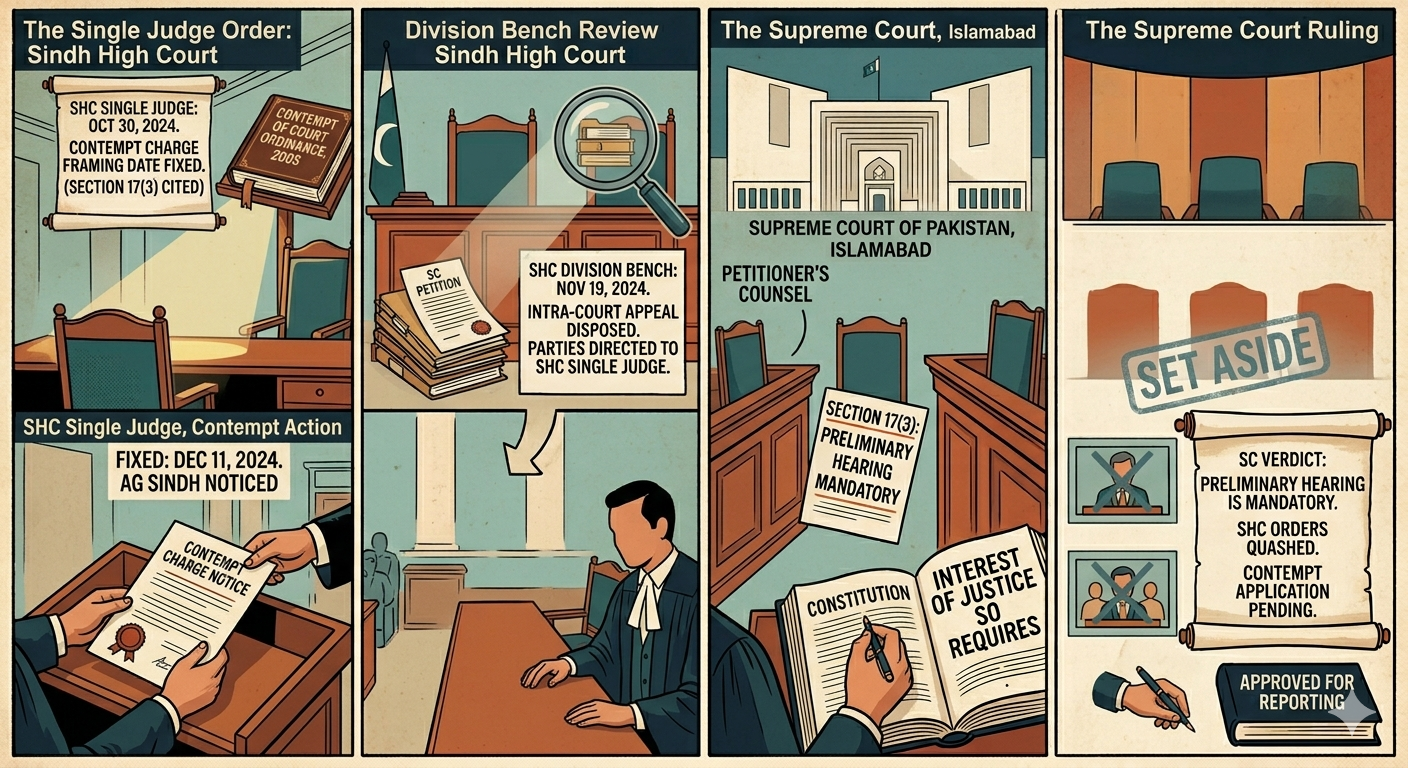
A three-page verdict in the matter disclosed that the case arose when one of respondents allegedly violated an order dated September 3, 2024, passed by the Sindh High Court in its original jurisdiction. The plaintiff moved a contempt application under Article 204 of the Constitution and Sections 3 and 4 of the Contempt of Court Ordinance, 2003. After notice, a counter-affidavit was filed.
The SHC single judge, citing Section 17(3) of the Ordinance, fixed December 11, 2024 for framing of charge and issued notice to the Advocate General Sindh to assist the court. The petitioner challenged this order through an intra-court appeal, which the Division Bench disposed of on November 19, 2024, directing parties to appear before the single judge for further proceedings.
Before the Supreme Court, counsel for the petitioner argued that both the single judge and the Division Bench had misread Section 17(3) and that no preliminary hearing was conducted before cognisance was taken. Counsel for Respondents 1 and 2 admitted that while a Nazir report had been submitted showing some violation, no preliminary hearing had in fact taken place. Counsel for Respondent No. 5 also acknowledged procedural lapses in the orders passed.
The court closely examined Section 17(3) of the Ordinance, which reads: “If, after giving the alleged contemner an opportunity of a preliminary hearing, the court is prima facie satisfied that the interest of justice so requires, it shall fix a date for framing a charge in open court…”
The bench held that a plain reading of this provision makes it clear that before taking cognisance or fixing a date for framing a charge, the alleged contemnor must first be given an opportunity for a preliminary hearing. Only after the court is duly satisfied that a prima facie case exists may it proceed to fix such a date.
“In our view, there are some lapses apparent on the face of record and this crucial question has also been overlooked by the learned Division Bench while disposing of High Court Appeal,” the order states.
Accordingly, the Supreme Court set aside the SHC single judge’s order dated October 30, 2024, as well as the Division Bench’s order dated November 19, 2024, both to the extent of contempt proceedings. The contempt application, however, shall remain pending. Should the court wish to initiate contempt proceedings afresh, it must first conduct a preliminary hearing on the basis of the contempt application and the counter-affidavit filed by the alleged contemnor, and thereafter determine whether a prima facie case is made out to proceed in accordance with law.
The appeal was allowed in the above terms whereas the judgment was approved for reporting.