Categories Courts

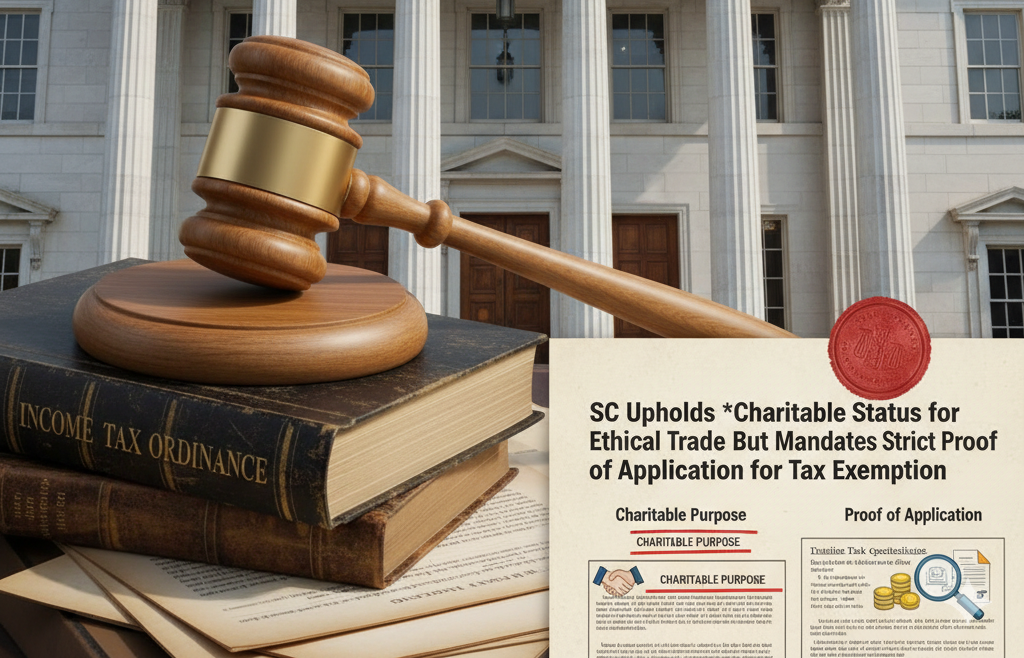
SC Upholds Charitable Status for Ethical Trade But Mandates Strict Proof of Application for Tax Exemption

ISLAMABAD – A recent Supreme Court ruling has provided essential clarity on the income tax exemption criteria for companies holding income under a legal obligation for charitable purposes, overturning a High Court decision that had denied the exemption.

The case centered on a company that claimed exemption on income derived from house property, arguing it was held under a “legal obligation” for charitable purposes as defined under the Second Schedule to the Income Tax Ordinances of 1979 (clause (93)) and 2001 (clause (59)). The High Court had initially denied the claim, asserting the company’s object of promoting “honorable practices” in trade was not charitable.

A three-member bench of the top court comprising Justices Munib Akhtar, Ayesha A. Malik and Aqeel Ahmed Abbasi addressed three core issues. First, it confirmed that a combined reading of the memorandum of association, including specific clauses related to expenditure, established a ‘legal obligation’ on the petitioner to expend its income only to achieve the defined purposes. The Court concluded that income held under a legal obligation for charitable purposes does qualify for exemption under the relevant statutory provisions. Second, applying established precedent, the Court ruled that the object of promoting “honorable practices” and equitable principles in trade and business, and discouraging malpractices, constitutes a “charitable purpose” within the statutory meaning. This is because such activities work to the benefit of the public at large and advance general public utility in economic and commercial life.

However, the Court delivered a critical finding regarding the third issue: entitlement to the exemption requires affirmative evidence that the income has been “actually applied” or “finally set apart” for charitable purposes. The Court found that the Tribunal had failed to make a necessary finding of fact on this requirement, wrongly treating it as automatically established by the finding of a legal obligation. The judgment underscores that while establishing the legal obligation and the charitable nature of the purpose are questions of law, proving the actual application or final setting apart of funds is a separate question of fact that the taxpayer must affirmatively prove to receive the exemption.

While concluding, the ruling confirms that income under a legal obligation for charitable purposes and the promotion of honorable trade practices are both covered under the exemption, but the taxpayer must strictly prove the actual use or earmarking of the income to successfully claim the relief.

Author

Khudayar Mohla, Managing Partner Mohla & Mohla, Founder of the Law Today Pakistan,

Managing Partner at Mohla & Mohla - Advocates and Legal Consultants, Islamabad, Founder of The Law Today Pakistan (TLTP) Newswire Service. Former President Press Association of Supreme Court of Pakistan with over two decades of coverage of defining judicial moments - including the dissolution and restoration of Chief Justice Iftikhar Muhammad Chaudhry, Asif Ali Zardari NAB cases, Syed Yousaf Raza Gillani contempt proceedings, Panama Papers case against Mian Nawaz Sharif, matters involving Imran Khan, and the high treason trial of former Army Chief and President Pervez Musharraf. He now practises law and teaches Jurisprudence, International Law, and Civil and Criminal Law. Contact: mohla@lawtoday.com.pk

More From Author

Leave a Reply

Your email address will not be published. Required fields are marked *

You May Also Like

Judicial Commission of Pakistan, JCP, Justice Miangul Hassan Aurangzeb, Supreme Court, permanent judge, majority decision, Justice Zafar Ahmed Rajput, Sindh High Court Chief Justice, Justice Kamran Mullahkhail, Balochistan High Court Chief Justice, superior judiciary appointments, 27th Amendment, Federal Constitutional Court, FCC, Justice Munib Akhtar opposition, Justice Mohsin Akhtar Kayani, Swat royal family, Miangul Jahan Zeb, last Wāli of Swat, Miangul Aurangzeb, Governor, legal education, University of Wales, Lincoln's Inn, SJC rules committee, Justice Jamal Mandokhail, institutional reforms, JCP rules panel, constitutional bodies, judicial accountability,Khudayar Mohla

JCP Votes to Elevate Justice Miangul Hassan Aurangzeb as Permanent SC Judge

ISLAMABAD – The Judicial Commission of Pakistan (JCP), apex body responsible for appointing justices to…

Judge With Command Over Law and Facts Is ‘Never Under Stress’, Says LHC’s Justice Jawad Hassan

LAHORE – While underscoring dire need for civil courts to examine and decide the maintainability…

Punjab Judicial Academy, Justice Aalia Neelum, Lahore High Court, PJA Board Meeting, first female Chairperson PJA, judicial training Punjab, judicial reforms Pakistan, Punjab Judicial Academy Act 2007, Section 4 PJA Act, judicial officers training, court personnel training, court management training, case management Punjab, delay reduction techniques, alternate dispute resolution training, judgment writing training, judicial administration Punjab, legal education Pakistan, Sardar Ahmed Naeem, Justice Sajid Mehmood Sethi, Justice Jawad Hassan, Amjad Iqbal Ranjha, Lahore news, judicial capacity building, Federal Judicial Academy collaboration, legal research Punjab, judicial ethics training, law and development Punjab, legislative drafting training, PJA conferences seminars workshops.

Chief Justice LHC Justice Miss Aalia Neelum Chairs PJA Board Meeting, Marks Historic First for Academy

LAHORE – Days ago the Punjab Judicial Academy marked a significant milestone when Chief Justice…