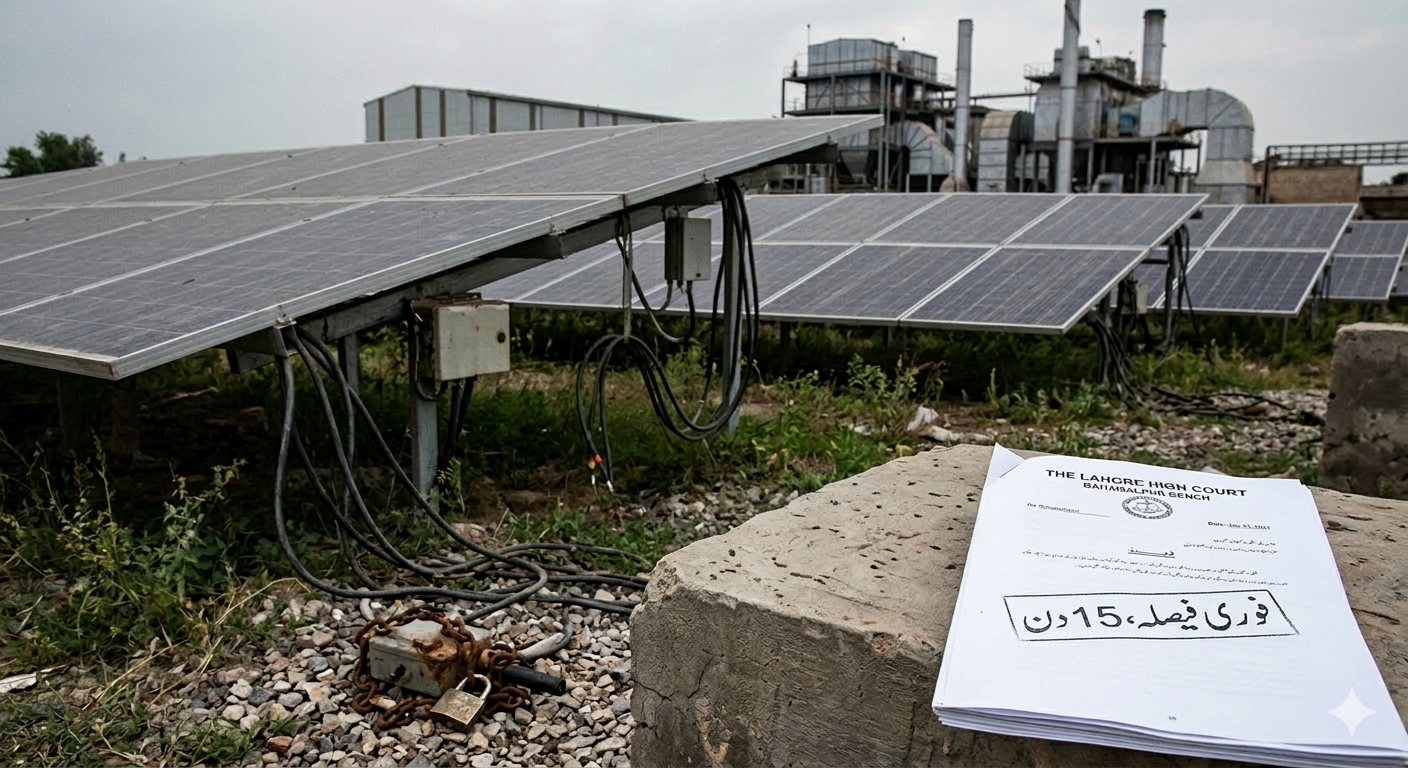
BAHAWALPUR : A Rahim Yar Khan-based paper and board mill, bleeding Rs. 250,000 daily, invoked jurisdiction of the Lahore High Court Bahawalpur Bench after its nearly Rs. 88 million solar energy system was unilaterally shut down at its factory, by the very company that installed it – despite the mill having paid in excess of the agreed installment schedule – prompting Justice Malik Waqar Haider Awan to dismiss the appeal on procedural grounds while directing the trial court to decide the matter swiftly within 15 days.
The factual position reveals in the matter that M/s SS Paper & Board Mills (Private) Limited had entered into two agreements in November 15, 2024 and February 26, 2025 – with Swift Solar Energy Private Limited for installation and operation of a 600 KW and 400 KW On-Grid Solar System at its Rahim Yar Khan factory against a total consideration of Rs. 87,868,000.
The respondents completed installation whereas appellant made regular payments, reportedly exceeding the settled schedule, while also leaving its security cheques in the respondents’ possession. Despite this, the respondents abruptly suspended the operation of the solar system without any apparent justification, throwing the appellant into a deepening financial crisis. With no power being generated and daily losses mounting to Rs. 250,000, the appellant rushed to the Civil Judge 1st Class, Rahim Yar Khan, filing a suit for specific performance of the agreements alongside an urgent stay application seeking restoration of the solar system’s operation and restraint against its dismantling or removal.
In February 24,2025 the trial court granted only partial ad interim relief – restraining the respondents from dismantling or removing the installed system – but stopped short of directing restoration of its operation. Unsatisfied with this limited relief and facing a ticking financial clock, the appellant challenged the trial court’s order before the Lahore High Court Bahawalpur Bench through a First Appeal under Order XLIII Rule 1(r) CPC. Before the High Court, counsel for the appellant Sardar Abdul Basit Khan argued saying the balance of convenience clearly tilted in his client’s favour. He contended that the appellant had not only honored all payment obligations but had paid amounts in excess of the agreed schedule, and that the respondents’ unilateral action of suspending the system was causing irreparable financial harm with every passing day.
The High Court, however, was not persuaded on the question of maintainability. Relying upon the precedent in Shariq Builders and Property Advisors v. Dr. Muhammad Faisal Murad and others (2024 MLD 32), Justice Malik Waqar Haider Awan held that a clear distinction exists between an ad interim injunction – which is merely a stopgap arrangement – and a temporary injunction, which is a considered order passed after formally hearing the parties. Since the stay application was still pending before the trial court and had not been finally decided, no First Appeal lay against the limited ad interim order at this premature stage. The appeal was accordingly declared not maintainable.
While upholding procedural law firmly, the Court did not remain blind to the appellant’s genuine distress. In a moment of rare judicial empathy, Justice Awan acknowledged the urgency of the situation through a vivid proverb:
“Till the antidote reaches, the snake-bitten may die.”
Rather than leaving the appellant without a remedy, the Court converted its order into a practical lifeline – directing the Civil Judge 1st Class, Rahim Yar Khan to decide the stay application preferably within 15 days of receiving the certified copy of the order, after affording both parties adequate opportunity of hearing and applying strictly the principle of balance of convenience and inconvenience as elaborated in Muhammad Rasab and another v. Muhammad Siddiquie Chaudhry (1998 MLD 2045).
A five-page verdict, approved for reporting, serves as a timely reminder that while appellate courts cannot be approached prematurely, justice must move at the speed of commerce – particularly when a business is losing a quarter million rupees with every sunrise.