

Categories National

Speakers at AJCONF Urge 18 as Minimum Marriage Age to Safeguard Children’s Right

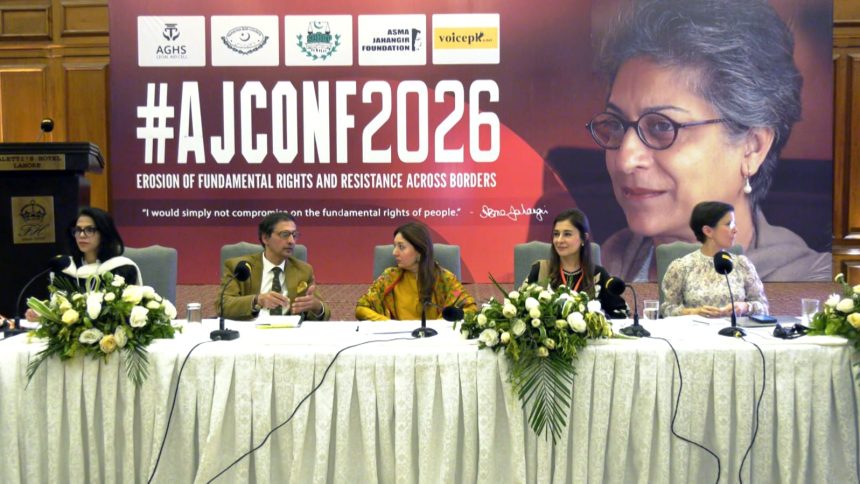
LAHORE: Speakers on Sunday, during a session titled “Where the Law Falls Silent: Child Marriages” at the Asma Jahangir Conference, called for the minimum age of marriage to be set and uniformly enforced at 18 years across Pakistan. They warned that child marriages amount to statutory rape and must be prosecuted and punished under the law. Underage marriages, they emphasized, violate children’s fundamental rights and should not be recognized, validated, or facilitated by courts or any state institutions.

Nida Aly, Executive Director of AGHS Legal Aid Cell moderated the session where speakers included Justice Jawad Hassan, Judge of the Lahore High Court; Sharmila Farooqi, Member of the National Assembly of Pakistan, Ayesha Raza Farooq, Chairperson of the National Commission on the Rights of Child (NCRC), and Reem Alsalem, United Nations Special Rapporteur on Violence against Women and Girls expressed views.

Justice Jawad Hassan emphasized that the judiciary plays a central role in addressing child marriage. “At the end of the day, the judiciary is the key. Upholding the Constitution is the State’s duty. Without executive action or legal change, injustice continues,” he stated. He stressed that ‘laws must be aligned with constitutional provisions’, including clearly setting 18 years as the minimum age of marriage, so that no parallel systems or misinterpretations can override fundamental rights.

Sharmila Farooqi highlighted the legislative challenges surrounding child marriage reform. During drafting, she explained, a key question was why such marriages were not explicitly declared void. Consensus was difficult due to legal, social, and religious sensitivities. She added that we are governed by personal law, and discussing it is often extremely sensitive, any debate quickly attracts objections. The aim, she said, was to create a law that could withstand legal scrutiny, respect traditions, and still ‘move society towards protection and inclusion’. “The purpose of introducing this law was not only to provide normative clarity, but also to ensure its legal survival and create a level of inclusivity around it.” she added.

Ayesha Raza Farooq called for uniformity across provinces and strong enforcement mechanisms. She stressed the need for coordinated legal reform, justice-driven implementation, behavioral change, and the abandonment of harmful practices to ensure children are protected. “We are working to ensure that all provinces align their laws to set 18 years as the minimum age of marriage,” she said.

Reem Alsalem observed that many ‘child marriage laws appear strong on paper but fail in practice’ due to weak monitoring and lack of resources. She warned that exceptions, such as parental or judicial consent, often undermine the effectiveness of laws that otherwise set the minimum age at 18. She also noted that ‘child marriage problem is particularly severe in conflict-affected and refugee-hosting countries’, where many children remain unregistered. “The State has the responsibility to take all proper measures to ensure the safety of every child,” she stressed.

All the panelists agreed that while legislative reform is crucial, effective enforcement, institutional commitment, and constitutional alignment are essential to ensure that child marriage is addressed not only in principle but in practice.  The panel unanimously resolved that all provinces must enforce the minimum age of marriage at 18 years, without exceptions under custom, personal law, or consent. They called on the judiciary to take an active role in preventing under-age marriages and to interpret existing laws to fully protect children’s rights to dignity, equality, and safety. The speakers stressed that ending child marriage requires firm judicial oversight, effective enforcement, and a committed state response to ensure that the best interests of every child are upheld.

Author

Shirin Ebadi,Kiana Rahman, Ali, Oslo, Editor, Kurdish woman Mahsa Jina Amini, Human Rights Activist Narges Mohammadi, Nobel Prize Committee, Woman, Life, Freedom, Nobel Peace Prize Award 2023

Ashi Asif is an Advocate of the High Court and has been associated with TLTP News Wire Service as a correspondent since 2020. She has covered major international events, including the Nobel Peace Prize Ceremony in Norway in 2022, and continues her global journalistic engagement with coverage of the Nobel Peace Prize Ceremony 2025 in Oslo. She can be reached at ashi@lawtoday.com.pk

More From Author

Leave a Reply

Your email address will not be published. Required fields are marked *

You May Also Like

Khudayar Mohla, Allama Iqbal Open University, AIOU Islamabad, Bahria University Pakistan, AIOU Bahria University MoU, higher education collaboration Pakistan, digital integration in education, online learning Pakistan, distance education Pakistan, AIOU digital infrastructure, Bahria University online education, Pakistan universities partnership, MoU higher education Pakistan, Prof Dr Nasir Mahmood AIOU, Vice Admiral Abid Hameed Bahria University, AIOU data center facilities, digital learning platforms Pakistan, modern education technology Pakistan, remote learning opportunities Pakistan, higher education reforms Pakistan, university collaboration Pakistan, e-learning Pakistan universities, digital education initiatives Pakistan, online academic resources Pakistan, AIOU distance learning programs, Bahria University academic partnership, education technology Pakistan, inclusive higher education Pakistan, digital literacy in Pakistan, academic cooperation Pakistan universities

AIOU, Bahria University Ink MoU to Transform Higher Education Through Digital Integration

ISLAMABAD: In a move that signals a transformative shift for Pakistan’s academic landscape, two of…

Khudayar Mohla,Senate of Pakistan, National Accountability Ordinance amendment, NAO amendment bill 2026, NAB law reforms Pakistan, second appeal in NAB cases, Federal Constitutional Court Pakistan, NAB appellate forum, accountability law Pakistan, private member bill Senate Pakistan, Senator Mohammad Abdul Qadir bill, Azam Nazir Tarar statement Senate, NAB bail provisions amendment, jurisdiction in NAB cases, Code of Criminal Procedure bail powers, NAB chairman term extension proposal, Pakistan Bureau of Statistics inflation index NAB threshold, accountability courts Pakistan, High Court appeals NAB cases, due process in accountability cases Pakistan, parliamentary debate NAO amendment, legislative reforms accountability law Pakistan, Senate legislation Pakistan 2026, National Accountability Bureau reforms, appellate framework accountability proceedings, Pakistan accountability law amendments

Senate Passes Bill Amending NAO to Introduce Second Appeal in NAB Cases

ISLAMABAD: The Senate on Thursday passed a private member’s bill seeking amendments to the National…

Senate of Pakistan, Virtual Assets Bill 2026, Pakistan crypto regulation, PVARA, Pakistan Virtual Assets Regulatory Authority, digital assets Pakistan, cryptocurrency law Pakistan, virtual asset licensing, investor protection, anti-money laundering, financial crime prevention, virtual asset exchanges, custody providers, crypto service providers, market transparency, responsible innovation, digital economy Pakistan, State Bank of Pakistan, Securities and Exchange Commission of Pakistan, crypto oversight, Pakistan National Assembly, presidential assent, cryptocurrency adoption Pakistan, crypto regulation framework, Pakistan news, Khudayar Mohla

Senate Okays Virtual Assets Bill 2026 for Crypto Regulation

ISLAMABAD: The Senate of Pakistan Saturday passed the Virtual Assets Bill 2026, marking a historic…