
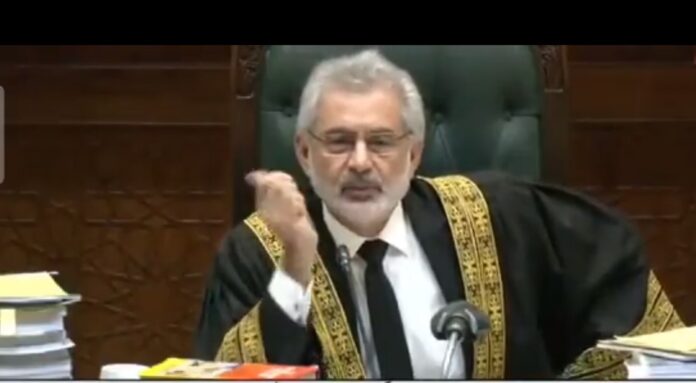
While announcing verdict in response to pleas challenging legislation curtailing powers of top court chief Justice regarding suo-motu notice Wednesday in a 10:5 landmark decision full court of the Supreme Court agreed with the outgoing Pakistan Democratic Movement (PDM) coalition of 13 political parties government law makers, ruling that benches of the top court would now be formed by a three-member committee rather than the Chief Justice of Pakistan (CJP) alone.
Reading the reserved verdict, Chief Justice of Pakistan (CJP) Qazi Faez Isa said that “a majority of 10-5 (Justice Ijazul Ahsan, Justice Munib Akhtar, Justice Mazahar Ali Akbar Naqvi, Justice Ayesha A. Malik and Justice Shahid Waheed dissenting), the SC Practice and Procedure Act 2023 is sustained as being in accordance with the Constitution of the Islamic Republic of Pakistan and to this extent, the petitions are dismissed”.
“By majority of 9-6 (Justice Ahsan, Justice Akhtar, Justice Afridi, Justice Naqvi, Justice Ayesha and Justice Waheed dissenting) sub-section 1 of Section 5 of the Act (granting a right of appeal prospectively) is declared to be in accordance with the Constitution and to this extent, the petitions are dismissed,” he ruled.
Sub-section 1 of Section 5 of the Act says: “An appeal shall lie within thirty days from an order of a bench of the Supreme Court who exercised jurisdiction under clause (3) of Article 184 of the Constitution to a larger bench of the Supreme Court and such appeal shall, for hearing, be fixed within a period not exceeding fourteen days”.
“By a majority of 8-7 (CJP Isa, Justice Sardar Tariq Masood, Justice Syed Mansoor Ali Shah, Justice Amin-ud-Din Khan, Justice Jamal Khan Mandokhail, Justice Athar Minallah and Justice Musarrat Hilali dissenting) sub-section (2) of Section 5 of the Act (granting a right of appeal retrospectively) is declared to be ultra vires the Constitution and to this extent the petitions are allowed,” the verdict added.
Sub-section (2) of Section 5 of the practice and procedure law says: “The right of appeal under sub-section (1) shall also be available to an aggrieved person against whom an order has been made under clause (3) of Article 184 of the Constitution, prior to the commencement of this Act.”
Proceedings of petitions against the Supreme Court (Practice and Procedure) Act 2023 began last month and were broadcast live by state television for the first time. Chief Justice Qazi Faez Isa, who took oath in September, took up as his first order of business the constitution of a full court bench, comprising all 15 judges of the apex court, to hear petitions challenging the law.
The Supreme Court (Practice and Procedure) Act 2023 curtails the discretion of the chief justice to take up any legal matter directly, commonly known as suo moto action, hear appeals, as well as his powers to entrust cases to his fellow judges. It instead proposed a three-member committee led by the chief justice and two senior-most Supreme Court judges to decide on such matters with majority vote.
The law was passed by Pakistan’s outgoing parliament in April but was struck down by the then Chief Justice Umar Ata Bandial-led Supreme Court. The law had pitted the outgoing coalition government of Prime Minister Shehbaz Sharif against CJP Isa’s predecessor, and ignited a debate about the supremacy of parliament over the top court.
“By majority of 10 to 5 (Justice Ijazul Ahsan, Justice Munib Akhtar, Justice Sayyed Mazahar Ali Akbar Naqvi, Justice Ayesha A. Malik and Justice Shahid Waheed dissenting) the Supreme Court (Practice and Procedure) Act, 2023 (‘the Act’) is sustained as being in accordance with the Constitution of the Islamic Republic of Pakistan (‘the Constitution’) and to this extent the petitions are dismissed,” a short order of the court read, adding that detailed reasons would be issued later, without specifying when.
By a majority of 9 to 6, the short order declared that a right of appeal to Supreme Court judgments prospectively was in accordance with the constitution while a previous “right of appeal retrospectively” was ruled as being against the constitution by a majority of 8 to 7 justices.
Live proceedings of the case were seen as a curtain raiser to CJP Isa’s tenure, whose elevation garnered nationwide interest given his reputation as a maverick judge and his hard-hitting judgments criticizing the role of the country’s powerful military in politics.
Among widely-discussed judgments during his judicial career, a ruling by CJP Isa in 2019 posed scathing questions about the role of the military and its Inter-Services Intelligence (ISI) spy agency in brokering a deal between religious activists and the then government.
Former Prime Minister Imran Khan, who was close to the then chief of the ISI Faiz Hameed, attempted to have Isa removed as a judge on charges of financial impropriety in 2018 — a charge that was thrown out in 2019 by his fellow judges for want of evidence.