

Categories Courts

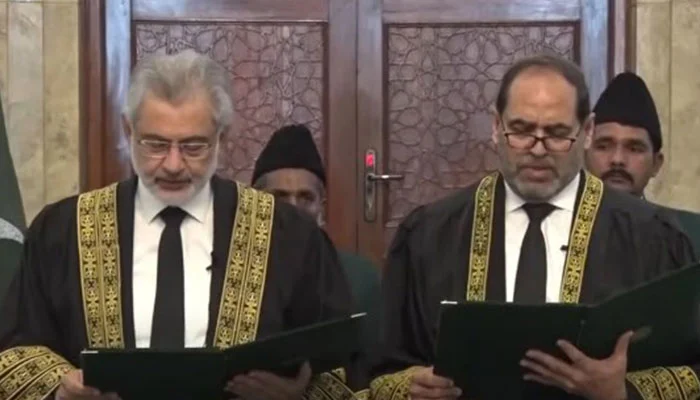
Justice Naeem Akhtar Afghan takes oath as top court judge

Justice Naeem Akhtar Afghan Monday was sworn in as a Supreme Court judge in the oath-taking ceremony administered by Chief Justice of Pakistan (CJP) Qazi Faez Isa in the apex court in Islamabad.

The development comes after former president Arif Alvi last week, had approved the appointment of Justice Afghan, who was serving as Balochistan High Court chief justice, to the country’s top court under Article 175(A) of the Constitution.

Meanwhile, Justice Muhammad Hashim Khan Kakar is poised to become acting chief justice of the Balochistan High Court (BHC), under Article 196 of the Constitution following Alvi’s approval, media reported.

On Friday Justice Malik Shehzad Ahmed Khan was also sworn in as the Lahore High Court (LHC) Chief Justice following the ex-president’s approval.

With Afghan’s elevation as a top court judge, the number of judges of the apex court stands at 14 with a further three vacant posts in the apex court. He has joined the CJP Isa, Justice Mansoor Ali Shah, Justice Munib Akhtar, Justice Yahya Afridi, Justice Amin-ud-Din, Justice Jamal Khan Mandokhail, Justice Muhammad Ali Mazhar, Justice Ayesha A Malik, Justice Athar Minallah, Justice Hasan Azhar Rizvi, Justice Shahid Waheed, Justice Mussarat Hilali and Justice Irfan Khan.

Who is Justice Afghan?

Born in 1963, Justice Afghan is the son of a retired government servant and holds a degree in Economics and Statistics and an LLB from Degree College Quetta and University Law College Quetta, respectively. Enrolled as an advocate of BHC in 1989 and an advocate of the SC in 2001.

As per the judge’s profile on the SC website, Afghan “practised law for 21 years before the subordinate courts, BHC, Federal Shariat Court and the apex court during which he conducted innumerable criminal, civil, and constitutional cases which have been reported in law journals.”

In 2011, he was elevated as an Additional Judge of the BHC followed by his appointment as a judge in 2012 and eventually as the province’s top court’s chief justice in 2021. He has previously served in various capacities and roles such as a member of the Alternate Dispute Resolution (ADR) Committee, chairman of the Building Committee, chairman of the Committee for Utilization of Funds under the Provincial Judicial Development Fund (PJDF), member of the National Judicial Automation committee and others.

Author

Khudayar Mohla, Managing Partner Mohla & Mohla, Founder of the Law Today Pakistan,

Managing Partner at Mohla & Mohla - Advocates and Legal Consultants, Islamabad, Founder of The Law Today Pakistan (TLTP) Newswire Service. Former President Press Association of Supreme Court of Pakistan with over two decades of coverage of defining judicial moments - including the dissolution and restoration of Chief Justice Iftikhar Muhammad Chaudhry, Asif Ali Zardari NAB cases, Syed Yousaf Raza Gillani contempt proceedings, Panama Papers case against Mian Nawaz Sharif, matters involving Imran Khan, and the high treason trial of former Army Chief and President Pervez Musharraf. He now practises law and teaches Jurisprudence, International Law, Civil and Criminal Law. Can be reached at: mohla@lawtoday.com.pk

More From Author

Leave a Reply

Your email address will not be published. Required fields are marked *

You May Also Like

Khudayar Mohla,Islamabad High Court, IHC, Justice Mohsin Akhtar Kayani, Dr. Zeeshan Ashraf, IVY School of Law, IVY College of Management Sciences, Amicus Curiae, Haq Mehr, Dower Rights, Islamic Jurisprudence, Shariah Law, Limitation Act 1908, Article 104 Limitation Act, Article 227 Constitution of Pakistan, Women's Financial Rights, Widow Inheritance, West Pakistan Family Courts Act 1964, Surah An-Nisa, Law and Justice Commission of Pakistan, National Commission on the Status of Women, Matrimonial Financial Disputes, Pakistan Legal News, Legislative Reform.

IVY School of Law HoD’s Dr. Zeeshan Ashraf Convinces IHC to Overturn Dower Time-Bar

ISLAMABAD: In a precedent-setting 21-page judgment aimed at harmonizing statutory law with Islamic injunctions, the…

Federal Constitutional Court Pakistan, FCC Pakistan judgment, tax raid without notice Pakistan, tax authorities raid powers, Justice Aamer Farooq decision, Income Tax Ordinance 2001 Pakistan, FBR enforcement powers, taxpayer raid law Pakistan, tax compliance enforcement Pakistan, super tax Pakistan ruling, Section 4(b) Income Tax Ordinance, Section 4(c) Income Tax Ordinance, Islamabad High Court contempt case, missing persons case Pakistan courts, Shehbaz Sharif contempt case, Aafia Siddiqui case legal developments, PTI cases in courts Pakistan, Article 175E Constitution Pakistan, judiciary independence debate Pakistan, Pakistan constitutional court performance, Khudayar Mohla Advocate

FCC Says Tax Authorities Can Conduct Raids Without Prior Notice

ISLAMABAD: In another legal reprieve for the government, the Federal Constitutional Court ruled that tax…

Khudayar Mohla Advocate, Editor Law Today Khudayar Mohla,Peshawar High Court, PHC, Tirah Valley, Tirah evacuation, illegal evacuation, unconstitutional evacuation, Khyber Pakhtunkhwa government, federal government, IDPs, internally displaced persons, Zarak Khan Afridi, Barrister Saud Javed Dawar, Advocate Mohammad Yousaf Orakzai, military operation, Khyber tribal district, relief and rehabilitation, compensation for displaced, safe return, lawful procedure, KP Assembly, Article 232, Pakistani courts, preliminary hearing, displaced population, extreme weather, snow, civilian safety, federal response, provincial response, court directives, Pakistan news, legal proceedings, Peshawar news

PHC Seeks Centre, KPK Response on Tirah Evacuation Plea

PESHAWAR: While issuing notices to federal and Khyber Pakhtunkhwa governments on Wednesday in response to …