

Categories Courts

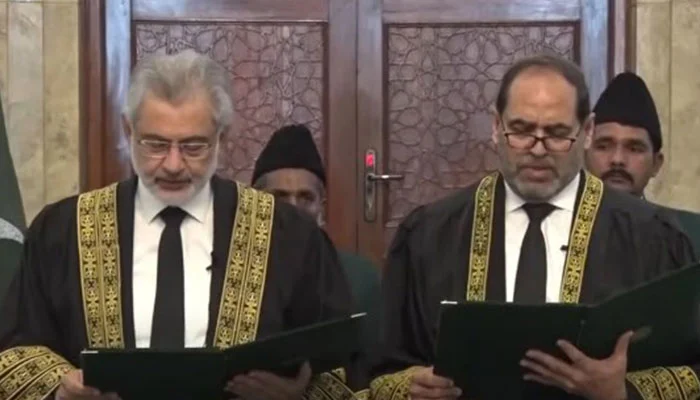
Justice Naeem Akhtar Afghan takes oath as top court judge

Justice Naeem Akhtar Afghan Monday was sworn in as a Supreme Court judge in the oath-taking ceremony administered by Chief Justice of Pakistan (CJP) Qazi Faez Isa in the apex court in Islamabad.

The development comes after former president Arif Alvi last week, had approved the appointment of Justice Afghan, who was serving as Balochistan High Court chief justice, to the country’s top court under Article 175(A) of the Constitution.

Meanwhile, Justice Muhammad Hashim Khan Kakar is poised to become acting chief justice of the Balochistan High Court (BHC), under Article 196 of the Constitution following Alvi’s approval, media reported.

On Friday Justice Malik Shehzad Ahmed Khan was also sworn in as the Lahore High Court (LHC) Chief Justice following the ex-president’s approval.

With Afghan’s elevation as a top court judge, the number of judges of the apex court stands at 14 with a further three vacant posts in the apex court. He has joined the CJP Isa, Justice Mansoor Ali Shah, Justice Munib Akhtar, Justice Yahya Afridi, Justice Amin-ud-Din, Justice Jamal Khan Mandokhail, Justice Muhammad Ali Mazhar, Justice Ayesha A Malik, Justice Athar Minallah, Justice Hasan Azhar Rizvi, Justice Shahid Waheed, Justice Mussarat Hilali and Justice Irfan Khan.

Who is Justice Afghan?

Born in 1963, Justice Afghan is the son of a retired government servant and holds a degree in Economics and Statistics and an LLB from Degree College Quetta and University Law College Quetta, respectively. Enrolled as an advocate of BHC in 1989 and an advocate of the SC in 2001.

As per the judge’s profile on the SC website, Afghan “practised law for 21 years before the subordinate courts, BHC, Federal Shariat Court and the apex court during which he conducted innumerable criminal, civil, and constitutional cases which have been reported in law journals.”

In 2011, he was elevated as an Additional Judge of the BHC followed by his appointment as a judge in 2012 and eventually as the province’s top court’s chief justice in 2021. He has previously served in various capacities and roles such as a member of the Alternate Dispute Resolution (ADR) Committee, chairman of the Building Committee, chairman of the Committee for Utilization of Funds under the Provincial Judicial Development Fund (PJDF), member of the National Judicial Automation committee and others.

Author

Khudayar Mohla, Managing Partner Mohla & Mohla, Founder of the Law Today Pakistan,

Managing Partner at Mohla & Mohla - Advocates and Legal Consultants, Islamabad, Founder of The Law Today Pakistan (TLTP) Newswire Service. Former President Press Association of Supreme Court of Pakistan with over two decades of coverage of defining judicial moments - including the dissolution and restoration of Chief Justice Iftikhar Muhammad Chaudhry, Asif Ali Zardari NAB cases, Syed Yousaf Raza Gillani contempt proceedings, Panama Papers case against Mian Nawaz Sharif, matters involving Imran Khan, and the high treason trial of former Army Chief and President Pervez Musharraf. He now practises law and teaches Jurisprudence, International Law, Civil and Criminal Law. He holds a Master in Mass Communications and an LLM degree. Contact: mohla@lawtoday.com.pk

More From Author

Leave a Reply

Your email address will not be published. Required fields are marked *

You May Also Like

Supreme Court of Pakistan, right to privacy, DNA test ruling, parentage confirmation, paternity dispute Pakistan, Article 14 Constitution of Pakistan, Article 9 Right to Liberty, human dignity, judicial system Pakistan, Khalid Hameed case, fundamental rights, personal autonomy, bodily integrity, unauthorized medical procedures, sanctity of family life, due process, legal justification for DNA test, inheritance dispute law, Anti-Corruption Court Pakpattan, Lahore High Court revision petition, Justice Muhammad Hashim Khan Kakar, ocietal embarrassment, psychological stigma, privacy rights, protection of women's reputation, moral integrity of the mother, genetic blueprint security, personal data protection, surveillance and disclosure, individual self-determination, Supreme Court ruling on DNA testing without consent, right to privacy under Article 14 Pakistan, legal protection against paternity challenges, impact of mandatory DNA tests on dignity, protection of genetic information in Pakistan law.

SC Bars Compulsory Paternity DNA Test, Citing Protection of Mother’s Character

ISLAMABAD: Affirming the right to privacy, the Supreme Court has set aside a subordinate court’s…

Lahore High Court, LHC Rawalpindi Bench, Justice Jawad Hassan, mediation, Alternate Dispute Resolution Act 2017, Shamsabad land dispute, Ojhri Camp compensation, military land dispute, land acquisition Pakistan, Panorama Shopping Centre, Article 199 Constitution, amicable settlement, land compensation Pakistan, Pakistan Army land dispute, legal mediation Pakistan, court-directed mediation, Pakistan land litigation, landowners dispute, fair market compensation, out-of-court settlement, Defence Ministry land, Pakistan judiciary, civil dispute resolution, structured mediation, Air Defence Command Pakistan, LHC directives, decades-old land dispute, Pakistan legal news

Mediation Mandated: Justice Jawad Hassan Sets Three-Month Deadline in Ojhri Camp Land Case

RAWALPINDI: Mediation – a process in which a mediator facilitates communication and negotiation to help…

Landmark Policy Shift: SC Streamlines Case Fixation for Litigant Accessibility

ISLAMABAD – In a significant move aimed at dramatically enhancing the efficiency of its operations and…