
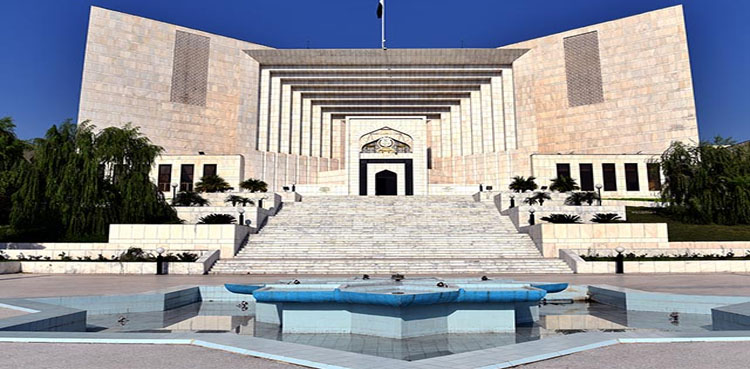
Identical intra-court pleas urged Constitutional Bench of the top court on Tuesday to strike down Sections 2(1)(d)(i) and (ii) of the Pakistan Army Act (PAA) on the basis of Article 10A of the Constitution that guarantees the right to a fair trial.
Unlike elsewhere in the world where civilians cannot be dragged into courts that are not independent, Section 2(1)(d)(ii) of PAA permits citizens’ trial by military courts in Pakistan, argued senior counsel Salman Akram Raja representing Arzam Junaid, who was sentenced to six years by a military court in connection with the May 9 violence.
Headed by Justice Aminuddin Khan, the seven-judge Constitutional Bench (CB) was hearing a set of intra-court appeals against the October 2023 order of the five-judge bench that nullified civilians’ trial by the military courts in the May 9 case.
While Salman Akram Raja, who is also PTI secretary general, completed his arguments, Uzair Bhandari, representing PTI’s founding chairman Imran Khan, will commence his arguments on Wednesday.
Mr Raja also cited the detailed reasons of Justice Ayesha A. Malik in the October 2023 decision. According to Justice Malik, Article 10A is a categorical, unqualified, and fundamental right that guarantees a fair trial and due process to individuals facing trial.
This right is not merely an ethical notion or philosophical concept, but a fundamental right enshrined in the Constitution that must be upheld. Consequently, Justice Malik ruled that fundamental rights cannot be compromised simply because it is deemed expedient.
Thus, Article 10A is a very powerful and standalone provision of the Constitution, and if the CB decides the present appeals based solely on Article 10A, it would be entirely sufficient and satisfactory, the counsel emphasised. As an independent court, rather than a military court, is an essential requirement, any court presided over by an executive officer, a colonel, or any senior military officer cannot be deemed an independent court, regardless of the severity of the crime committed by the accused, the counsel argued.
However, he expressed serious reservations with certain observations of Justice Munib Akhtar in his detailed reasoning on the military trial, and said application of these observations would have a catastrophic effect on civilians’ trials.
According to Justice Akhtar, challenge in terms of Article 175 to courts martial is of no avail. “All that is meant is that courts martial as presently conceived and understood, for historical reasons stand outside the framework of Article 175 (3) and cannot be constitutionally attacked or challenged.”
The counsel reiterated that the CB was not bound by the October 2023 observations, as it has to interpret the Constitution in the correct manner while deciding the appeals.
If exception was allowed on the basis of historical perspective or the moral ground, then it would provide exception to judges to decide matters on the basis of their perception of morality and historical backgrounds and thus would become very dangerous, the counsel said, while citing the then CJP Qazi Faez Isa’s ruling on review petitions against Article 63A’s interpretation in which the latter regretted the tendency of replacing constitutional provisions with personal likes and moralism.
At this, Justice Jamal Khan Mandokhail observed that at least the counsel finally appreciated the judgement on Article 63A. The counsel argued that courts should give decisions on the express text of the Constitution rather than their personal beliefs or perceptions. To put it simply, he said, a court martial could not be conducted by abolishing fundamental rights, adding that civilians’ court martial was also against the international norms of fair trial.
He emphasised Article 10A was made a part of the Constitution in the light of international norms, adding that a European court decision compelled many countries to change their court martial procedures.
When Justice Naeem Akhtar Afghan remarked it was not written anywhere internationally that civilians could not be court martialed, the counsel reminded him that in the UK, court martial was conducted by independent judges, and not army officials.
The counsel said the UN Human Rights Committee had expressed concern over the court martial of civilians in Pakistan, saying these were not independent and that bails should also be granted at the trial stage.
During the hearing, the counsel cited a 1997 case from the European Court of Human Rights, which had declared British soldier Alexander Findlay’s trial illegal. Findlay had been court-martialled in the UK after opening fire and breaking a TV set while under severe mental stress. Justice Muhammad Ali Mazhar noted a parallel with the May 9 violence, where a TV was also broken.
In response, the counsel shared that he had met the suspect, describing how he was consumed by shame. The man was jobless and did not complete his primary school education, he said. “What has our society given to such people?”