

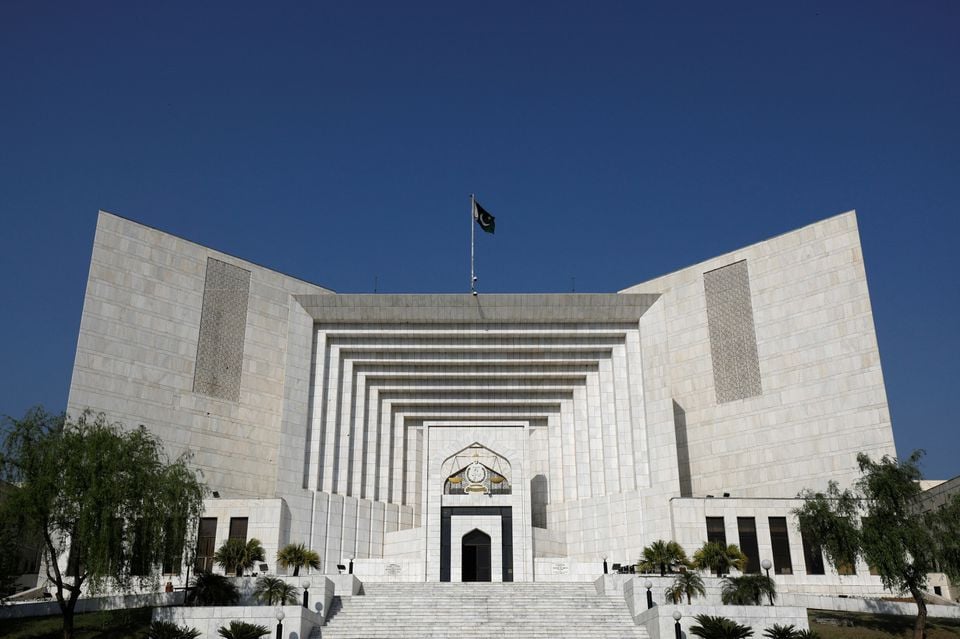
While resuming hearing of identical pleas relating to trial of civilian, involved in May 09 violence a member of the constitutional bench of the top court cited extension in the service of former army chief Qamar Javed Bajwa as precedent as court directive in administrative functions.
A seven-judge constitutional bench was hearing the pleas seeking revisit of top court’ October 23,2023 verdict that nullified military trial of civilian in the matter. During proceeding of the case, a member of the bench Justice Naeem Akhtar Afghan recalled the issue of “an army chief’s tenure,” which was resolved by the Supreme Court’s suggestion to the parliament.
In August 2019, then prime minister Imran Khan extended the tenure of Gen Bajwa – set to retire on November 29, 2019 – for three years. On a petition challenging the PM’s decision, a three-judge Supreme Court bench first suspended Gen Bajwa’s extension but then allowed him to remain at the post for six months, during which parliament was asked to legislate on the tenure and terms and conditions of the army chief’s service.
“There was no provision of extension in service tenure of the army chief, but the law was enacted on Supreme Court’s suggestion to the parliament in 2019,” Justice Afghan observed on Tuesday.
Justice Aminuddin Khan, who is heading the CB, recalled how political parties sat together in parliament to grant an extension to the former army chief. “This was the state of affairs at that time.”
The extension in Gen Bajwa’s tenure came up when Justice Muhammad Ali Mazhar asked Uzair Karamat Bhandari, the counsel for PTI founder Imran Khan, to cite any judicial precedent where the court directed the government on any administrative functions.
While hearing cases under Article 184(3) of the Constitution, the Supreme Court can issue any direction to the government, the counsel argued. Mr Bhandari recalled that in 2014, on a petition filed by MQM, the court had directed the Election Commission of Pakistan and the government to improve election laws.
He also cited the 2001 Asfandyar Wali case, in which the top court directed the government to improve the law governing the National Accountability Bureau.
Letters from prison
The exchange between Mr Khan’s counsel and the bench took an interesting turn when he cited restrictions on his client, who is incarcerated in Adiala Jail.
Mr Bhandari contended that “not a piece of paper is allowed inside Adiala Jail” since visitors were thoroughly frisked before entering the premises.
At this, Justice Khan asked the counsel “not to go into this controversy” and remarked that “two-page letters were coming out of the jail these days”.
This was a reference to two letters written by Mr Khan to Army Chief Gen Asim Munir earlier this month.
The letters said to have been written by Mr Khan, urged the military to “reevaluate” its policies because “the distance between the people and the establishment was widening”.
International obligations
The judges also questioned the Supreme Court’s obligations to follow international conventions when deciding cases on local law. Mr Bhandari cited Article 14 of the United Nations’ International Covenant on Civil and Political Rights (ICCPR), which was ratified by Pakistan.
Article 14, which has seven sub-clauses, outlines the rights and procedures for individuals to get “fair and public hearing by a competent, independent and impartial tribunal established by law”.
The counsel then cited a Supreme Court judgment from 1958, which held that the top court would also consider international conventions while interpreting domestic laws.
Mr Bhandari also cited the order in the 1999 Farooq Leghari case, where the court considered Article 4 of ICCPR while deciding the matter. He contended that the Supreme Court had sought the assistance of ICCPR in many cases to preserve the fundamental rights of the people.
However, Justice Hilali observed the obligation to comply with international conventions was on the federal government and not the Supreme Court. The counsel also referred to the Generalized System of Preferences (GSP Plus) status granted by the EU, which allows Pakistani goods duty-free entrance into the European market.
The GSP Plus status is a “lifeline for our ailing economy”, Mr Bhandari claimed, adding the preferred status was “under threat” since the EU has taken a position on the trial of civilians by the military court.
At this, Justice Jamal Khan Mandokhail wondered whether the extension of rights was subject to international benefit or should be extended unconditionally. Justice Afghan brought up the ordinance promulgated by the president to grant the right of appeal to Indian spy Kulbushan Jadhav, who was sentenced to death by a military tribunal for espionage and fomenting terrorism in Pakistan.
However, Additional Attorney General (AAG) Chaudhry Aamir Rehman explained that the law was necessitated by a decision of the International Court of Justice. “We can give consular service to a foreigner, but the right of appeal was being denied to our citizens, remarked Justice Mandokhail .” However, AAG Rehman said the right of appeal was available to convicts in the present case.