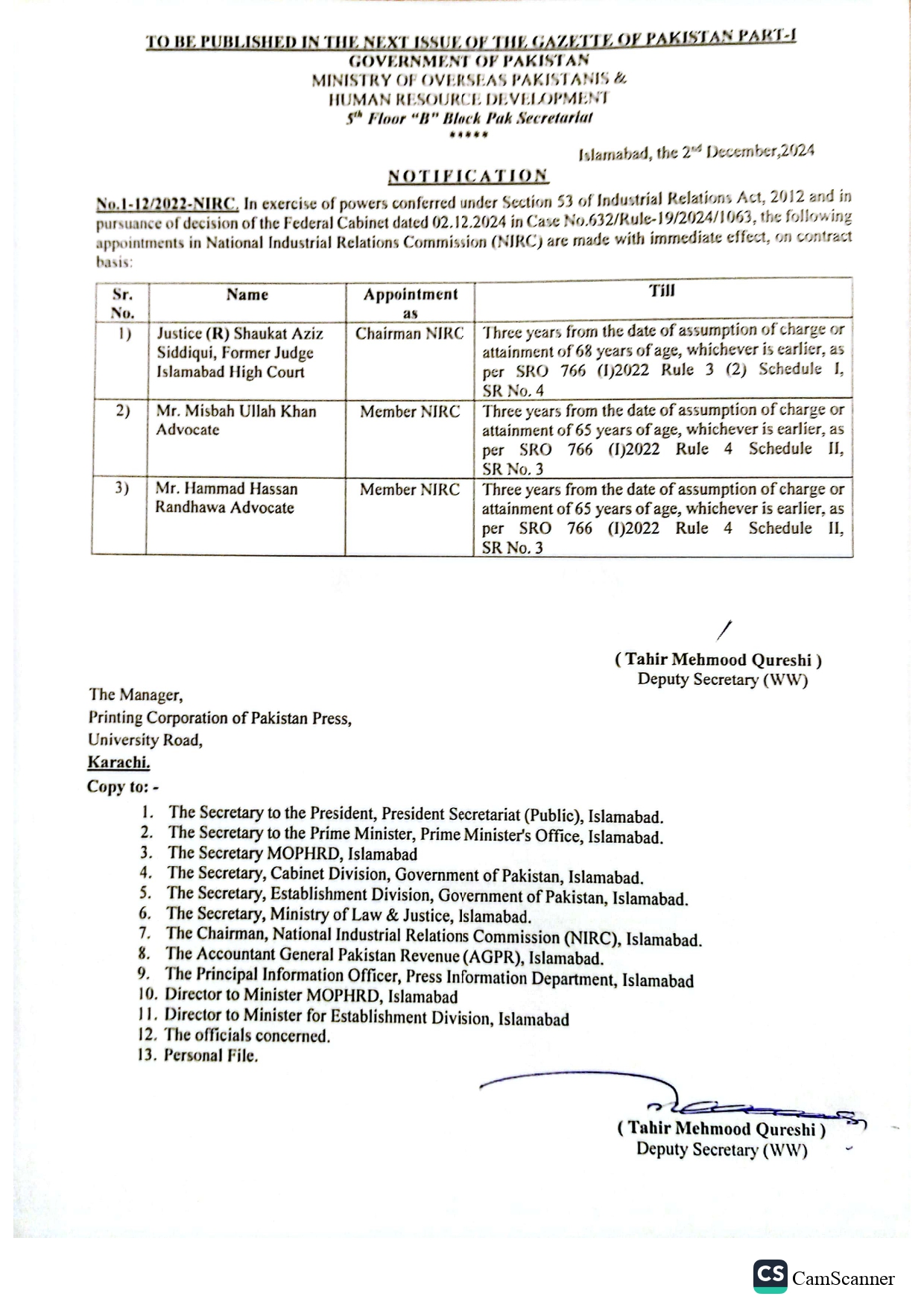

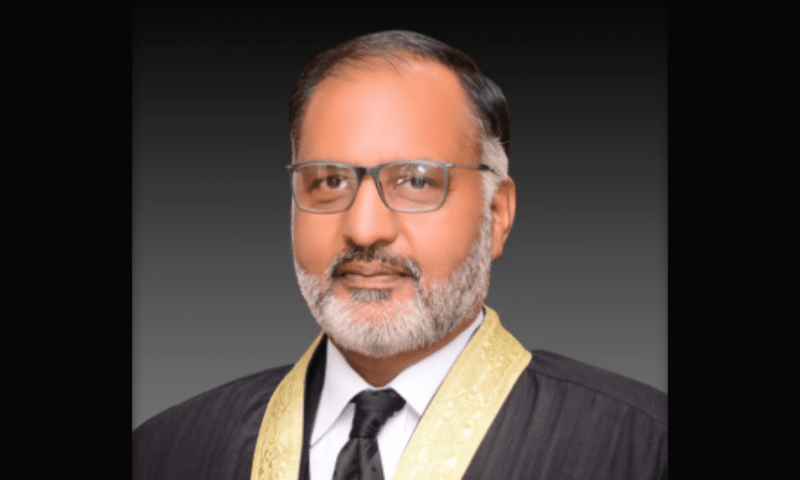
In a groundbreaking move to modernize the delivery of justice in resolving industrial disputes between employer and workman, the National Industrial Relations Commission (NIRC), under the leadership of Chairman Justice (Retired) Shaukat Aziz Siddiqui, has implemented video link hearing facilities in seven cities across Pakistan. This reform has significantly improved access to justice for workers and employers while reducing time delays and litigation costs.
Soon after assuming charge of the Commission a few months ago, Chairman Siddiqui set out to utilize the Commission’s limited resources to maximize its delivery and outreach. Emphasizing access, efficiency, and transparency, he introduced the video link hearing system to ensure that remedy seekers – both employers and workmen – can present their cases without the burden of travelling long distances or bearing unnecessary legal expenses.
“As a lawyer and litigant entering the NIRC building Islamabad, one will immediately sensed a transformation – not just in structure, but in spirit. Once a traditional forum for employer – workman disputes, the Commission now feels reimagined. The greenery outside, clean courtrooms, and efficient staff reflect a refreshing shift. Since Justice (Retd) Shaukat Aziz Siddiqui took charge as Chairman on December 24, administrative efficiency and a renewed commitment to justice have become visible. With his legal insight and aesthetic sense, the NIRC now delivers both form and function. For regular practitioners, the impact is clear: cases move faster, the environment is welcoming, and justice feels dignified and under Chairman Siddiqui’s leadership, no longer delayed.”
The full bench of the Commission is now conducting regular hearings through video link in major cities including Islamabad, Lahore, Karachi, Quetta, Peshawar, Multan, and Sukkur. This innovation allows parties or their legal representatives to appear from their respective stations, saving time and financial resources. What was once a laborious process involving week-long hearing sessions in different cities is now being managed swiftly and effectively through technology.
In a conversation with journalists during March this year, Chairman Siddiqui shared that the introduction of virtual hearings has resulted in the disposal of nearly 80% of the previously pending cases within the last three months. Additionally, there has been a marked increase in the number of new case registrations, indicating the rising trust of the working class and industrial stakeholders in the Commission’s performance.
Chairman Siddiqui, who had earned the respect of both litigants and the judiciary during his law practice, brings with him a deep commitment to the rule of law and social justice. His experience and legal acumen have allowed him to approach the Commission’s mandate with clarity and resolve. He has repeatedly expressed his intention to realize the objectives outlined in the preamble of the Industrial Relations Act 2012 – particularly the recognition of the freedom of association, the right to collective bargaining, and the need to regulate fair relations between employers and workers.
The role of Registrar Arbab Amjad has also been acknowledged in the successful implementation of this initiative. His dedicated efforts as a team member were instrumental in translating the Commission’s vision into practical reality, in line with the spirit of the law.
Established in 1972 following amendments to the Industrial Relations Ordinance of 1969, the NIRC was initially mandated to register trade unions and federations at industrial and national levels. Over time, its role expanded to cover unfair labour practices and dispute resolution. After the 18th Constitutional Amendment, labour matters were devolved to provinces, but the Industrial Relation Act 2012 now governs federal and inter-provincial labour issues.
Members of the legal fraternity, labour law practitioners, and union leaders across the country have welcomed this initiative as a “landmark development.” They believe that the use of modern technology will not only expedite the resolution of long-standing disputes but also promote trust in legal institutions and reinforce industrial peace.