

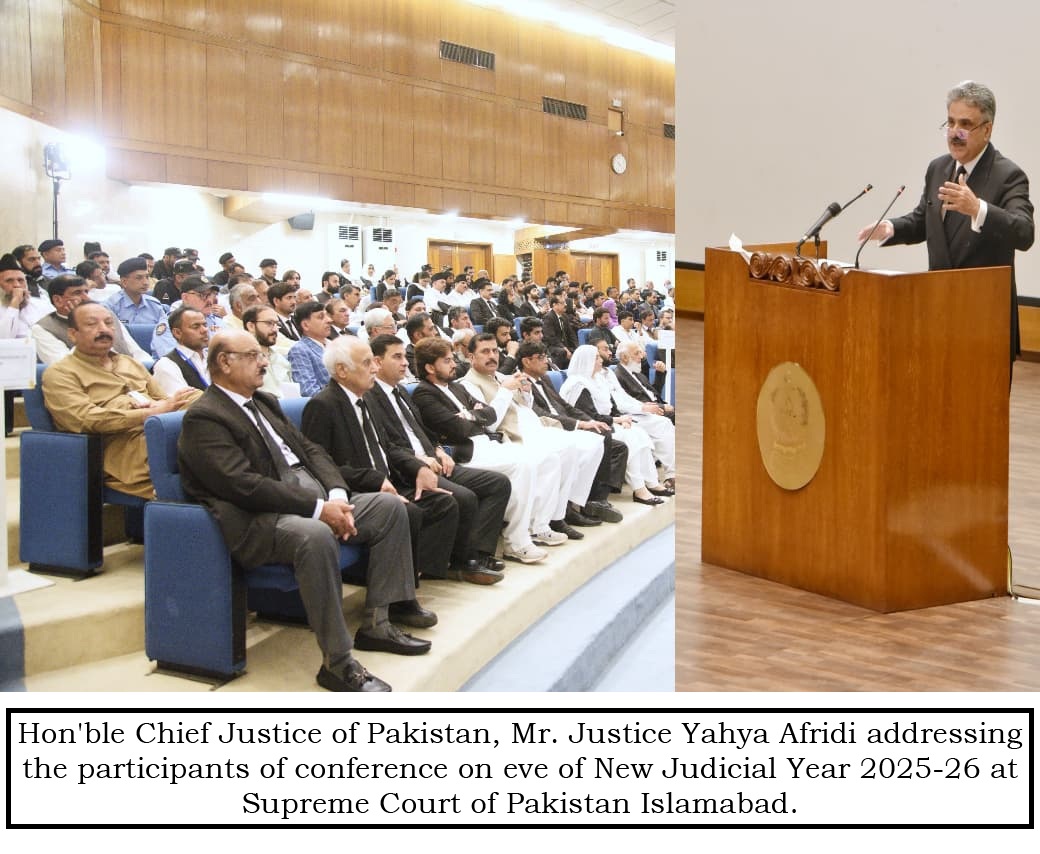
ISLAMABAD – Top Court is charting a new course for the country’s legal system as during its annual Judicial Conference Monday, Chief Justice Yahya Afridi and other court leaders reviewed the past year’s work and unveiled a bold reform agenda for the future. Judges, top lawyers, and journalists attended the event, which signals the court’s commitment to modernizing justice and making it more accessible to everyone.
- pin up
- 1win aviator
- pinup
- mostbet
- mosbet casino
- mostbet
- mostbet
- pin up casino
- 1 win casino
- mosbet
- мостбет казино играть
- lucky jet
- pin up slots
- aviator
- pin up
- pinup casino
- pinco
- pinup
- 1vin
- pinko
- 1win casino
- 1 vin
- snai app
- mosbet casino
- pinup
- 4a bet
- 1 win tr
- 1 win
- mostbet
- pin up casino
- 1 win online
- 1 win casino
- 1 win casino
Addressing the gathering on the occasion, the Chief Justice emphasized that the conference is more than a formality; it is a critical opportunity for genuine reflection and strategic planning. He highlighted the wide-ranging reforms initiated over the past year, which he said were aimed at creating a more “citizen-centric” justice system by reducing backlog, shortening timelines, and enhancing accessibility.
The Chief Justice detailed five foundational pillars of the reform agenda including Improving Service Delivery: Leveraging technology to modernize judicial processes. Enhancing Access and Transparency: Making the court more open and accountable to the public. Strengthening the Legal Framework: Updating laws and rules to improve efficiency. Leveraging Resources: Utilizing both international and external support. Revitalizing Institutions: Strengthening attached judicial bodies.
Major achievements were cited, including the successful implementation of digital case filing, e-notices, and video-link hearings.11 The court also launched key public-facing initiatives, such as an anti-corruption hotline, a public feedback portal, and the establishment of the Overseas Litigants Facilitation Cell (OLFC).
The notification of the new Supreme Court Rules, 2025, was also highlighted as a significant milestone.
Presenting the court’s performance data, the Chief Justice reported that from September 2024 to September 2025, the Supreme Court disposed of 22,863 cases, surpassing the 20,811 new cases instituted during the same period. This led to a notable reduction in overall pendency from 60,635 to 56,943 cases. However, the Chief Justice also called upon the Bar to assist in reducing the sharp rise in adjournments.
The conference concluded with three symbolic inaugurations, underscoring the judiciary’s commitment to its various stakeholders.17 A randomly invited litigant, Mr. Muhammad Basharat Javed, inaugurated the Public Facilitation Centre, symbolizing the citizen’s central role in the justice system.18 The Supreme Court Media Platform was inaugurated by Mr. Zulqarnain Iqbal, President of the Court Reporters Association, acknowledging the press’s role in promoting transparency. Finally, Mian Muhammad Rauf Atta, President of the Supreme Court Bar Association, inaugurated the Supreme Court Bar Cafeteria, recognizing the Bar’s integral part in the justice system.
In his closing remarks, the Chief Justice reaffirmed the judiciary’s mission to build on these reforms in the new year, ensuring a justice system that is stronger, swifter, and more accessible for all citizens of Pakistan.