


Categories Courts

LHC Justice Jawad Hassan Decodes Legal Anthropology of Pakistan’s Constitution

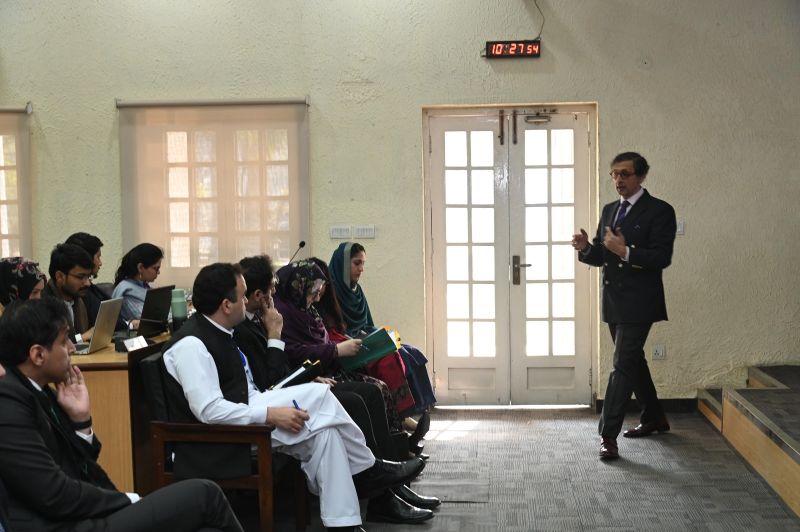
LAHORE : In a profound historical analysis, Justice Jawad Hassan of the Lahore High Court delivered a lecture at the Civil Services Academy, urging participants to view the Constitution not as a static document, but as a living organism that reflects the social, political, and cultural shifts of the Pakistani people.

Justice Hassan who is also member of the Board of Management of the Punjab Judicial Academy, meticulously detailed the ‘Aetiology’ or the underlying causes of various constitutional amendments, explaining how each change was a response to the shifting needs of the state.

Addressing the future leadership of Pakistan’s bureaucracy days ago, Justice Hassan explored the intricate ‘Legal Anthropology of the Pakistani Constitution,’ tracing the evolutionary arc from 1937 to the current 1973 framework. The session served as an intellectual deep-dive into the ‘Aetiology’ of constitutional amendments, framed through the lens of judicial precedents and the tension between legal Orthodoxy and Heterodoxy.

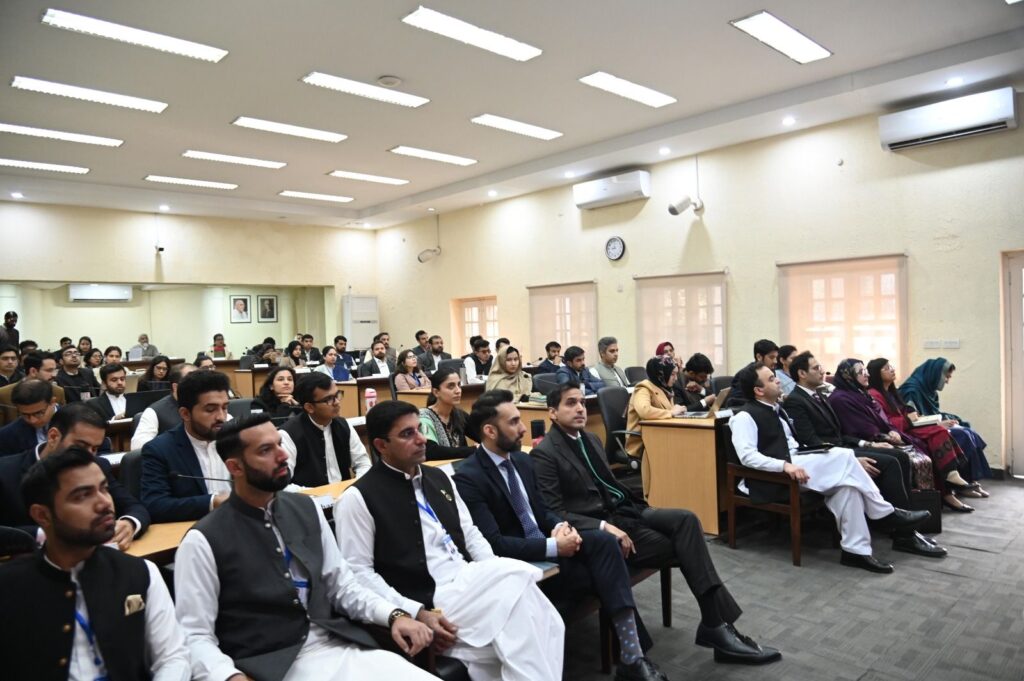
The lecture hall at the CSA was filled with the next generation of Pakistan Administrative Service (PAS) officers. The audience included as many as 55 Probationers (BS-17) of the 48th Specialized Training Programme (STP), 13 PAS Officers (BS-18) attending the Domain-Specific Mid-Career Management Course, more than 200 Probationers (BS-17) of the 54th Common Training Programme (CTP), who joined the session via video link from various regions.
Khudayar Mohla,Justice Jawad Hassan, Lahore High Court, Civil Services Academy, Constitution of Pakistan, constitutional interpretation, living constitution, constitutional amendments Pakistan, Punjab Judicial Academy, legal anthropology Pakistan, judicial precedents, Supreme Court Pakistan, High Courts Pakistan, orthodoxy vs heterodoxy, judicial philosophy Pakistan, Government of India Act 1935, Constitution 1973, rule of law Pakistan, separation of powers, judiciary and civil service, Pakistan Administrative Service, PAS officers training, CSA Lahore, STP probationers, CTP probationers, legal literacy, constitutional governance, Pakistani judiciary

Justice Hassan’s lecture went beyond mere dates, analyzing the ‘DNA’ of Pakistani law. He began with the Government of India Act 1935 (applied in 1937), explaining how it laid the structural foundations for the subsequent 1956, 1962, and 1973 Constitutions. A key highlight of the session was the discussion on the Judicial Anthology of the Superior Courts. Justice Hassan analyzed how precedents from the Supreme Court and High Courts have shaped the interpretation of the law.

He introduced the compelling dichotomy of Orthodoxy vs. Heterodoxy saying the orthodoxy is the traditional, strict adherence to established legal norms and the literal text of the Constitution. Whereas Heterodoxy is the innovative, progressive judicial thought that adapts to modern challenges, ensuring the law remains a tool for justice in a changing world. The session concluded with an interactive Q&A, where Justice Hassan urged the probationers to understand that the administration of the state (Civil Service) and the interpretation of the law (Judiciary) are two pillars of the same house.

The lecture has been hailed as an “intellectually enriching session” that provided the civil servants with the critical legal literacy required to navigate the complexities of governance while remaining steadfastly within the bounds of constitutional mandates.

Author

Khudayar Mohla, Managing Partner Mohla & Mohla, Founder of the Law Today Pakistan,

Managing Partner at Mohla & Mohla - Advocates and Legal Consultants, Islamabad, Founder of The Law Today Pakistan (TLTP) Newswire Service. Former President Press Association of Supreme Court of Pakistan with over two decades of coverage of defining judicial moments - including the dissolution and restoration of Chief Justice Iftikhar Muhammad Chaudhry, Asif Ali Zardari NAB cases, Syed Yousaf Raza Gillani contempt proceedings, Panama Papers case against Mian Nawaz Sharif, matters involving Imran Khan, and the high treason trial of former Army Chief and President Pervez Musharraf. He now practises law and teaches Jurisprudence, International Law, Civil and Criminal Law. Can be reached at: mohla@lawtoday.com.pk

More From Author

Leave a Reply

Your email address will not be published. Required fields are marked *

You May Also Like

Khudayar Mohla,Rawalpindi Judicial Complex, judicial lock-up expansion, Bakhshi Khana Rawalpindi, Rawalpindi courts infrastructure, judicial lock-up renovation, Rs48.366 million project, Adiala Jail accused, court lock-up facilities Pakistan, Rawalpindi Kacheri lock-up, judicial complex Rawalpindi, accused holding facility, security enhancement courts, judicial infrastructure development, Punjab court facilities, Anti-Terrorism Court lock-up, NAB court Rawalpindi, Anti-Narcotics Court Rawalpindi, Customs Court Rawalpindi, Banking Crimes Court Rawalpindi, Drugs Court Rawalpindi, FIA court Rawalpindi, Anti-Corruption Court Rawalpindi, sessions courts Rawalpindi, civil courts Rawalpindi, court security arrangements, judicial administration Pakistan, public sector development project, court renovation project, detainee facilities Pakistan, prison to court transfer, law and justice infrastructure, Rawalpindi district administration

Judicial Lock-Up Facilities to Be Expanded; Rs48.366m Project Set for Six-Month Completion

RAWALPINDI: The expansion and renovation project of the judicial lock-up (Bakhshi Khana) at the Rawalpindi…

Public Facilitation Center, Islamabad Supreme Court of Pakistan – Where Justice Meets the Litigant

ISLAMABAD, (PR) – Justice is not measured only by the words written in judgments. It…

Supreme Court of Pakistan, FIR rights, Faryaadi term, Bakhidmat Janaab SHO, police terminology Pakistan, police reforms Sindh, Section 154 CrPC, citizens legal rights, criminal justice system Pakistan, colonial police legacy, police accountability, delayed FIR registration, Section 201 PPC, police officers duty, police public service, Itlaah Deendhar, Shikayat Kandhar, Itlaah Dahinda, Sindh police reforms, constitutional guarantees Pakistan, rights-based policing, criminal petition verdict, Sindh High Court, murder case appeal, Pakistan police procedure, criminal law Pakistan, top court landmark verdict, citizen protection law, law today Pakistan, Khudayar Mohla, Justice Muhammad Hashim Khan Kakar, Justice Salahuddin Panhwar, Justice Ishtiaq Ibrahim

SC Banishes ‘Faryaadi’ Culture and ‘Bakhidmat Janaab SHO’ Salutations to End Colonial Policing Legacies

ISLAMABAD: Announcing its 19-page landmark verdict , the Supreme Court made it clear that citizens…