
Categories Courts

LHC Justice Jawad Hassan Decodes Legal Anthropology of Pakistan’s Constitution

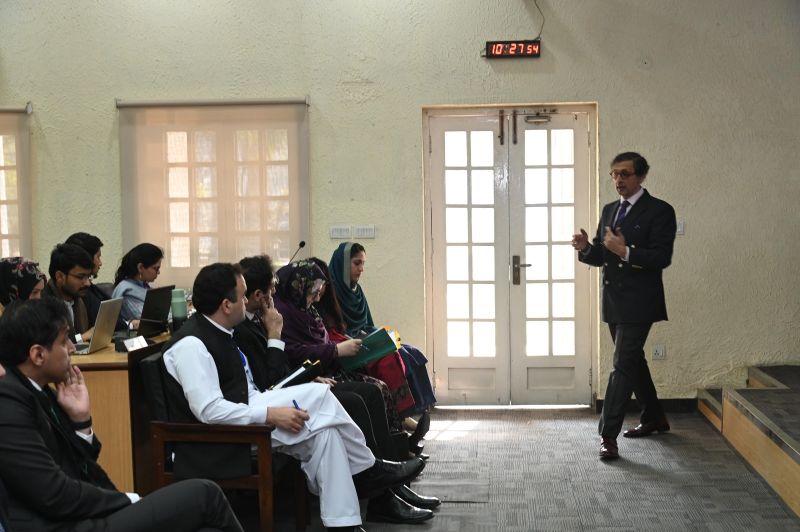
LAHORE : In a profound historical analysis, Justice Jawad Hassan of the Lahore High Court delivered a lecture at the Civil Services Academy, urging participants to view the Constitution not as a static document, but as a living organism that reflects the social, political, and cultural shifts of the Pakistani people.

Justice Hassan who is also member of the Board of Management of the Punjab Judicial Academy, meticulously detailed the ‘Aetiology’ or the underlying causes of various constitutional amendments, explaining how each change was a response to the shifting needs of the state.

Addressing the future leadership of Pakistan’s bureaucracy days ago, Justice Hassan explored the intricate ‘Legal Anthropology of the Pakistani Constitution,’ tracing the evolutionary arc from 1937 to the current 1973 framework. The session served as an intellectual deep-dive into the ‘Aetiology’ of constitutional amendments, framed through the lens of judicial precedents and the tension between legal Orthodoxy and Heterodoxy.

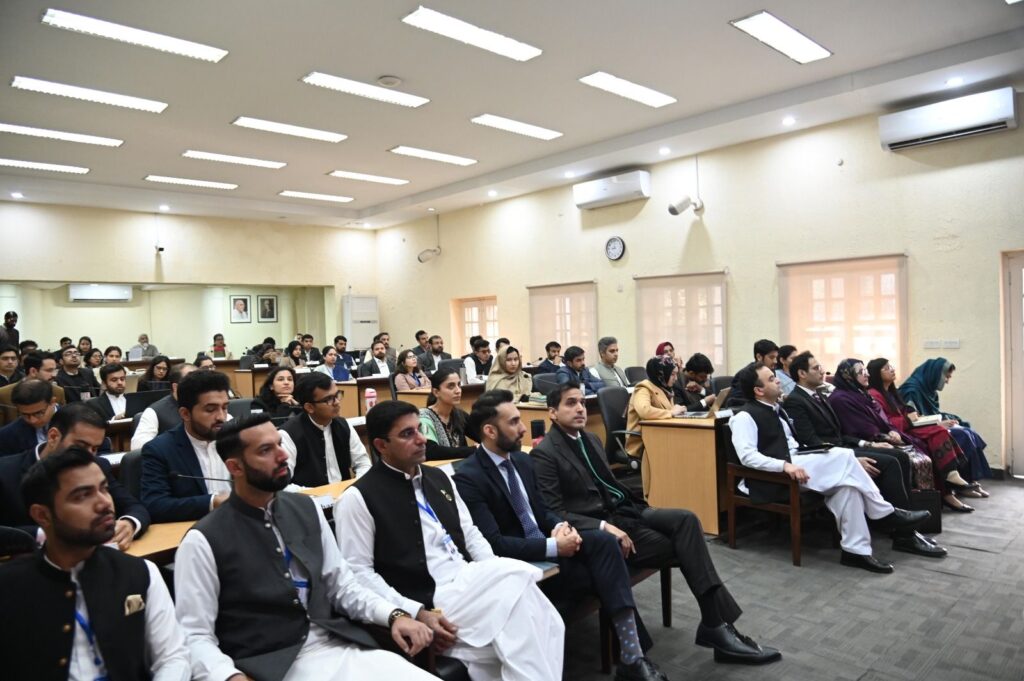
The lecture hall at the CSA was filled with the next generation of Pakistan Administrative Service (PAS) officers. The audience included as many as 55 Probationers (BS-17) of the 48th Specialized Training Programme (STP), 13 PAS Officers (BS-18) attending the Domain-Specific Mid-Career Management Course, more than 200 Probationers (BS-17) of the 54th Common Training Programme (CTP), who joined the session via video link from various regions.
Khudayar Mohla,Justice Jawad Hassan, Lahore High Court, Civil Services Academy, Constitution of Pakistan, constitutional interpretation, living constitution, constitutional amendments Pakistan, Punjab Judicial Academy, legal anthropology Pakistan, judicial precedents, Supreme Court Pakistan, High Courts Pakistan, orthodoxy vs heterodoxy, judicial philosophy Pakistan, Government of India Act 1935, Constitution 1973, rule of law Pakistan, separation of powers, judiciary and civil service, Pakistan Administrative Service, PAS officers training, CSA Lahore, STP probationers, CTP probationers, legal literacy, constitutional governance, Pakistani judiciary

Justice Hassan’s lecture went beyond mere dates, analyzing the ‘DNA’ of Pakistani law. He began with the Government of India Act 1935 (applied in 1937), explaining how it laid the structural foundations for the subsequent 1956, 1962, and 1973 Constitutions. A key highlight of the session was the discussion on the Judicial Anthology of the Superior Courts. Justice Hassan analyzed how precedents from the Supreme Court and High Courts have shaped the interpretation of the law.

He introduced the compelling dichotomy of Orthodoxy vs. Heterodoxy saying the orthodoxy is the traditional, strict adherence to established legal norms and the literal text of the Constitution. Whereas Heterodoxy is the innovative, progressive judicial thought that adapts to modern challenges, ensuring the law remains a tool for justice in a changing world. The session concluded with an interactive Q&A, where Justice Hassan urged the probationers to understand that the administration of the state (Civil Service) and the interpretation of the law (Judiciary) are two pillars of the same house.

The lecture has been hailed as an “intellectually enriching session” that provided the civil servants with the critical legal literacy required to navigate the complexities of governance while remaining steadfastly within the bounds of constitutional mandates.

Author

Khudayar Mohla, Managing Partner Mohla & Mohla, Founder of the Law Today Pakistan,

Managing Partner at Mohla & Mohla - Advocates and Legal Consultants, Islamabad, Founder of The Law Today Pakistan (TLTP) Newswire Service. Former President Press Association of Supreme Court of Pakistan with over two decades of coverage of defining judicial moments - including the dissolution and restoration of Chief Justice Iftikhar Muhammad Chaudhry, Asif Ali Zardari NAB cases, Syed Yousaf Raza Gillani contempt proceedings, Panama Papers case against Mian Nawaz Sharif, matters involving Imran Khan, and the high treason trial of former Army Chief and President Pervez Musharraf. He now practises law and teaches Jurisprudence, International Law, Civil and Criminal Law. Can be reached at: mohla@lawtoday.com.pk

More From Author

Leave a Reply

Your email address will not be published. Required fields are marked *

You May Also Like

Lahore High Court, Justice Jawad Hassan, Christian Divorce Act 1869, Pakistan legal news, Shahroz Masih case, minority rights Pakistan, judicial separation Christian law, dissolution of marriage grounds, Section 22 desertion, Section 11 adultery co-respondent, Article 199 writ petition, Article 10-A fair trial, Article 20 religious freedom, Article 4 due process, Mianwali court verdict, substantial justice vs technicalities, irretrievable breakdown of marriage, Punjab Judicial Academy workshops, district judiciary sensitization, matrimonial relief for Christians, evidentiary rigor in divorce cases, legal journalism Pakistan., Khudayar Mohla

LHC Quashes Lower Court Orders on Christian Divorce, Remands the Matter for Re-Adjudication

RAWALPINDI: Justice Jawad Hassan of the Lahore High Court, Rawalpindi Bench, sets aside concurrent findings…

Khudayar Mohla,Supreme Court of Pakistan, witness box seating, witness dignity Pakistan courts, Article 14 Constitution Pakistan dignity of man, fair trial Article 10A Pakistan, witness protection laws Pakistan, courtroom reforms Pakistan judiciary, Qanun e Shahadat witness examination, Supreme Court directives judiciary Pakistan, witness rights Pakistan courts

SC Directs Courts Nationwide to Provide Seating for Witnesses During Testimony

ISLAMABAD: Emphasizing that justice must be administered with humanity and respect for individual dignity, the…

Khudayar Mohla,Islamabad High Court, IHC, Justice Mohsin Akhtar Kayani, Dr. Zeeshan Ashraf, IVY School of Law, IVY College of Management Sciences, Amicus Curiae, Haq Mehr, Dower Rights, Islamic Jurisprudence, Shariah Law, Limitation Act 1908, Article 104 Limitation Act, Article 227 Constitution of Pakistan, Women's Financial Rights, Widow Inheritance, West Pakistan Family Courts Act 1964, Surah An-Nisa, Law and Justice Commission of Pakistan, National Commission on the Status of Women, Matrimonial Financial Disputes, Pakistan Legal News, Legislative Reform.

IVY School of Law HoD’s Dr. Zeeshan Ashraf Convinces IHC to Overturn Dower Time-Bar

ISLAMABAD: In a precedent-setting 21-page judgment aimed at harmonizing statutory law with Islamic injunctions, the…