

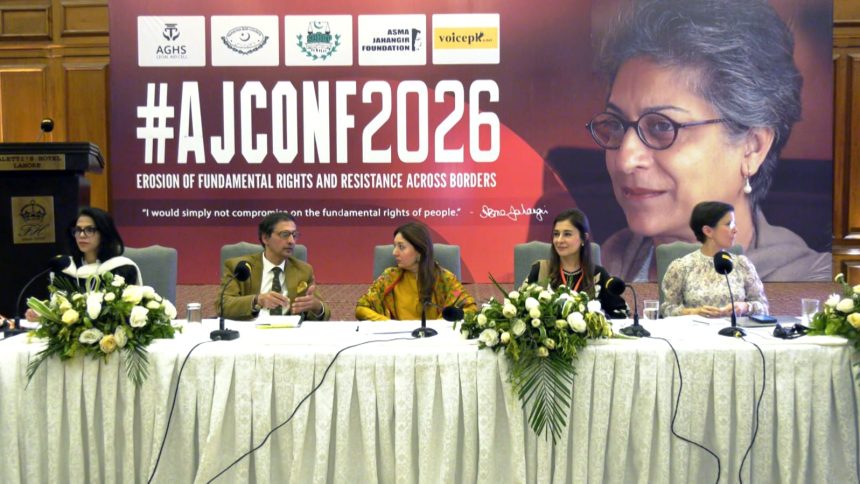
LAHORE: Speakers on Sunday, during a session titled “Where the Law Falls Silent: Child Marriages” at the Asma Jahangir Conference, called for the minimum age of marriage to be set and uniformly enforced at 18 years across Pakistan. They warned that child marriages amount to statutory rape and must be prosecuted and punished under the law. Underage marriages, they emphasized, violate children’s fundamental rights and should not be recognized, validated, or facilitated by courts or any state institutions.
Nida Aly, Executive Director of AGHS Legal Aid Cell moderated the session where speakers included Justice Jawad Hassan, Judge of the Lahore High Court; Sharmila Farooqi, Member of the National Assembly of Pakistan, Ayesha Raza Farooq, Chairperson of the National Commission on the Rights of Child (NCRC), and Reem Alsalem, United Nations Special Rapporteur on Violence against Women and Girls expressed views.
Justice Jawad Hassan emphasized that the judiciary plays a central role in addressing child marriage. “At the end of the day, the judiciary is the key. Upholding the Constitution is the State’s duty. Without executive action or legal change, injustice continues,” he stated. He stressed that ‘laws must be aligned with constitutional provisions’, including clearly setting 18 years as the minimum age of marriage, so that no parallel systems or misinterpretations can override fundamental rights.
Sharmila Farooqi highlighted the legislative challenges surrounding child marriage reform. During drafting, she explained, a key question was why such marriages were not explicitly declared void. Consensus was difficult due to legal, social, and religious sensitivities. She added that we are governed by personal law, and discussing it is often extremely sensitive, any debate quickly attracts objections. The aim, she said, was to create a law that could withstand legal scrutiny, respect traditions, and still ‘move society towards protection and inclusion’. “The purpose of introducing this law was not only to provide normative clarity, but also to ensure its legal survival and create a level of inclusivity around it.” she added.
Reem Alsalem observed that many ‘child marriage laws appear strong on paper but fail in practice’ due to weak monitoring and lack of resources. She warned that exceptions, such as parental or judicial consent, often undermine the effectiveness of laws that otherwise set the minimum age at 18. She also noted that ‘child marriage problem is particularly severe in conflict-affected and refugee-hosting countries’, where many children remain unregistered. “The State has the responsibility to take all proper measures to ensure the safety of every child,” she stressed.