

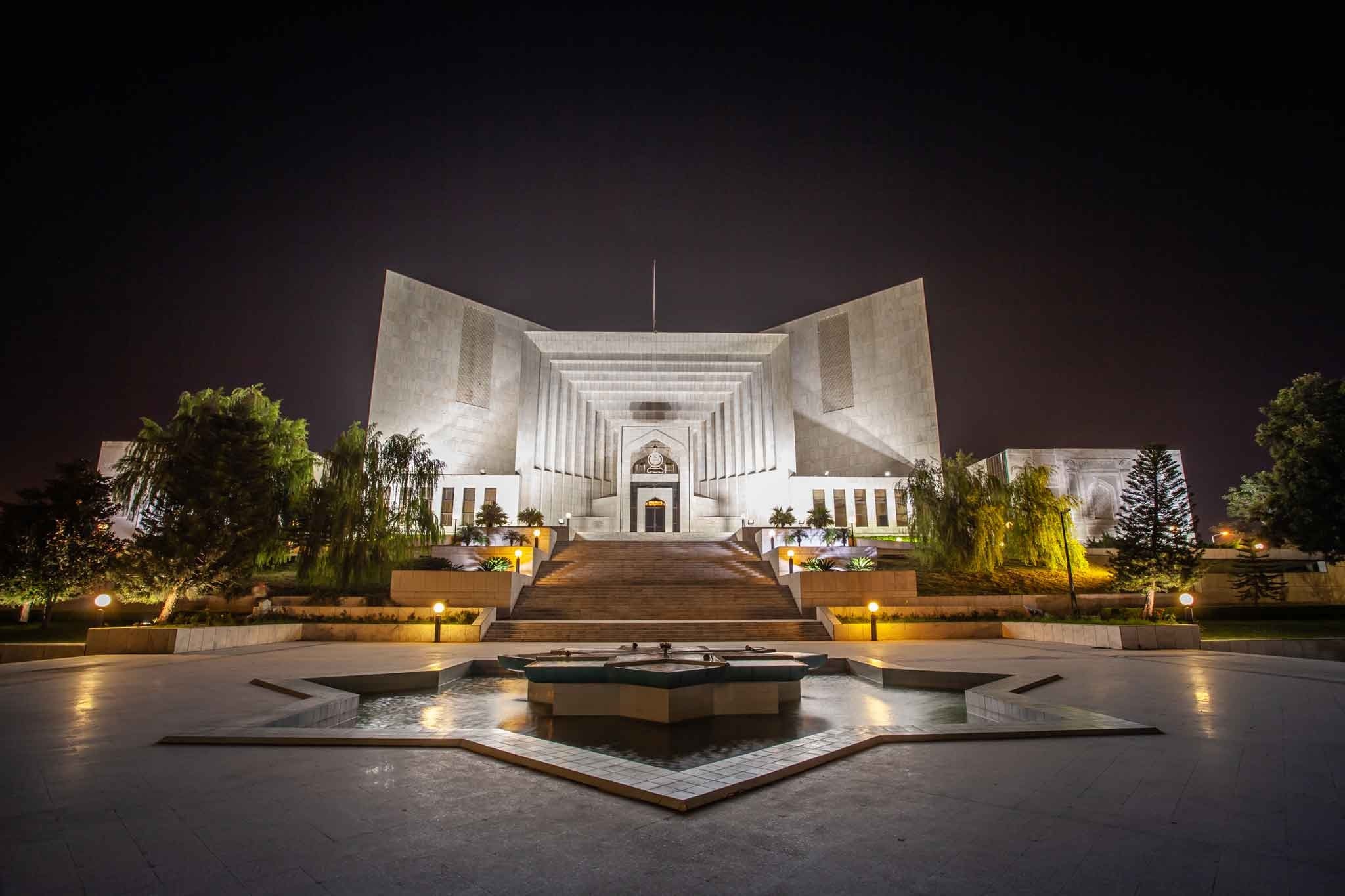
ISLAMABAD: While deciding a jail appeal, Supreme Court commuted man’s double death sentence to life imprisonment, saying that hanging the last surviving parent of a minor child makes the state an architect of a child’s total abandonment.
Top court Justice Ishtiaq Ibrahim authored the judgment whereas law clerk Tayyaba Munir assisted the honourable justice in writing the verdict in the matter.
The verdict disclose that on the morning of 22 April 2021, during the holy month of Ramzan, Mr.A armed himself with a dagger inside his family home in Muslim Town, Vehari, and inflicted repeated blows upon his wife Mst. B and their daughter Mst. C. Both women died at the scene. A third victim, their fifteen-year-old daughter Mst. D, survived only because she managed to flee toward her maternal uncles, who had spent the entire preceding night attempting to pacify Mr.A over a family dispute about the sale of one acre of agricultural land.
The dispute, the prosecution would later prove through a sale deed and bank receipts tendered as documentary evidence, was real and bitter. Mr A’s wife and children had opposed the proposed sale of the land in a village. It was this opposition, the prosecution alleged, that drove him to his deadly rampage. By the time Mr K, brother of the slain wife and the complainant in the case and his brother returned from Fajr prayers that morning, they walked into the horror of finding Mr A standing at the kitchen door, dagger still in hand, his wife and daughter already fallen.
The prosecution’s case rested on three pillars, each reinforcing the other. The first was the eyewitness testimony of the surviving daughter Mst. D, who had herself been wounded in the attack, her two incised wounds forming what the court called an unimpeachable guarantee of her presence at the scene. Alongside her stood her brother Mr Z, who corroborated every material detail of her account. The second pillar was the post-mortem evidence: the examining doctor recorded as many as twenty-one incised wounds on the body of Mst. B and eight on Mst. C, a count that the court found fully consistent with the eyewitnesses’ description of successive, repeated blows. The third was the forensic science laboratory report confirming that the recovered dagger was stained with blood.
The defence subjected all three eyewitnesses to lengthy and searching cross-examination, yet could extract nothing material to shake the core of the prosecution’s case. The court dismissed as legally insignificant the minor discrepancies that did emerge, noting they did not go to the root of the matter. More pointedly, the bench observed that it would be highly improbable and contrary to the normal course of human conduct for a son and daughter – already deprived of their mother by the very act in question to falsely implicate their own innocent father, thereby stripping themselves of his support as well. No evidence of enmity, ulterior motive, or extraneous consideration was ever placed before the court to suggest otherwise.
Having affirmed guilt beyond reasonable doubt, the three-member bench – comprising Justice Muhammad Hashim Khan Kakar, Justice Salahuddin Panhwar, and Justice Ishtiaq Ibrahim, who authored the judgment turned to the question that would distinguish this ruling from the two courts below it. Both the Additional Sessions Judge Vehari and the Lahore High Court’s Multan Bench had awarded sentence to Mr A to death on two counts under Section 302(b) of the Pakistan Penal Code, a sentence the Supreme Court declined to sustain on two independent grounds.
The first ground was statutory. Section 306(b) of the PPC expressly provides that qatl-i-amd – intentional killing shall not be liable to Qisas when the offender causes the death of his own child or grandchild. Section 306(c) adds a further bar where any wali, or heir, of the victim is a direct descendant of the offender. In the present case, Mr A had killed his own daughter Mst. C, placing him squarely within clause (b), while the surviving heirs of both victims were his own children, engaging clause (c). This alone, the court held, meant that death as Qisas was simply unavailable as a matter of law, regardless of the strength of the evidence.
The second ground broke newer ground. Writing for the bench, Justice Ibrahim articulated what he described as the doctrine against judiciary-sponsored orphanhood – the proposition that when a court executes the sole surviving parent of a minor child, it does not merely punish a criminal but also, inadvertently, completes the destruction of what remains of that child’s family.
“To commute a death sentence to life imprisonment is not to excuse the crime, but to prevent the state from becoming the architect of a child’s total abandonment. Justice must be tempered with the realisation that the law should preserve the remnants of a broken family, rather than completing its destruction”, Justice Ishtiaq Ibrahim wrote in the verdict.
Invoking Article 3 of the United Nations Convention on the Rights of the Child, which obliges states to treat the best interests of the child as a primary consideration in all actions concerning children, the court held that the presence of Mst. D, the couple’s surviving minor daughter, aged approximately fifteen to sixteen years constituted a meaningful mitigating factor in sentencing. The bench drew a thread between this reasoning and the legislative wisdom already embedded in Section 306(c) PPC, suggesting that the statute’s protection of the accused’s parental lineage from Qisas reflected a broader principle: the law prizes the preservation of the remaining family bond over the enforcement of capital punishment.
In a landmark ruling that weaves Islamic penal law with the United Nations Convention on the Rights of the Child, Pakistan’s Supreme Court has held that executing the sole surviving parent of a minor child makes the state complicit in that child’s total abandonment – and has commuted a double death sentence accordingly.
The court was careful to ensure the mitigation of sentence did not translate into any broader indulgence. Having regard to the sheer ferocity of the assault – twenty-one stab wounds on the wife, eight on the daughter, and additional injuries on the surviving child – the bench declined to extend to Mr A, the benefit of Section 382-B of the Code of Criminal Procedure, which allows courts to set off pre-conviction detention against the sentence. The manner and brutality of the offence, the judgment held, placed this case firmly outside the zone of discretionary relief that Section 382-B is designed to serve.
All other convictions and sentences were maintained in full. Mr A’s seven-year rigorous imprisonment under Section 324 PPC for the attempt on Mst. D’s life, along with the Daman payments of Rs. 25,000 and Rs. 50,000 under Sections 337-F(i) and 337-F(ii) PPC respectively, and the compensation of Rs. 10,00,000 under Section 544-A of the Code on two counts, remain intact. All substantive imprisonment sentences are to run concurrently.
The petition was converted into an appeal and partly allowed. The death sentence on two counts under Section 302(b) PPC was commuted to imprisonment for life on two counts. The judgment has been approved for reporting.