
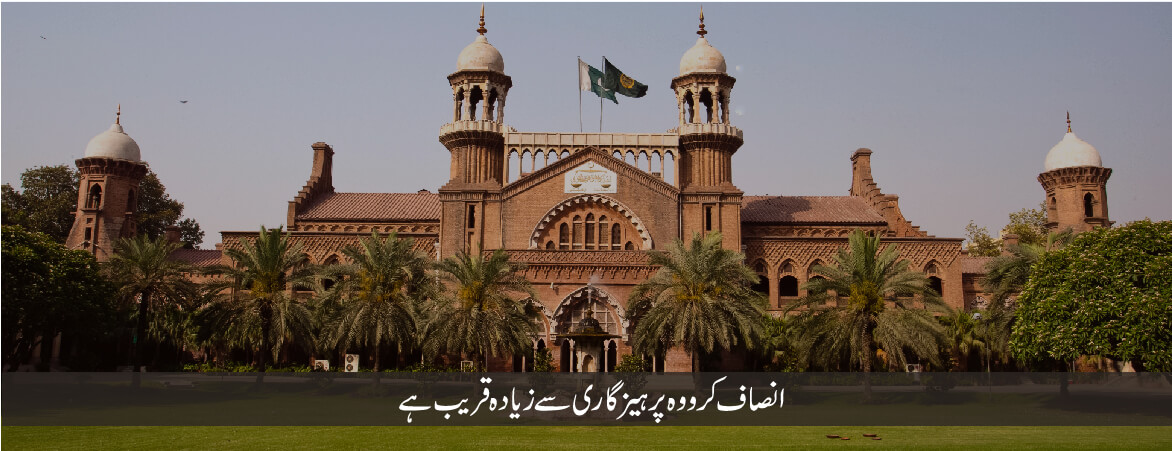
The Lahore High Court Wednesday issued directives to the federal government to establish a ‘Special Islamic Board’ in order to restraining and removal of controversial, amended and un-Islamic content from social media networks.
Identical petitions were filed in the Lahore High Court (LHC) seeking directives for people at the helm of affairs and institutional arrangements to restrain Ahmadiyya sect preaching that the sect is disseminating through uploading their content on social media networks.
The petitioners have made the federation of Pakistan through the interior ministry, ministry of information & technology, ministry of religious affairs and inter-faith harmony and Pakistan Telecommunication Authority (PTA) and others as respondents in the case.
Appearing before the single-member bench of the Chief Justice Muhammad Qasim Khan on Wednesday counsel for petitioners Advocate Bilal Riaz Sheikh argued that the found a search engine Google showing that the 5th and current Caliph of the Messiah of the Ahmadiyya Community is Mirza Masroor Ahmad after the death of Ghulam Ahmad, his successors directed the Ahmadiyya community from Qadian, India which remained the headquarters of the community until 1947 with the creation of Pakistan.
The counsel also produced a number of weblinks and urged the court to issue directives for removal of such web links from the social media networks saying otherwise it will be an alarming situation for the whole Muslim community and Allah Almighty will not spare on the day of Judgment.
On his turn, counsel for Pakistan Telecommunication Authority (PTA) Barrister Hashim Javed submitted that under the PECA Act, PTA has the power to remove/block unlawful content. He apprised the bench that the PTA has already developed a system where complaints can be registered by any party saying the PTA has also installed a Web monitoring system through which they resolve complaints.
After hearing arguments of both the sides, Chief Justice Muhammad Qasim Khan issued directives to the government to identify the websites, hosting or uploading Islamic content, as authentic or un-authentic in order to better inform people on the content.
The chief justice also directed the government to take the initiative of establishing its own website for the purpose of Islamic teachings in light of the Holy Quran and Hadith. He said that while establishing the website, the government should take into confidence all schools of thought whereas the Ulema should be included on the board.
He directed the government officials to become complainant and get FIRs registered against the website, uploaded in violation of the Constitution saying the Ulema’s board will be in a position to block all those websites uploading un-Islamic content. He reiterated while dictating order in the matter saying, “If any website is found running controversial, amended and un-authentic content, it must be taken to task and FIRs would be registered against them”,. Later, the bench disposed of the petitions