

ISLAMABAD – Supreme Court Justice Miangul Hassan Aurangzeb Friday lauded women’s progress in law while urging stronger state capacity to counter technology-facilitated gender-based violence.
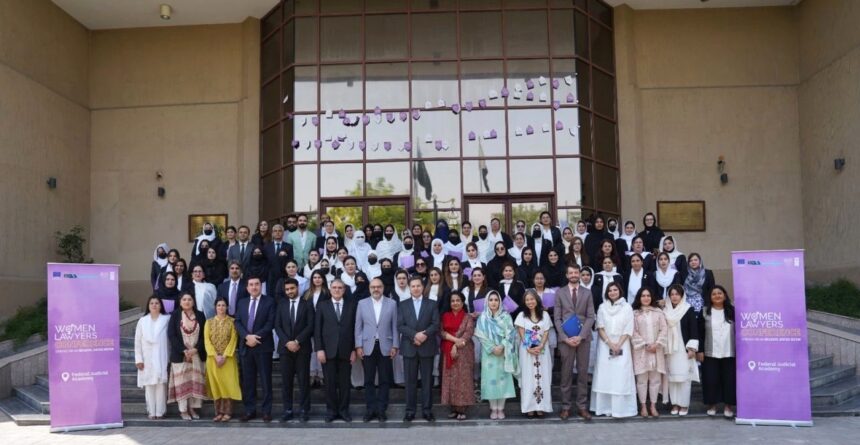
The Federal Judicial Academy (FJA), in collaboration with UNDP Pakistan under the EU-funded Deliver Justice Project, organized the National Women Lawyers Conference in Islamabad, bringing together women legal professionals from Khyber Pakhtunkhwa, Balochistan, and Islamabad. The conference focused on emerging challenges posed by Technology-Facilitated Gender-Based Violence (TFGBV) and the need for strengthened institutional responses.
Addressing the conference as Chief Guest, Justice Miangul Hassan Aurangzeb highlighted the significant progress of women in the legal profession while emphasizing that enhanced investigative capacity is essential to effectively address emerging digital forms of gender-based violence.
On the occasion, Hayat Ali Shah, Director General of the Federal Judicial Academy, along with Dr. Sébastien Lorion, Team Leader Governance and Human Capital Development at the Delegation of the European Union to Pakistan; Ms. Noureen Bano Lehri, Chairperson of the National Commission on the Status of Women (NCSW); and Ms. Van Nguyen, Deputy Resident Representative of UNDP Pakistan, underscored the importance of strengthening survivor-centred and gender-responsive justice systems. They emphasized the need to invest in women’s leadership in the legal profession and enhance institutional readiness to respond to TFGBV.
A panel discussion on confronting TFGBV was moderated by Ms. Shahzada Ahmad, Programme Manager, Rule of Law Programme, UNDP Pakistan, featuring Ms. Munizae Jehangir, Senior Journalist; Ms. Huma Akhtar Chughtai, Member National Assembly; Mr. Usama Khilji, Director, Bolo Bhi; and Advocate Alia Zareen, who shared perspectives on the legal, policy, and digital dimensions of online gender-based harms.
The conference concluded with key recommendations aimed at strengthening institutional responses to technology-facilitated harms, improving access to justice for survivors, and building resilient justice systems capable of addressing evolving digital challenges.