

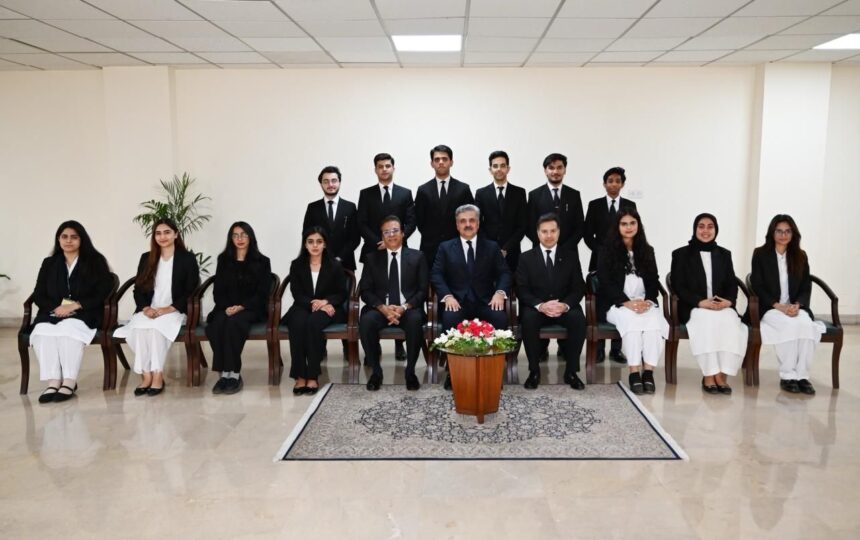
ISLAMABAD – The Supreme Court of Pakistan convened its selected Judicial Law Clerks Cohort for the 2025-2026 term at the principal seat in Islamabad to bridge the gap between seasoned judicial wisdom and youth-driven dynamism through immersive legal research and mentorship.
Captured in the official commemorative photograph, the exceptional law graduates stand alongside the top leadership of the judiciary, including the Chief Justice of Pakistan, Justice Yahya Afridi, and the distinguished members of the Supreme Court Clerkship Committee, Justice Muhammad Ali Mazhar and Justice Mian Gul Hassan Aurangzeb. This gathering sets a powerful institutional precedent, formalizing a framework where Pakistan’s brightest young legal minds work in tandem with the court’s senior jurists to manage a substantial national case portfolio.
The initiative serves as an unparalleled professional crucible where these young professionals actively fetch deep legal insights from the finest brains of the country’s highest judicial forum. Selected through a highly competitive and transparent national process, the cohort features top academic talent from both prestigious local and international universities. Once paired directly with a Supreme Court Justice, the clerks are entrusted with critical, analytical responsibilities aimed at enhancing the court’s operational efficiency.
Operating in a deeply descriptive capacity, the clerks immerse themselves in conducting deep-dive legal research into complex, evolving facets of constitutional, civil, and criminal law. They shoulder the responsibility of analyzing intricate legal arguments to compile objective, structured case briefs that assist justices ahead of critical hearings. Furthermore, they provide essential chamber support by rigorously proofreading and analyzing legal documentation to maintain the absolute highest standards of accuracy. Legal experts have long lauded this continuous interaction as an essential mechanism for reducing the heavy burden on the judiciary, facilitating swifter case disposal, and enhancing the overall clarity of historic judgments.
Ultimately, the collaborative environment allows the clerks to witness the inner workings of high-stakes legal decision-making and the meticulous craft of judicial reasoning firsthand. By absorbing the institutional knowledge passed down by their mentors, these young clerks are shaped into highly capable advocates, corporate legal experts, and future judges. The presence of this cohort highlights the Supreme Court’s mandate to champion inclusivity and meritocracy, ensuring that the brilliant minds fetching insights today will successfully transition to shape the long-term future of Pakistan’s legal ecosystem tomorrow.