

ISLAMABAD – The Supreme Court of Pakistan’s Law Clerkship Programme has cemented its standing as one of the country’s most competitive professional development pathways, drawing the brightest law graduates to serve under the direct mentorship of the apex court
The programme reflects the Court’s institutional commitment to channelling the intellectual potential of emerging legal professionals into the work of constitutional adjudication and appellate practice through structured mentorship and rigorous legal research.
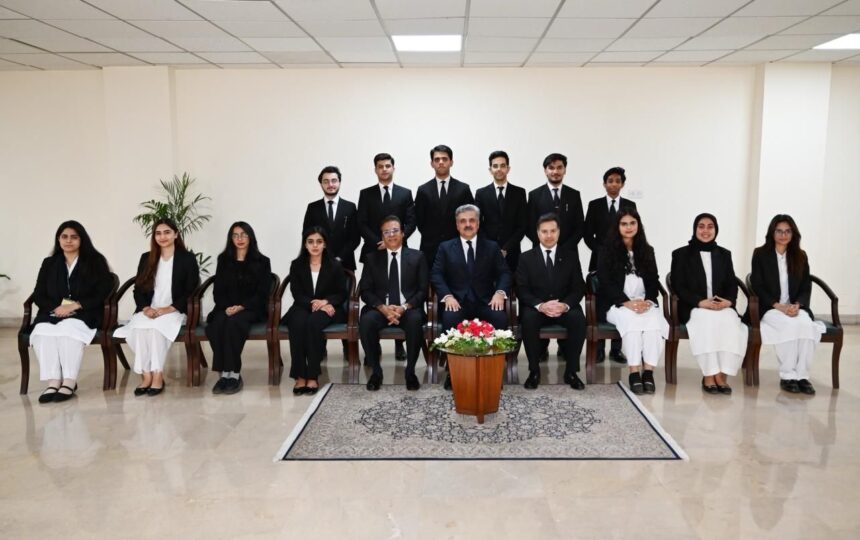
An official photograph released by the Supreme Court captures clerks from preceding batches who continue to serve at the Court, alongside Chief Justice of Pakistan, Justice Yahya Afridi, and the Supreme Court Law Clerkship Committee comprising Justice Muhammad Ali Mazhar and Justice Mian Gul Hassan Aurangzeb. The continued service of these clerks is a testament to the programme’s depth and the sustained institutional value they bring to the apex court beyond their initial term.
Judicial law clerks are selected annually through a highly rigorous and competitive recruitment process open to outstanding graduates from leading Pakistani and international law schools. The selection process is among the most demanding in Pakistan’s legal landscape, with candidates evaluated on academic distinction, research aptitude, and legal reasoning. Those selected are placed directly with Supreme Court judges, contributing to legal research and judicial administration while gaining practical exposure to constitutional interpretation and appellate practice. With a new cohort expected to join the Court later this year, the programme continues its unbroken record of infusing fresh legal talent into the country’s apex judicial institution.
Under the direct supervision of Supreme Court judges, clerks undertake extensive legal research spanning constitutional, civil, criminal, commercial, and public law matters. Their responsibilities include examining comparative jurisprudence, analysing complex legal questions, preparing research memoranda and case briefs, reviewing legal authorities, and assisting judges in the examination of records ahead of hearings. Clerks also assist chambers in proofreading judicial materials and ensuring documentary consistency.
Legal practitioners and academic commentators have consistently recognised judicial clerkship programmes as mechanisms that enhance judicial efficiency, improve the quality of legal reasoning, and support informed decision-making at the appellate level. Beyond their immediate contribution to the Court, the programme functions as a critical training ground for Pakistan’s future legal leadership. Direct exposure to judicial reasoning, constitutional interpretation, and appellate advocacy at the country’s apex court equips participants for careers spanning litigation, academia, public service, corporate practice, and the judiciary itself. The continued success of the programme reflects the Supreme Court’s emphasis on merit-based selection, professional excellence, and the long-term development of a generation of legal professionals capable of strengthening the country’s justice system.