

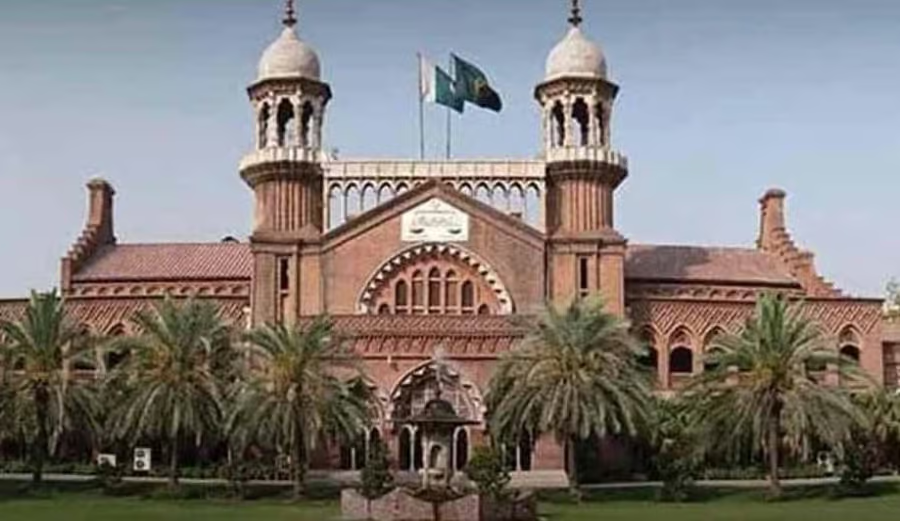
LAHORE: A husband’s property was attached, auctioned, and nearly lost – over a calculation error that no executing court had the authority to make. That is, in essence, the story behind a recent Lahore High Court (LHC) verdict that carries implications far beyond one family dispute.
While hearing a writ petition, Justice Muhammad Sajid Mehmood Sethi of the Lahore High Court set aside concurrent orders of two courts below, holding that the executing court had overstepped its jurisdiction by applying a 10% annual enhancement clause to past maintenance – an amount that had already been fixed, crystallized, and closed by the original family court decree of 2020. The case had its roots in a maintenance suit filed by a wife against her husband. The learned Judge Family Court decreed the suit on 12 August 2020, awarding Rs.12,000 per month as maintenance under two distinct heads – arrears for six preceding years, and future maintenance from the date of suit with a 10% annual increase.
When the wife filed an execution petition, the husband’s property was attached and auctioned. The husband challenged the auction under Order XXI Rule 89 CPC, arguing that the executing court had miscalculated the decretal amount by wrongly applying the annual enhancement to past maintenance as well – inflating the liability by approximately Rs.400,000.
Both the executing court and the appellate court dismissed his objections. He then invoked jurisdiction of the Lahore High Court saying the courts below decided the matter against facts and law of the land. Justice Sethi’s analysis was precise and unsparing. Reading the decree of 2020 plainly, the court found that it maintained a clear distinction between two categories of maintenance – past and future. The annual enhancement clause, the court held, was textually and contextually attached only to future maintenance. Past maintenance, once quantified, had assumed the character of a fixed and crystallized liability.
The courts below, the judgment noted, appeared to have proceeded on the assumption that the word “with” in the decree automatically subjected the entire maintenance amount to annual enhancement – an interpretation the High Court firmly rejected.
“Any interpretation extending the enhancement clause to the already determined arrears of maintenance would amount to enlarging the scope of the decree, which is impermissible in execution proceedings.”
The LHC anchored its reasoning in a well-established principle of civil law: an executing court is bound to execute the decree as it stands and cannot travel beyond its terms. Citing the Supreme Court’s ruling in Mushtaque Ahmed v. Shahzad Khan (PLD 2024 SC 960), the court reiterated that an executing court cannot rescind, amend, or modify a decree even under the guise of interpretation. The court further held that Section 17-A of the Family Courts Act, 1964 – which empowers family courts to award and periodically enhance maintenance – operates in the field of adjudication, not execution. Once a decree attains finality, the executing court cannot invoke Section 17-A to enlarge an already adjudicated liability.
Family court decrees involving maintenance are executed daily across Pakistan’s district courts. The question of whether an enhancement clause applies to past arrears or only to future maintenance is not merely technical – it can mean hundreds of thousands of rupees in additional liability, and in execution proceedings, that difference can cost a debtor their property.
This judgment draws a firm constitutional line: what the decree says is what the executing court enforces – nothing more, nothing less. If a decree-holder believes an enhancement was intended to cover past maintenance as well, the remedy lies in seeking clarification or correction of the decree, not in persuading an executing court to reinterpret it during enforcement proceedings. Resultantly, the LHC allowed the petition, declared the impugned orders illegal, and directed the executing court to recalculate the decretal amount strictly in accordance with the decree – excluding the 10% annual enhancement from the past maintenance component entirely.
—————————————————-
W.P. No.12390 of 2026 – Rana Tasneem Ejaz v. Sadia Abbas – decided on 11 June 2026 by Justice Muhammad Sajid Mehmood Sethi, Lahore High Court. The judgment has been approved for reporting.