

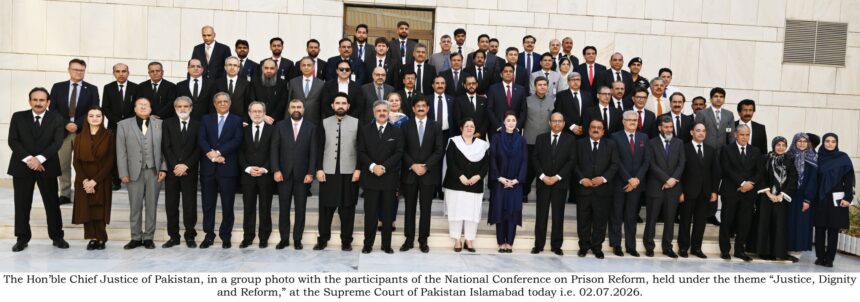
ISLAMABAD – The Supreme Court of Pakistan on Thursday hosted the National Conference on Prison Reform under the auspices of the National Judicial (Policy Making) Committee (NJPMC), bringing together representatives from the judiciary, federal and provincial governments, prison administrations, human rights institutions, law enforcement agencies and development partners to chart a coordinated path forward for the country’s correctional system.
The conference concluded with the four Chief Ministers of Pakistan’s provinces signing a joint declaration pledging coordinated action to overhaul the prison system. The “Islamabad Declaration on Prison Reform” was endorsed by the Chief Ministers of Punjab, Sindh, Khyber Pakhtunkhwa and Balochistan, who unanimously reaffirmed their commitment to supporting and implementing the reform agenda under the NJPMC’s guidance. The Federal Minister for Law and Justice, who also serves as Chairperson of the National Commission for Human Rights, addressed the gathering as well.

In his keynote address, the Chief Justice of Pakistan observed saying prisons reflect the true pulse of the criminal justice system, stressing that meaningful reform requires shared institutional responsibility and sustained provincial leadership. He welcomed the provinces’ collective commitment to advancing the NJPMC’s National Prison Reform Action Plan through coordinated and practical measures.
The conference served as a platform for dialogue on the challenges facing Pakistan’s prisons and explored practical steps to strengthen prison governance, improve rehabilitation programmes, enhance coordination among agencies, and promote a rights-based approach to prison management.
In the declaration itself, the Chief Ministers acknowledged that Pakistan’s prisons are under serious strain due to overcrowding, a large population of under-trial prisoners, weak infrastructure, and limited access to healthcare, mental health services, and rehabilitation opportunities. They noted these conditions have consequences not just for prison administration but for access to justice, public safety, and human dignity more broadly.
They reaffirmed that all persons deprived of liberty retain fundamental rights under the Constitution, including protections related to life, dignity, fair trial and humane treatment, while also recognizing Pakistan’s international human rights obligations toward vulnerable groups such as women, children and persons with disabilities in detention.
The declaration outlines seven core commitments, including:
- Reducing unnecessary incarceration through expanded access to bail, legal aid, probation, parole and other non-custodial measures, with particular attention to women, children, persons with disabilities and those held for minor or poverty-related offences
- Reviewing provincial laws and policies governing arrest, detention, sentencing and rehabilitation to reduce overcrowding
- Improving prison infrastructure, sanitation, nutrition, healthcare and mental health services, along with safeguards against torture and ill-treatment
- Expanding education, vocational training, psychosocial support and post-release reintegration programs
- Strengthening coordination among prison departments, police, prosecutors, the judiciary and welfare agencies
- Setting up provincial mechanisms to develop time-bound reform plans and monitor progress
- Reporting regularly to a national prison reform coordination body
The declaration describes prison reform as “not only an administrative necessity, but a constitutional, humanitarian and public safety imperative,” with the provinces committing to build a system that is lawful, humane and rehabilitative.
The document was signed at Islamabad on July 2, 2026, by the Chief Ministers of Balochistan, Khyber Pakhtunkhwa, Punjab and Sindh.