

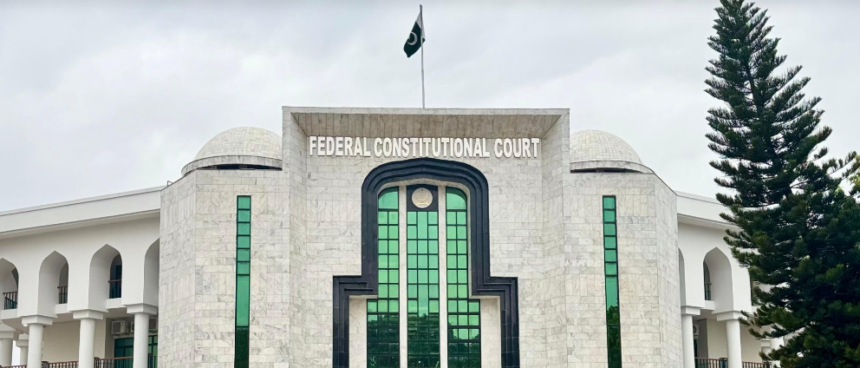
ISLAMABAD: The Federal Constitutional Court dismissed an appeal filed by the Khyber Pakhtunkhwa government against the reinstatement of two former FATA health department employees, upholding a 2018 Peshawar High Court (PHC) judgment that had ordered their regularization after their contract-based jobs were terminated in 2010.
A two-member bench comprising Justice Aamer Farooq and Justice Syed Arshad Hussain Shah heard Civil Petition for Leave to Appeal No. 632-P of 2018, filed by the Government of Khyber Pakhtunkhwa through the Chief Secretary against Tanveer Ahmad and another respondent, challenging the Peshawar High Court’s judgment dated May 31, 2018. The bench refused to leave to appeal in the matter through a verdict.
The respondents had worked as Dispensers (BS-6) in health facilities in the erstwhile Federally Administered Tribal Area (FATA) since 2002 and 2007, respectively, on a contract basis. Their services were terminated in June 2010 after health facilities were removed from the Annual Development Programme. The employees challenged the termination before the Peshawar High Court after departmental appeals failed, and the High Court ruled in their favour, directing their reinstatement and regularization, while treating the intervening period as leave without pay.
The KP government’s law officer argued before the Federal Constitutional Court that the respondents were project-based contract employees whose services stood automatically terminated upon closure of the project, and that they held no vested right to regularization. The government relied on a 2022 Supreme Court judgment in a similar FATA employment case.
The Court rejected this argument, noting that neither the respondents’ advertisement nor their appointment letters had specified that their posts were tied to a particular project. It held that their case fell within the scope of a 2008 federal cabinet decision that had regularized all contract employees in BS-1 to BS-15 working prior to June 2008, including FATA employees, and that the respondents had been illegally deprived of this entitlement.
Distinguishing the case relied upon by the government, the Court observed that the earlier precedent involved employees who had sought regularization under a Khyber Pakhtunkhwa law inapplicable to FATA, rather than under the 2008 federal policy – meaning the Supreme Court in that case had not been properly assisted on the applicable law.
The bench further held that regularization of long-serving contract employees is not merely a service matter but is linked to fundamental rights under Articles 9 and 25 of the Constitution. It ruled that Article 9’s guarantee of the right to life extends to the right to livelihood and job security, and that keeping employees on contract for years despite permanent posts and continuous need for their services amounts to arbitrary exercise of power and economic exploitation.
The Court cited earlier Supreme Court rulings holding that regularization depends on length of service and the enforcement of fundamental rights rather than the existence of statutory service rules, and condemned the practice of engaging employees on prolonged temporary contracts, sometimes with artificial service breaks, to deny them regularization benefits.
Finding no merit in the petition, the Court dismissed it and refused leave to appeal, upholding the Peshawar High Court’s 2018 judgment in favour of the respondents.