

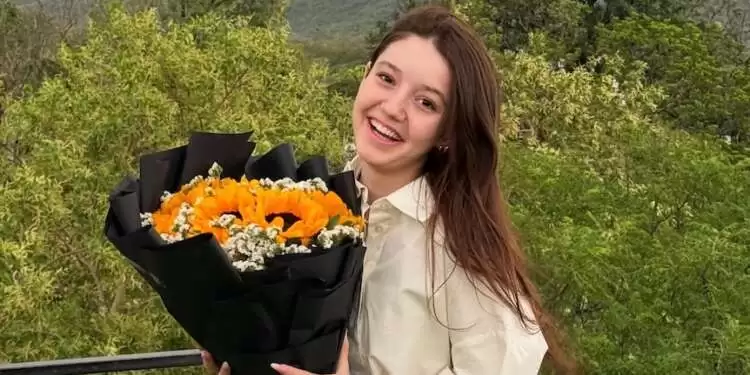
Day after 17-year-old Sana Yousaf was shot dead in her Islamabad house on June 2, 2025, police arrested Hayat on Monday, 23-year-old Hayat who is son of a retired government official and a TikToker himself . Additional District and Sessions Judge Muhammad Afzal Majoka announced the verdict on Tuesday, awarding Hayat death sentence under Section 302(b) of the Pakistan Penal Code (PPC) for committing qatl-i-amd (intentional murder) of Sana Yousaf. Under criminal administration of justice once a Session Court awards death sentence – the concerned High Court gets it confirmed if the awarded sentence remained intact after proceeding known as murder reference before division bench of High Court.
As per the process, a division bench of the Islamabad High Court will decide murder reference in the current matter under Section 374 (sentence of death to be submitted by Court of Session) of the Code of Criminal Procedure (CrPC). The Session Court Islamabad also awarded fine to the convict to pay Rs2.5 million as compensation to the legal heirs of the deceased under Section 544-A of the CrPC. In case of default in compensation amount, the convict would further undergo six months’ simple imprisonment. Under Section 392 (punishment for robbery) of the PPC, Hayat was sentenced to 10 years of rigorous imprisonment along with a fine of Rs200,000, while under Section 499 (defamation) of the PPC, he was handed another 10-year sentence with a fine of Rs200,000.
Under Section 411 (dishonestly receiving stolen property) of the PPC, the court awarded him one year of rigorous imprisonment and imposed a fine of Rs100,000. Judge Majoka ordered that all sentences would run concurrently and also extended to the convict the benefit of Section 382-B of the CrPC, allowing the period already spent in custody to be counted towards the sentence. In his statement recorded under Section 342 of the CrPC on Monday while testifying before Judge Majoka, Hayat maintained he was falsely implicated in the case.
He repeatedly avoided answering questions put to him in the absence of his counsel, later recording his detailed statement after his lawyer appeared before the court. Hayat was arrested from Faisalabad within 20 hours of the incident, according to Islamabad Inspector General (IG) Syed Ali Nasir Rizvi, who termed it a case of ‘repeated rejections’. Yousaf, a TikTok star with more than a million followers on social media platforms, was known for sharing videos of her favourite cafés, skincare routines, and traditional outfits. Her killing drew nationwide condemnation, reigniting debate over women’s safety in Pakistan.
‘Justice for all girls’
Speaking to the media after the verdict’s announcement, Yousaf’s parents welcomed the court decision. Yousaf’s mother, Farzana, said she had been served justice, thanking her counsels for efforts in trial proceedings and the police for their cooperation. She further thanked the judge and the media, noting that the “media supported us from the beginning”. “The culprit has been handed the right punishment,” she said. The victim’s father, Yousaf Hassan, said, “We had been waiting for today for the past 11 months […] and the judiciary has given its verdict in the spirit of justice.” Thanking his lawyers, he said: “This verdict is not just for me as an individual; it is for the entire society. This is a lesson for all such criminals in society that if they commit such an act, they can get such a result.” Hassan termed the verdict “justice for all girls” and society. One of the parents’ lawyers hailed the judge’s “patience”, claiming that personal attacks were made against him through the accused and his legal team during over eight months of court proceedings. He also alleged the use of “tactics to further complicate the case”.
Retraction of confessional statement
In his confessional statement recorded before a magistrate under Section 164 of CrPC in July 2025, Hayat had detailed the motive behind the killing, how the crime was committed, his escape plan, and where he disposed of the murder weapon. He had admitted to developing a one-sided obsession with Yousaf after online interactions, and said jealousy and suspicion drove him to commit the crime. According to the statement, Hayat had travelled from Jaranwala to Islamabad on May 28 to wish Yousaf on her birthday. When she did not meet him, he became convinced she was deliberately avoiding him. He added that on June 2, he returned to the capital after renting a Toyota Fortuner and carrying a 30-bore pistol, intending to confront her. However, in his recent statement, Hayat denied the sequence of events, claiming that he had never quarrelled with Yousaf, never requested to meet her and had had no contact with her.
He alleged that he was implicated due to public pressure generated on social media, as both he and Yousaf were well-known TikTokers. Last month, IHC Chief Justice Sardar Muhammad Sarfaraz Dogar turned down plea of Hayat seeking transfer of his trial from Judge Majoka’s court to another court. In late February, IHC’s Justice Khadim Hussain Soomro dismissed Hayat’s application challenging recording of a witness statement in the absence of the accused and his counsel. Justice Soomro had observed that no legal flaw, irregularity or jurisdictional defect had been found in the impugned order, noting that the accused’s attendance via a video link constituted legally valid presence.
