

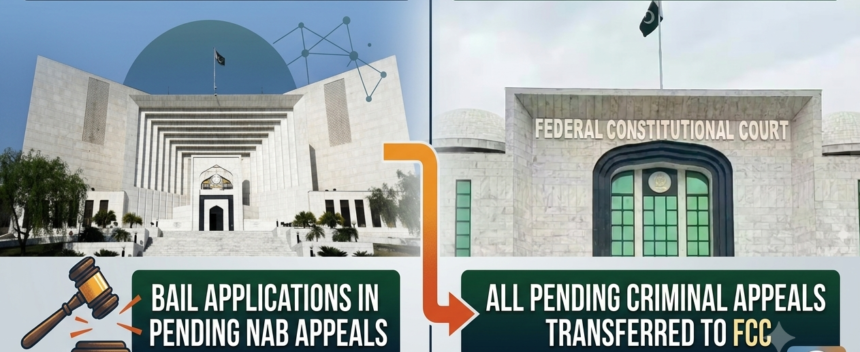
ISLAMABAD: While addressing a jurisdictional issue on Friday, the Supreme Court ruled that bail applications in pending National Accountability Bureau (NAB) appeals fall outside its jurisdiction, directing that all such pending criminal appeals be transferred to the Federal Constitutional Court (FCC).
“This court has no jurisdiction to take cognisance of the NAB cases in terms of Article 175F (a) of the Constitution, read with Section 32 and 32-A of the National Accountability Ordinance, 1999 (NAO),” stated a 30-page judgement authored by Justice Muhammad Ali Mazhar, who headed a three-member bench that took up the matter.
The ruling also referred to arguments that the Supreme Court should not surrender its jurisdiction come what may, with the judges observing that courts could “not play to the gallery” for admiration, popularity, media commendation, or fovourable public perception, instead of adhering to the law and Constitution.
The duty of the court was to follow the law, not to make decisions or assume jurisdiction for media attention or public consumption, the bench noted. “We are fully conscious and also sanguine that neither the court should assume the jurisdiction not vested in it by law nor it should abdicate its jurisdiction so vested under the law, rather, the jurisdiction is decided by the Constitution and the law itself. It is not a matter of surrender or conquest, but it is regulated by the law,” the judgement read.
The bench further observed that “unbridled judicial overreach, including the flagrant misuse of suo motu powers under a ‘might is right’ approach in the past, severely harmed the institution’s image and legitimacy, ultimately resulting in numerous legislative changes to the Constitution and the country’s judicial laws”.
“If a court does not possess statutory jurisdiction over a matter, it must step aside without any intervention. No judge is robed, crowned or sceptered as a king to do whatever suits his whim and caprice as one-man rule,” the judgement concluded.
The ruling came on two petitions taken up by the bench headed by Justice Mazhar and comprising Justice Musarrat Hilali and Justice Shahid Bilal Hassan. One of the pleas was filed by the NAB, challenging an acquittal by the Peshawar High Court, and another by an under-trial prisoner, Aamir Mahmood, who challenged the Islamabad High Court’s refusal of his post-arrest bail.
During the hearing, NAB argued before the court that after the insertion of Section 32-A in the NAO, the Supreme Court did not have the jurisdiction to proceed and decide the criminal petitions under consideration for leave to appeal, and now, only the FCC had the jurisdiction in all NAB cases, including bail applications.
According to Section 32-A of the NAO, any convicted person, aggrieved by a decision on their appeal against their conviction by a high court, may file a second appeal before the FCC. But, the counsel for Mr Mahmood, Ibadur Rehman Lodhi, argued that his client’s case was distinct as he was an under-trial prisoner whose bail rejection was not a second appeal against his conviction.
The bench observed in its ruling that the insertion of Section 32-A in the NAO had become a statutory remedy with retrospective effect following the establishment of the FCC under the 27th Constitutional Amendment, which was passed by Parliament in November last year.
It noted that the FCC was established in accordance with the newly inserted Article 175-F of the Constitution under the latest amendment, the provision dealing with the appellate jurisdiction of the FCC.
“An appellate jurisdiction has been conferred upon the FCC in the categories of cases providing that all petitions for leave to appeal, appeals, review applications, and every other proceeding falling within the jurisdiction of the FCC, whether instituted or pending before the Supreme Court prior to the commencement of the amendment, will stand transferred to the FCC,” the bench declared.
It further observed that the right of appeal introduced under Section 32-A of the National Accountability Ordinance (NAO) had become a “statutory remedy with retrospective effect”, and that all pending civil petitions for leave to appeal would automatically stand converted into direct second appeals, while criminal petitions in which leave had already been granted would be heard by the new appellate forum.
“For all intents and purposes, the vested right of a second appeal has restructured or transformed the final appellate forum for accountability cases from the Supreme Court to the Federal Constitutional Court (FCC), while converting the discretionary grant of leave into an automatic right of appeal,” the ruling stated.
The judgement also recalled that the counsel for Mr Mahmood had referred to an order of the Supreme Court to show that in the recent past, despite the amendment to the NAO, one criminal petition for leave to appeal moved for bail was entertained and decided by the court on March 18, converting the criminal petition into an appeal in which no question of jurisdiction was raised by the NAB.
“The order shows that no point of jurisdiction was raised by NAB in that case and reasons of such lapses are best known to them but here they take the hardline and objected to the jurisdiction,” the judgement said.
Noting the “failure to raise the objection to jurisdiction”, the judgement further stated: “Jurisdiction is neither conferred on the Supreme Court by the will or whim of any party nor by the consent of the parties; it is always regulated by law.”
Imran’s pending pleas
Meanwhile, legal observers believe that the judgement, which was earlier reserved on July 16, carries consequences for pending pleas of former prime minister Imran Khan and his wife, Bushra Bibi, in the Al-Qadir Trust case.
Both of them had filed pleas in the Supreme Court, seeking the suspension of their sentences in the financial corruption case. The pleas, however, were returned by the registrar’s office, following which they filed chamber appeals against the court office’s objections.