
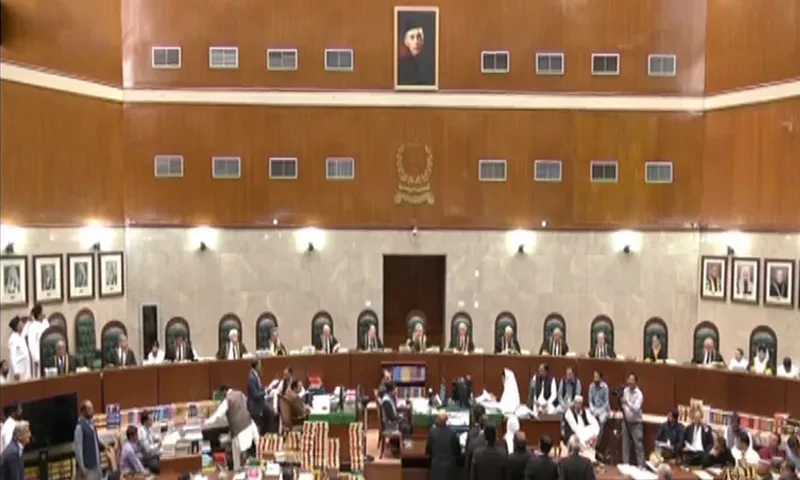
Days ago, an amendment bill to increase number of judges in the top court has been tabled in the Senate – a meaningful legislative development benefitting to whom the judge or the administration of justice – time will tell whether the move is truly in the interest of justice or a maneuver to tip the balance of power in its favor.
Mohammad Abdul Qadir who is an independent Senator from Balochistan has presented the bill in Upper House titled, “Supreme Court (Number of Judges) Amendment Act 2024” who sought an increase in the number of top court judges from 17 to 21 to address what the document described as a “rising number of pending cases.”
Arab News reported, “An amendment bill to increase the number of judges in the Supreme Court of Pakistan was tabled in the Senate on Monday, in a move that is widely being seen as an attempt by the ruling coalition led by Prime Minister Shehbaz Sharif to stack the top court with pro-government jurists”.
“The Supreme Court has four jurisdictions, original, appellate, advisory, and review, being diverse and demanding, contributing to the continuous accumulation of cases,” stated in the bill.
“With economic growth and social changes, the complexity and variety of cases have increased. This backlog … necessitates more judicial resources.”
Speaking on the floor of the Upper House, Qadir said several constitutional matters were being referred to the top court as well as financial cases worth billions of dollars which were pending as the top court did not have time to hear them.
Federal Minister for Law and Justice Azam Nazeer Tarar backed the legislation and suggested forwarding the new bill to relevant committees for debate. Several cases pertaining to capital punishment were still awaiting verdicts since 2015, he said.
“A person spent 34 years in jail due to a pending appeal before the top court,” Tarar said, adding that the “architects of the constitution of Pakistan” had not fixed a specific number of judges but given parliament the power to determine judicial strength.
However, the bill was strongly opposed by opposition lawmakers. Pakistan Tehreek-e-Insaf (PTI) Senator Syed Ali Zafar said the law was “suddenly tabled” in the upper house, calling it “an attempt to impose a judicial martial law.”
He said the government should start increasing the judicial strength from subordinate courts instead of the Supreme Court. PTI Chairman Barrister Gohar Ali Khan had told journalists on Sunday the party would oppose any amendment bill regarding the judiciary.
“None of our MNA or senator will vote in favor of the proposed amendments. Every MNA has been individually instructed in this regard,” Gohar said.
RESERVED SEATS:
Independent analysts say if approved, the amendment bill, and a number of other judiciary-related planned legislations, could get the government a favorable hearing of its review petition in a case involving reserve seats.
In a verdict on July 12, the Supreme Court of Pakistan declared the opposition PTI party of jailed ex-PM Imran Khan was eligible for reserved seats in parliament. The ruling dealt a major blow to Sharif’s weak ruling coalition, which may lose its two-thirds majority in Pakistan’s parliament if the verdict is implemented. Sharif’s Pakistan Muslim League-Nawaz (PML-N) party has already filed a review petition in the Supreme Court against the apex court’s verdict in favor of the PTI.
PTI candidates contested the Feb. 8 national election as independents after the party was barred from polls on the technical grounds that it did not hold genuine intra-party polls, which is a legal requirement.
Subsequently, the PTI-backed candidates won the most seats in the election, but the Election Commission of Pakistan (ECP) ruled independents were ineligible for their share of 70 reserved seats — 60 for women, 10 for non-Muslims. The reserved seats were then distributed among other parties, mostly those in the ruling coalition, a decision Khan allies contested in the court.
Reserved parliamentary seats for women and minorities are allocated in Pakistan in proportion to the number of seats a political party wins in general elections. This completes the National Assembly’s total 336 seats. A simple majority in Pakistan’s parliament is 169 out of 336 seats.