
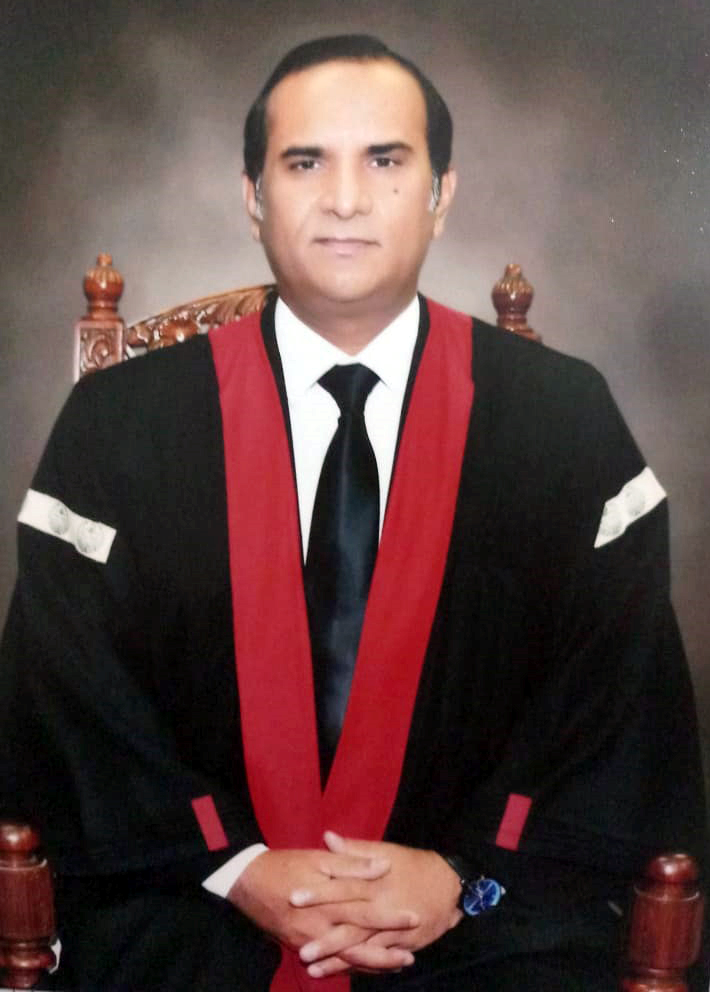
LAHORE: Reiterating the principle that an accused is presumed innocent until the prosecution proves guilt beyond reasonable doubt, a single-member bench of the Lahore High Court, comprising Justice Muhammad Amjad Rafiq, has acquitted a convict who had been sentenced to life imprisonment in a murder case, extending him the benefit of doubt because the CCTV footage did not reliably identify him as the assailant.
The Court held that video footage is documentary evidence that must be proved through a relevant witness and put to the accused under Section 342 Cr.P.C., and that it can independently sustain a conviction only where it is authentic and identifies the accused reliably. It observed that one reasonable doubt is sufficient to acquit an accused, set aside the conviction and ordered the appellant’s release, if not required in any other case.
Hafiz Israr-ul-Haq and Farhan Tariq Butt, Advocates, appeared for the appellant whereas Muhammad Irfan Sadiq Tarrar, Prosecutor General Punjab, along with Dr. Usman Iqbal, Deputy Prosecutor General, appeared for the State, assisted by PFSA officials led by Director General Dr. Muhammad Amjad. Sardar Rashid Shakeel and Ch. Sajid Ali Bul, Advocates, appeared for the complainant in the matter.
Justice Muhammad Amjad Rafiq decided the matter in response to Criminal Appeal No. 27357 of 2024, of Raja Shahid, after hearings on 9, 22 and 28 September 2026. The Additional Sessions Judge, Lahore, had convicted him on 30 March 2024 under Section 302(b) PPC in FIR No. 2162/2022 of Police Station Mughalpura, sentencing him to life imprisonment as Ta’zir and directing payment of Rs300,000 as compensation to the legal heirs. Three co-accused were acquitted by the trial court.
According to the prosecution, the victim, Rana Muhammad Naeem Qaiser, was shot in the head in front of the appellant’s house on 18 September 2022, and the assailants fled with his motorcycle, mobile phone and purse. A CCTV video of the incident was played during the trial, but the trial court did not specifically confront the appellant with it. Only a general question about the video evidence was put to him under Section 342 Cr.P.C. The High Court observed that neither the complainant nor any other prosecution witness could be seen anywhere in the footage, which showed the shooting and the subsequent events but not the faces of the assailants clearly.
Finding that the case raised important questions of law, the Court appointed Ms. Sheeba Qaiser, Advocate Supreme Court, and Mr. Muhammad Naveed Umar Bhatti, Deputy Prosecutor General, as amici curiae. It also sought assistance from the Prosecutor General Punjab and the Director General of the Punjab Forensic Science Authority (PFSA).
On the law, the Court examined Article 164 of the Qanun-e-Shahadat Order 1984 as amended in 2023. It held that the amended provision now operates primarily as a procedural provision for recording evidence through modern devices, rather than as a provision making such evidence admissible. Evidence generated through modern devices is treated as documentary evidence, whose admissibility is recognised under the Electronic Transactions Ordinance 2002 and Articles 46A, 73 and 78A of the Order.
The Court held that video footage must be produced through a relevant witness, put to witnesses for explanation where necessary and put to the accused under Section 342 Cr.P.C. It also directed that the guidelines in Ishtiaq Ahmad Mirza v. Federation of Pakistan (PLD 2019 SC 675) be followed where authenticity is disputed.
On appellate powers, the Court held that where the trial court fails to follow the required procedure, the appellate court may cure the omission by summoning the witnesses and the accused to record additional evidence. It held that mere clarification of facts shown in footage already admitted does not amount to additional evidence under Section 428 Cr.P.C., but is an inquiry to clarify the facts observed. Where footage was available but never collected by police, the appellate court may use its powers under Sections 428, 94 and 540 Cr.P.C. to summon it and record the evidence, and may issue a search warrant under Section 96.
On enhancement, the Court held that unclear footage can be pixel-enhanced through techniques such as contrast adjustment, super-resolution, sharpening, noise reduction and frame averaging, but that such work should be done in a forensic laboratory rather than in open court. It held that, where image quality permits, the court may itself compare the footage with the accused, by analogy with Article 84 of the Order. Where visual identification remains inconclusive, the court may direct a PFSA expert to use techniques including facial comparison, gait analysis, clothing comparison, photogrammetry, body morphology, behavioural analysis and voice analysis.
Since the PFSA told the Court that some of these techniques are unavailable, the Court directed the Government of the Punjab to equip the agency with the requisite facilities. Until then, the Court said, the evidence may be sent, where necessary, to a competent international forensic laboratory at the parties’ expense.
On local inspection, the Court noted that the power under Section 539B Cr.P.C. is personal to the court and cannot be delegated. It found persuasive the alternative proposed by the Deputy Prosecutor General: in an appropriate case, the High Court may direct further investigation or, under Section 561A Cr.P.C., appoint a person or commission to inspect the scene, as an exceptional measure supported by reasons.
On the central question, the Court held that the absence of prosecution witnesses from the footage does not by itself prevent a conviction based solely on the video, nor does it necessarily make their testimony liable to rejection. Relying on the silent witness doctrine and the Supreme Court’s decision in Zahir Zakir Jaffar v. The State (PLD 2026 SC 251).
It held that a conviction on video alone is permissible only where the footage is authentic and of sufficient quality to identify the accused reliably, and excludes every reasonable hypothesis other than guilt. Where facial features are unidentifiable and enhancement fails, it held, the benefit of doubt must go to the accused, as laid down in Muhammad Ramzan v. The State (2025 SCMR 1742).
Applying these principles, the Court summoned the appellant and the two prosecution witnesses, PW-6 and PW-7, on 28 September 2026 and confronted them with the footage. The appellant admitted being present and kicking the deceased after he fell, but denied firing at him. The Court found that additional evidence was unnecessary.
It noted that the medical evidence showed all fatal injuries were caused while the victim was still on the motorcycle, with no injuries from shots fired at him on the ground, a point the Deputy Prosecutor General conceded. It also found that the witnesses’ claims that the man in black clothes remained at the scene threatening them, and fled as a pillion passenger, contradicted the footage, which showed that the pillion rider was the shorter man in shirt and trousers.
The Court observed that the physical stature of the man who kicked the victim and fled on the motorcycle resembled the appellant. However, it held that, with the facial features indiscernible, it is legally unsafe to base a conviction on a partial admission or general physical similarity, in the absence of an expert facial comparison report or robust corroborative evidence. Applying the principle that a single reasonable doubt is sufficient for acquittal, it concluded that the prosecution had not proved the murder charge, allowed the appeal and acquitted the appellant.